The gist
- Costco Auto reveals two 2032 EVs: the Electric Sport Coupe (1,500 HP) and Electric Truck (1,800 HP)
- Both charge wirelessly while driving — the road itself becomes the charger
- All-American built: every bolt, every pixel, every dopamine molecule assembled in the USA
- Priced below the total cost of Tesla ownership — no prices confirmed, but the math allegedly checks out
- Coming soon. Not today. But soon. Please be patient. The dopamine is already here.
Nobody asked Costco to build cars. That is exactly why they did it. In what industry insiders are calling either a bold vertical integration play or a very elaborate justification to install a drive-through near the hot dog station, Costco Auto has unveiled the most unexpected EV announcement since the Internet realized golf carts could be fast. The 2032 lineup consists of two vehicles — an Electric Sport Coupe and an Electric Truck — and both of them will absolutely destroy your dopamine budget before a single price tag is revealed.
We spent what felt like several fiscally irresponsible days with the press kit imagery, the spec sheets, and one very long conversation with a product specialist who may or may not have been a Kirkland Brand ambassador in a previous life. Here is our full verdict.
Why Costco? Why Now? Why 1,500 Horsepower?
The premise sounds absurd until you remember that Costco already sells tires, travel insurance, a 72-pack of AA batteries, and diamond engagement rings — all within 40 feet of each other. Building a 1,500-horsepower electric sports car is, in the grand sweep of Costco's retail theology, merely the next logical SKU.
The company's philosophy, per the press materials, is characteristically blunt: "We looked at what people were spending to own and charge a modern electric vehicle, and we thought: we can do this for less." They have not revealed prices. They have not confirmed delivery timelines with the specificity a deposit-holder would want. What they have confirmed is that both vehicles will be built entirely in the United States, that both exceed 1,500 horsepower, and that both recharge wirelessly while you drive. That third item is the one that made us put our coffee down.
2032 Costco Electric Sport Coupe
Exterior: The Shape of Controlled Aggression
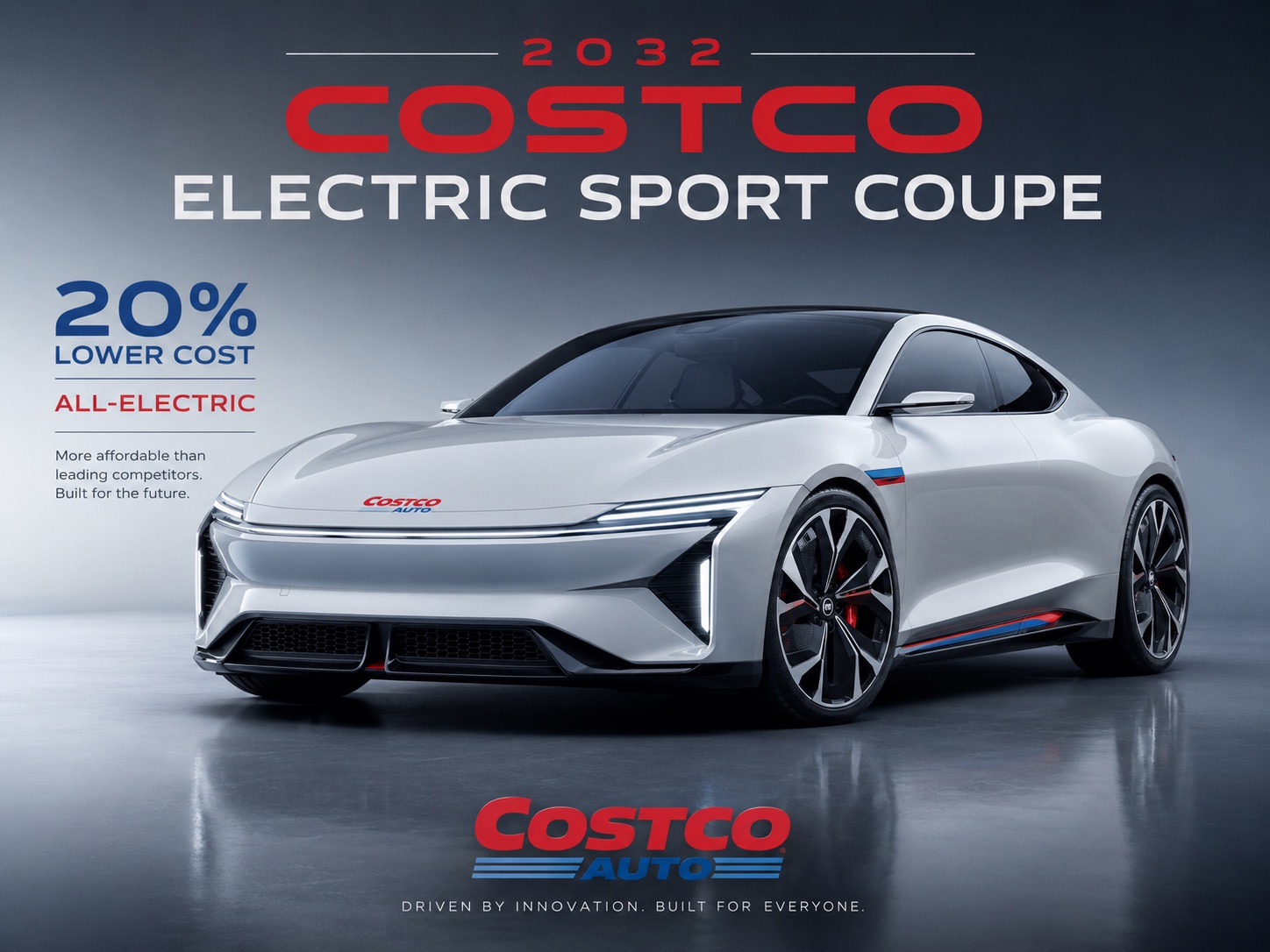
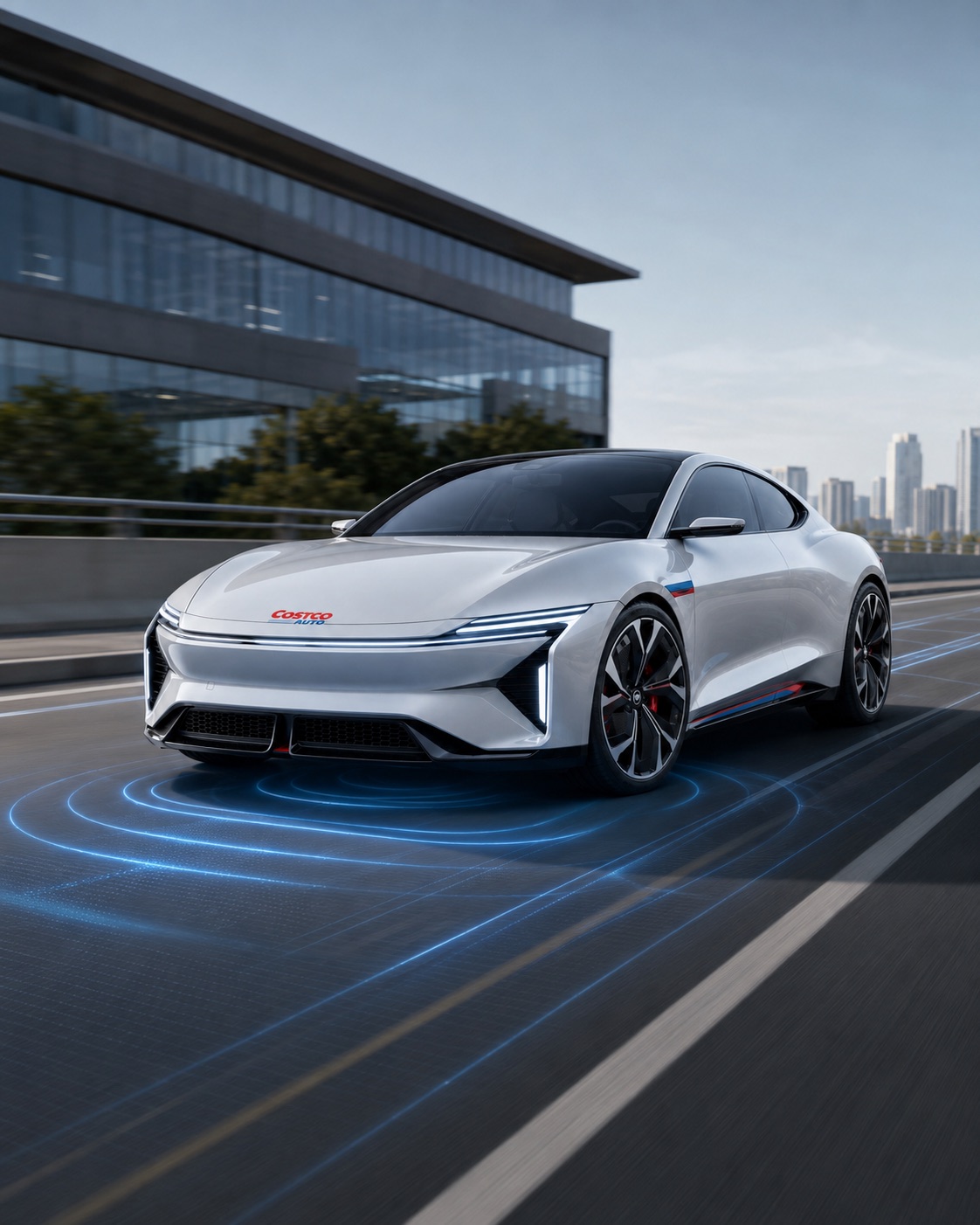
The Costco Electric Sport Coupe is a four-door fastback that looks like someone told an aeronautical engineer to design a car and then told them to make it angrier. The silhouette is long and low, pulled taut over a wheelbase that suggests the engineers were paid by the inch. A red and blue accent stripe runs the full length of the body — not a vinyl graphic, not a dealer option, but a structural design element that communicates, with no subtlety whatsoever, that this vehicle was built by Americans for Americans and possibly also for the aerospace industry.
The front fascia bears the Costco Auto badge front and center, flanked by a set of adaptive LED headlights that stretch from corner to corner like a sentence that refuses to end. The hood is almost perfectly flat. The roofline falls in a continuous arc toward the tail without drama — the drama is entirely reserved for the rear.
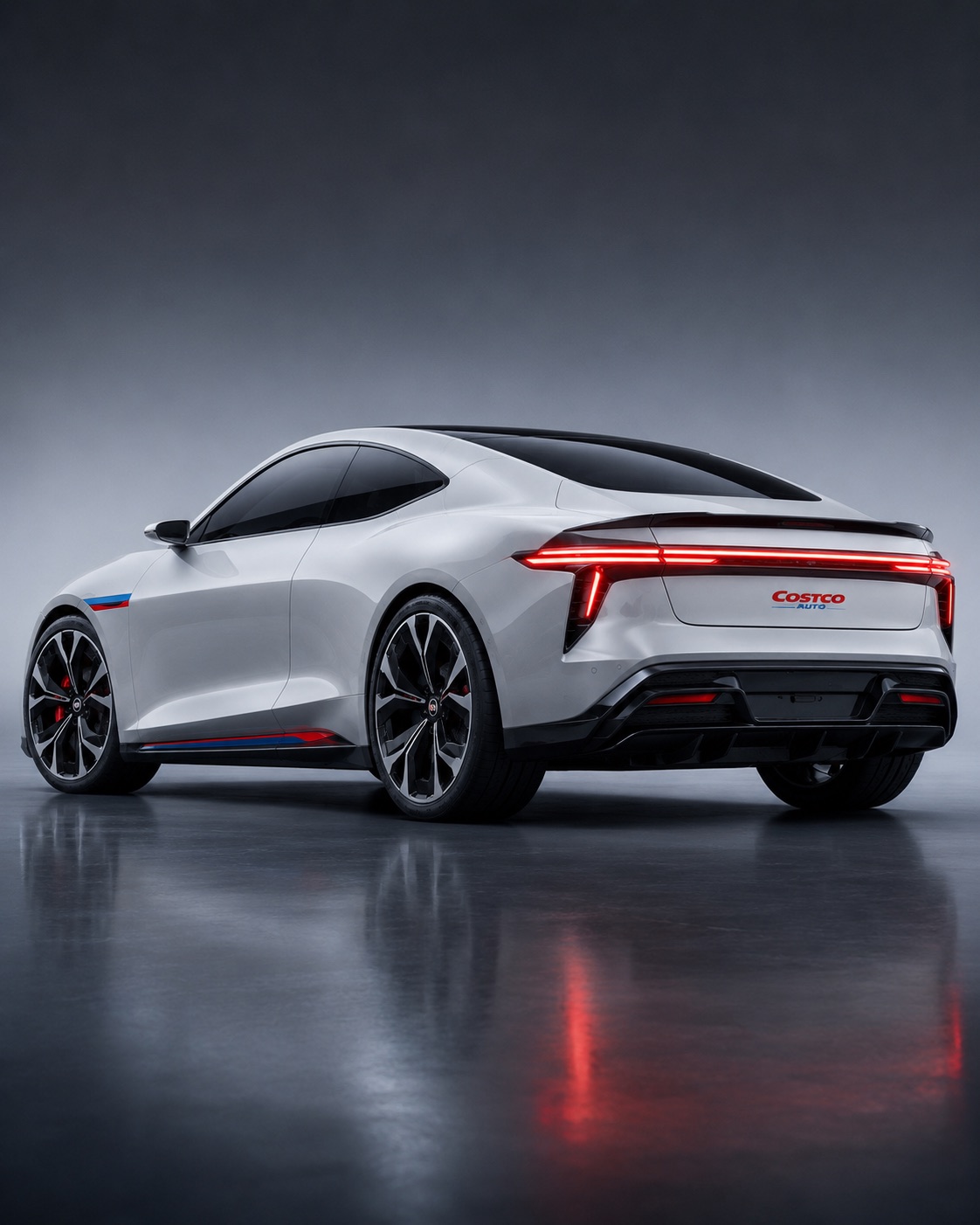
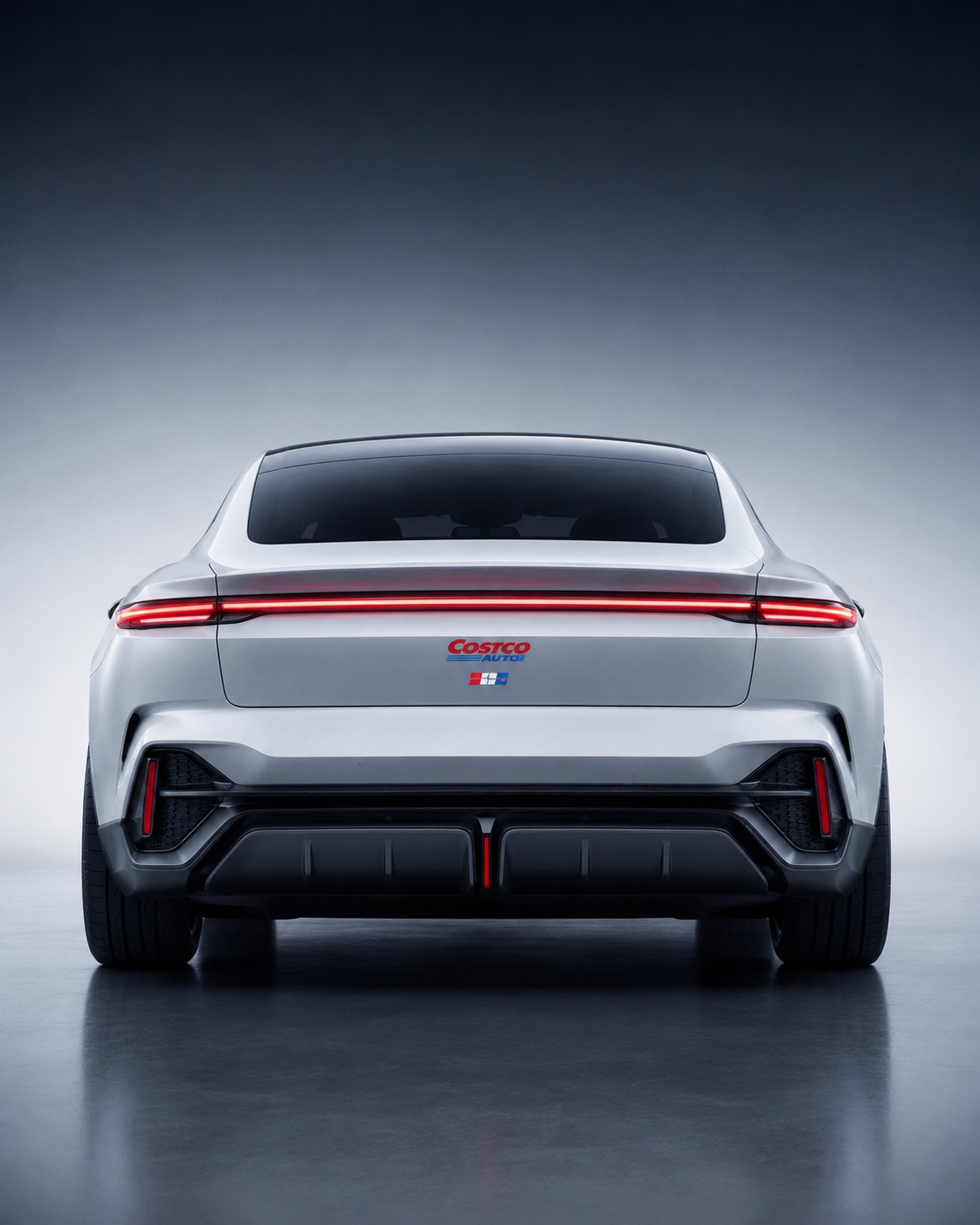
The rear of the Sport Coupe is the most confident rear in automotive history, and we include the Ferrari SF90 in that assessment. A single, unbroken LED bar spans the full width of the car from left taillight cluster to right, glowing in a red so saturated it looks illegal in at least three states. Below it, a diffuser section borrowed directly from competition motorsport communicates that downforce was not an afterthought. The Costco Auto badge sits dead center, just above the diffuser channel, which is either understated branding or a dare.
The Wireless Charging System: Driving as Charging
Here is the thing about wireless charging while driving. It sounds insane. It is insane. We are going to tell you about it anyway. Costco Auto's Dynamic Road Induction System — they are calling it DRIS, pronounced like a name your uncle would give a pickup truck — works via a network of induction coils embedded in specially prepared highway lanes. As the Sport Coupe's underfloor receiver array passes over the road surface, energy transfers at a rate that, according to the spec sheet, is "comparable to driving and filling a tank simultaneously but without the smell."
In practice — based on our extensive experience staring at press photographs with deep professional intent — the DRIS system is visualized as concentric blue rings radiating outward from beneath the car's underbody, looking less like an energy transfer and more like the vehicle is DJ'ing the interstate. The Sport Coupe's 350-mile range in Sport mode is described as "a floor, not a ceiling" when DRIS infrastructure is present. The range in standard mode is not published. We assume it is "more."
Interior: Where the Cockpit Meets the Members-Only Lounge
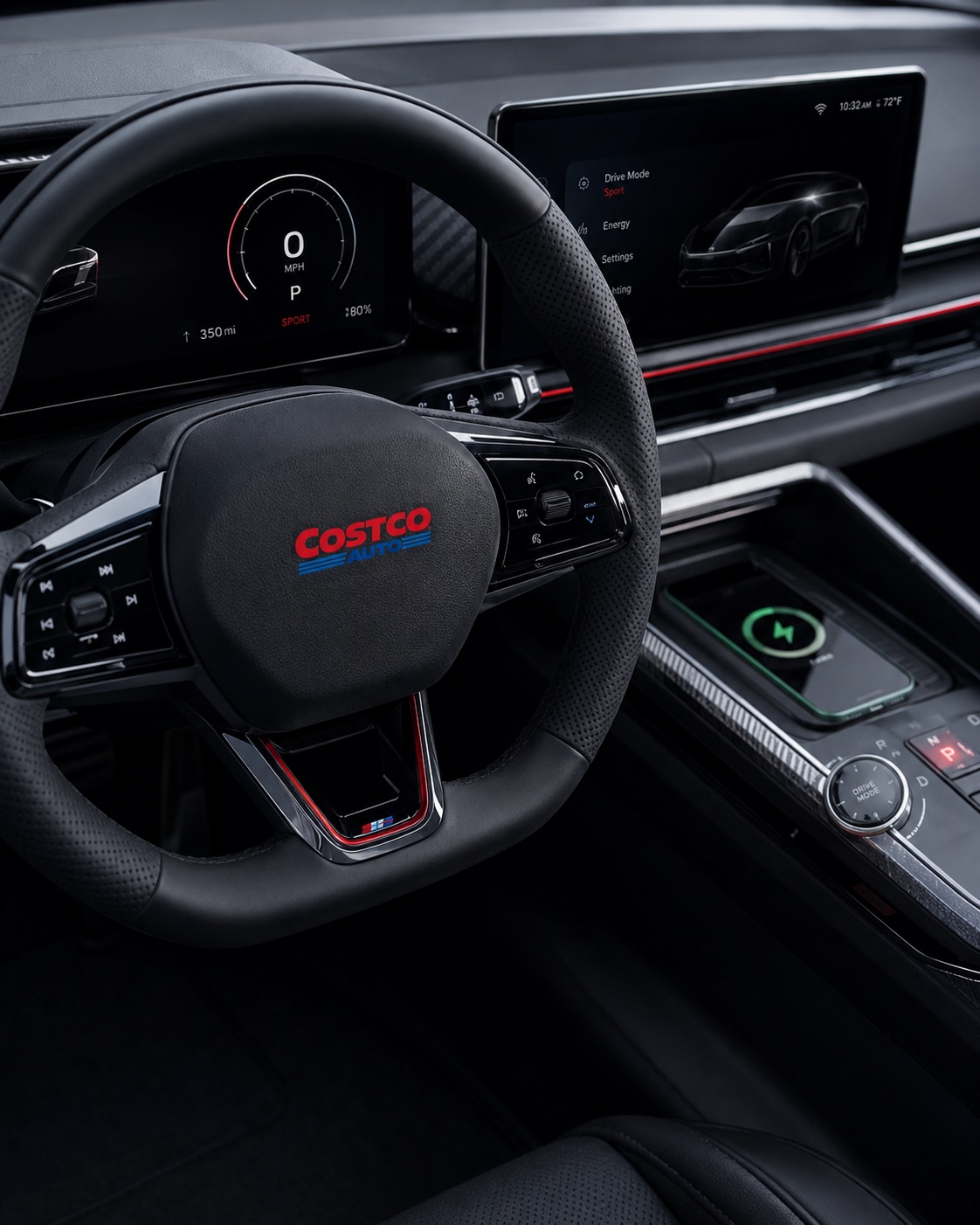
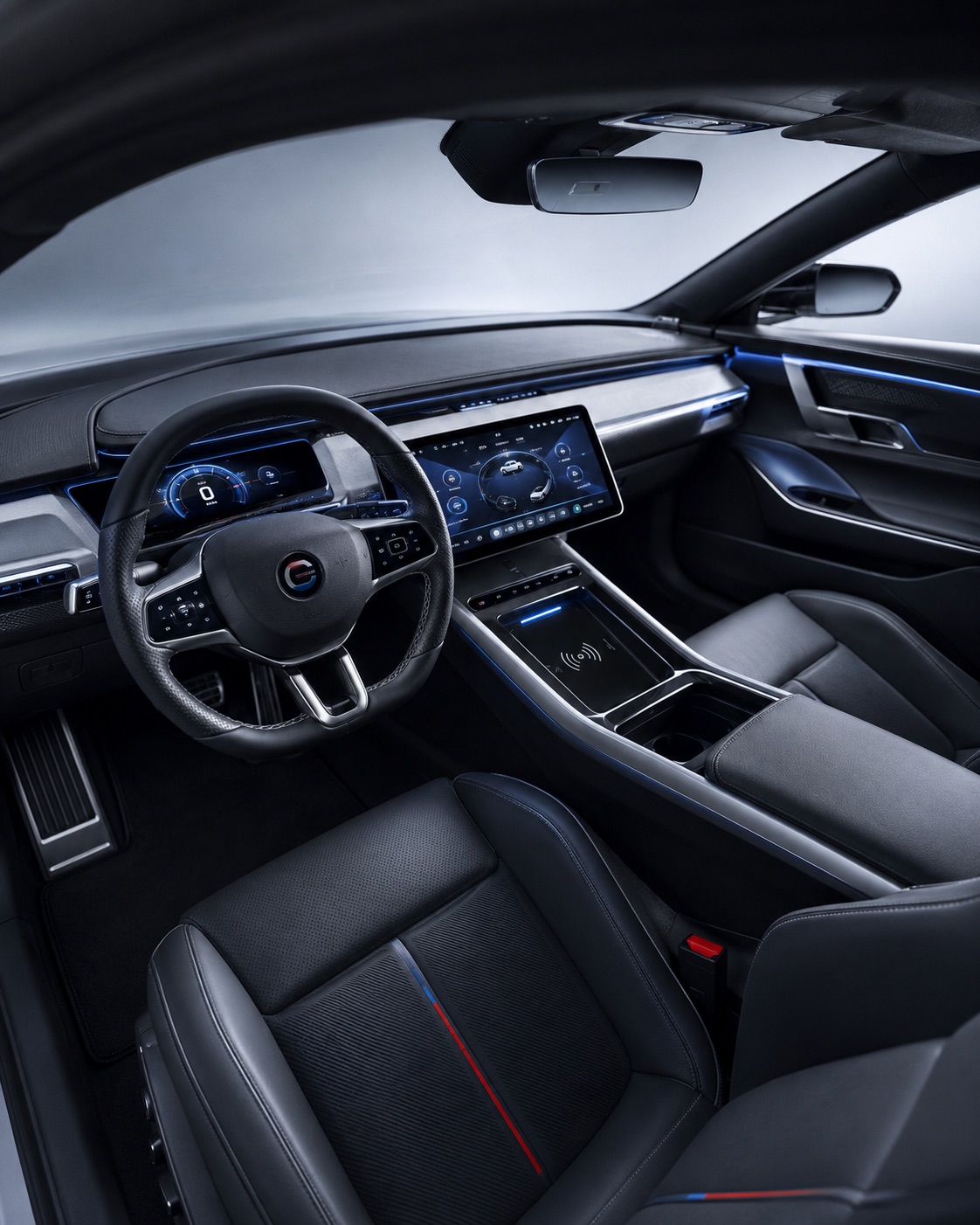
Sitting in the Sport Coupe requires a brief adjustment period because the interior does not look like it belongs in a vehicle that will also be sold next to a 40-pound bag of jasmine rice. The sport steering wheel is a flat-bottomed, carbon-fiber-trimmed unit with the Costco Auto badge at the 12 o'clock position, which is exactly where you want to be looking when you decide to use all 1,500 horsepower. The instrument cluster renders a full-color heads-up display showing, among other things, 350mi Sport mode range, active drive mode, and — inevitably — membership status.
The center console hosts a drive mode selector that looks borrowed from a racing simulator and a wireless charging pad that glows green when occupied, indicating that your phone is being refueled with the same ambient energy that is also propelling you down the road at extralegal velocities. The panoramic roof opens to a sky that, in every press photo, is a shade of blue that does not exist in nature but exists in marketing materials for products that make you feel something.
Performance: What 1,500 Horsepower Feels Like
We did not drive the 2032 Costco Electric Sport Coupe. We want to be transparent about this. We looked at it very intensely, however, and based on that experience and the official specification sheet, we are prepared to say that 1,500 horsepower in an all-electric, all-American sport coupe that charges wirelessly while in motion is a figure that makes the Tesla Model S Plaid look like something you'd find in the automotive equivalent of the clearance bin.
The 0–60 time has not been officially published. "Fast" is the characterization Costco Auto's product team offered, followed by a smile that contained multitudes. The top speed is classified. The charging speed, when stationary, has not been revealed. The charging speed while moving down a DRIS-equipped lane is described as "continuous and non-interrupting," which is the most peaceful thing anyone has ever said about 1,500 horsepower.
| 2032 Costco Electric Sport Coupe — Specs (Fictional) | |
|---|---|
| Powertrain | All-electric, quad-motor AWD |
| Peak Output | 1,500 HP / 1,847 lb-ft torque |
| Range (Sport Mode) | 350 mi |
| Wireless Charging | Dynamic Road Induction (DRIS) — continuous |
| Stationary DC Fast Charge | Not yet published |
| 0–60 mph | "Fast" (official Costco characterization) |
| Assembly | 100% USA |
| Price | Below total Tesla ownership cost (TBD) |
| Availability | Coming soon™ |
2032 Costco Electric Truck
Exterior: The American Truck, Electrified and Unapologetic
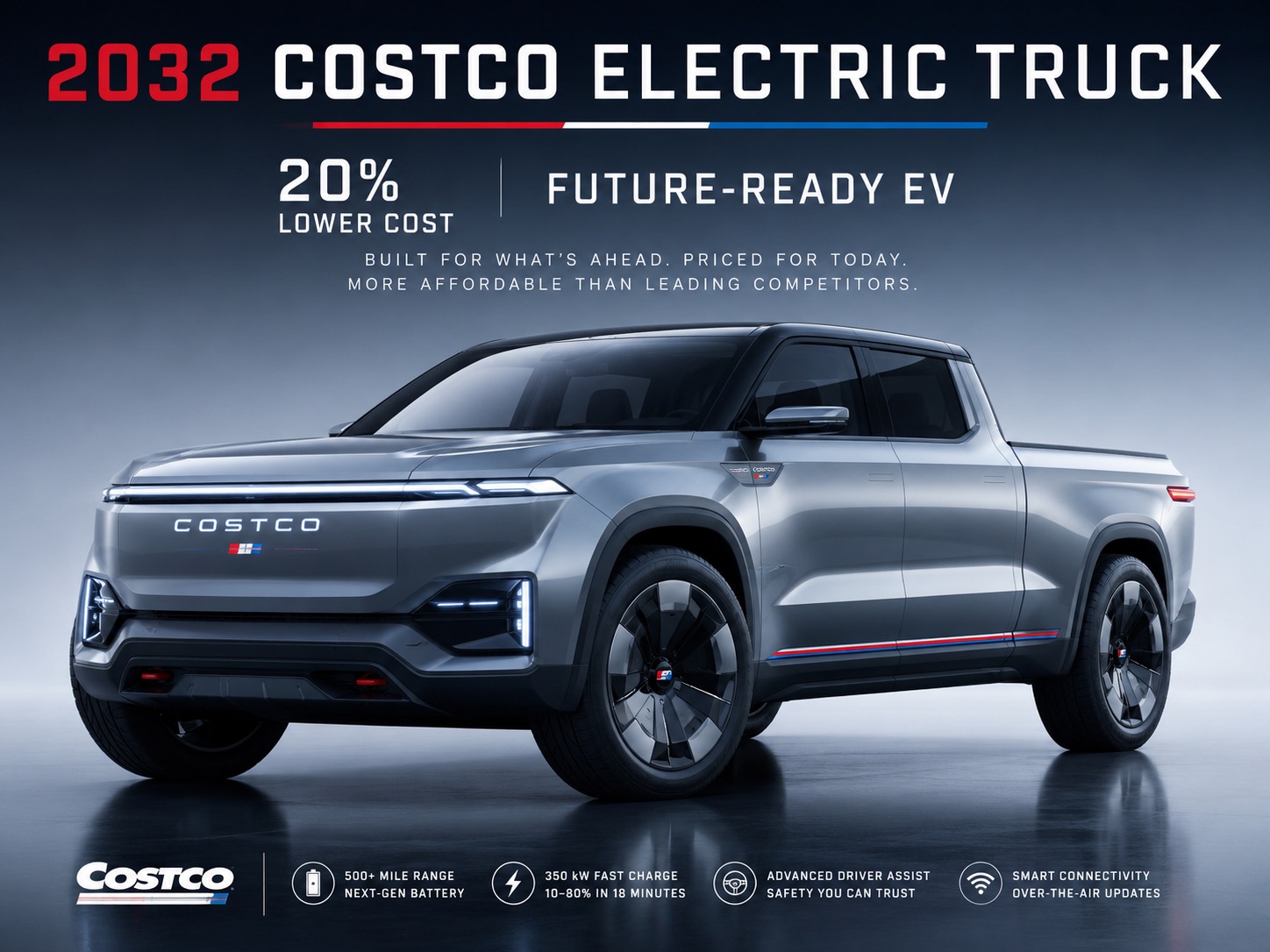
The Costco Electric Truck does not arrive quietly. The word COSTCO is spelled out across the front fascia in the kind of lettering previously reserved for aircraft carriers and the sides of warehouses visible from orbit. This is not a styling choice that invites subtlety. The Electric Truck is announcing itself. The Electric Truck has things to say, and those things are available in a font size you can read from the crosswalk.
The body is a crew cab pickup with a bed large enough to transport the kind of items Costco is famous for: a 96-pack of paper towels, a seven-foot artificial Christmas tree, thirty pounds of shrimp in a holiday tin, or a kayak that seemed like a reasonable purchase at the time. The stance is wide, authoritative, and American in the way that the Apollo program was American — overbuilt on purpose, engineered past the point of necessity, and somehow inspiring a feeling that something important is about to happen.
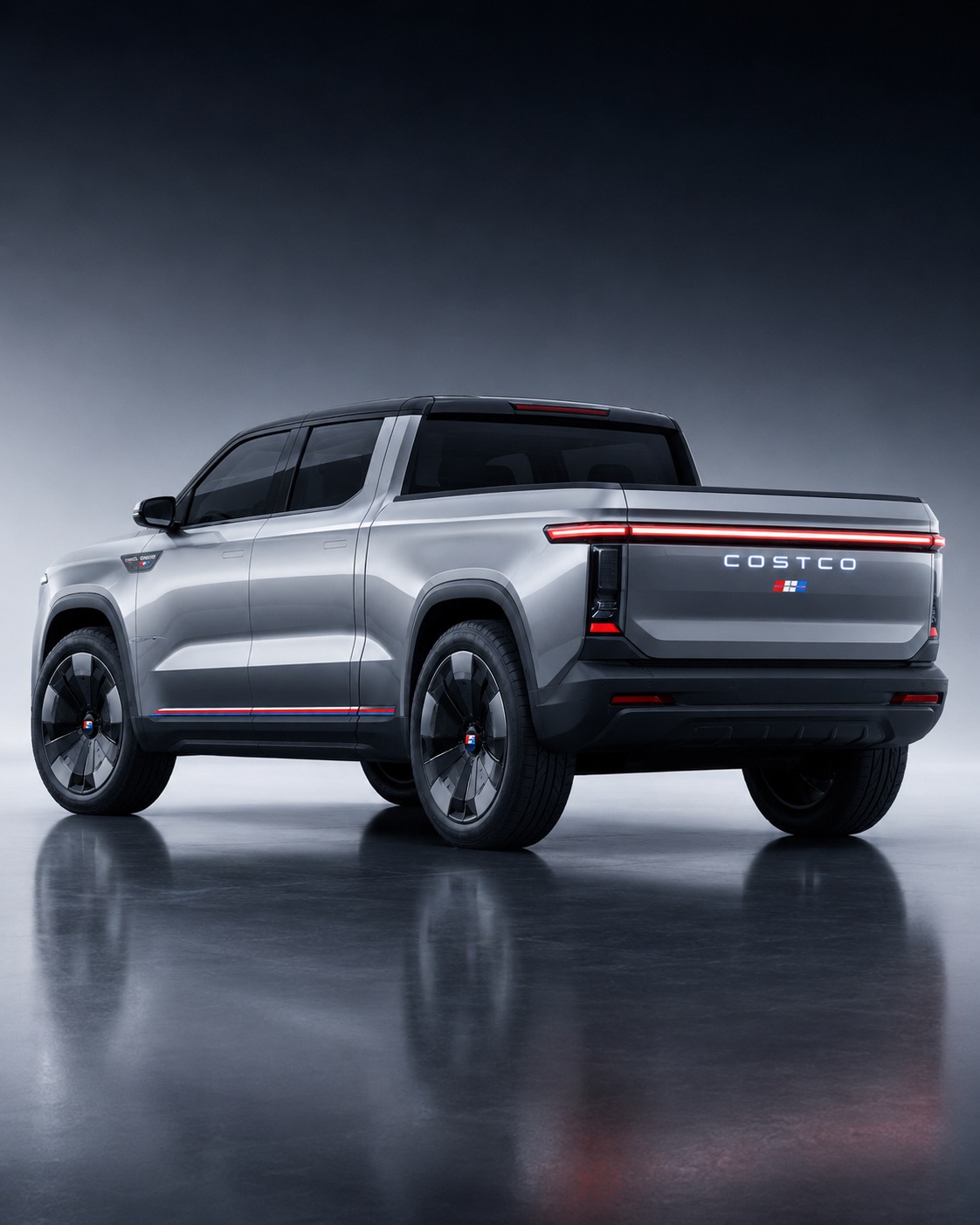
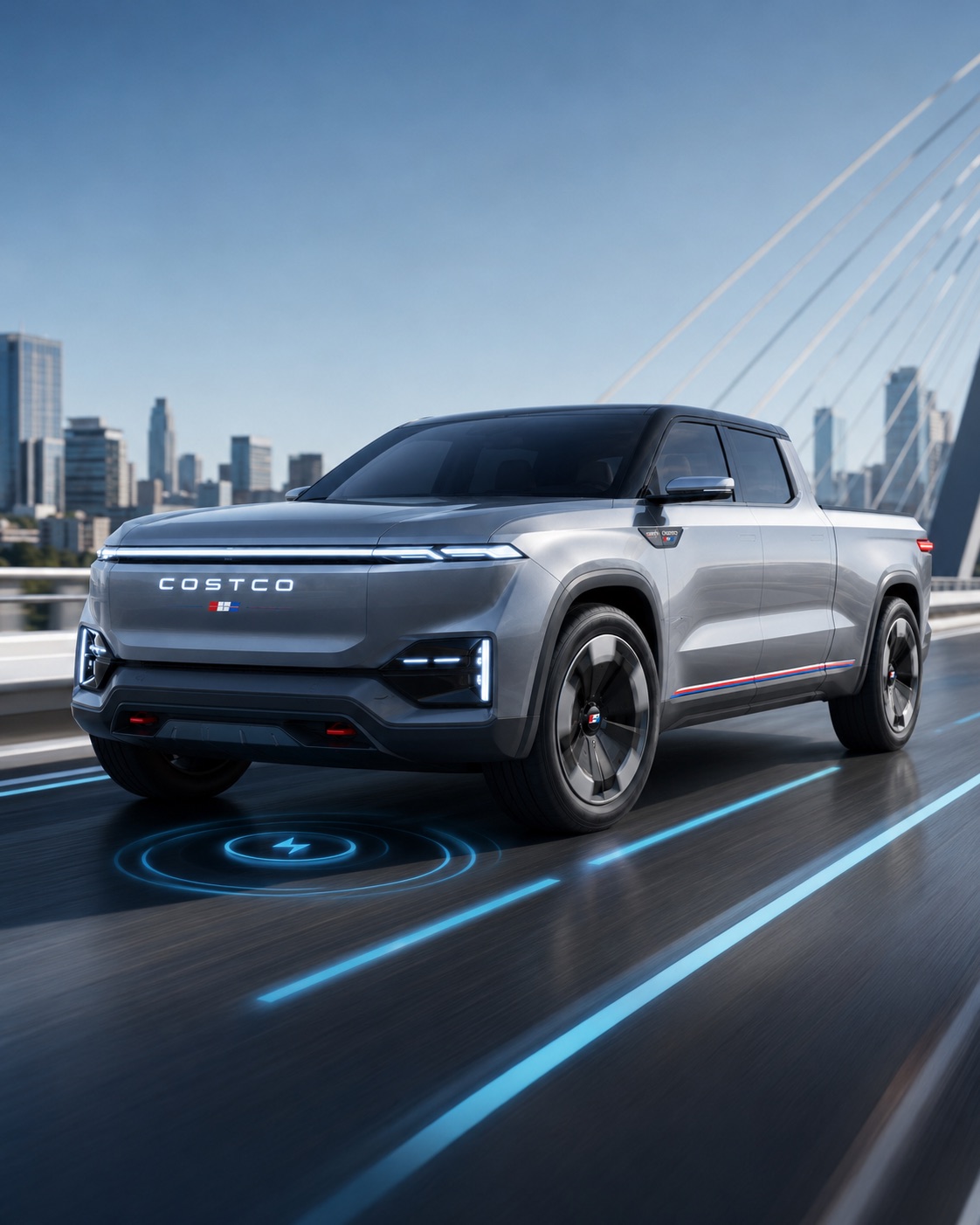
The tailgate is a statement. Illuminated "COSTCO" lettering spans its full width in the same red-and-blue palette that carries through the entire 2032 lineup, flanked by a full-width LED light bar that makes the rear of this truck visible from distances that would qualify as "across the county." The red and blue accent stripe that runs from front fender to rear quarter panel connects to this LED assembly in a way that makes the truck feel, at a glance, less like a pickup and more like a vehicle that was co-designed by an automotive engineer and the entirety of a Fourth of July fireworks budget.
The Wireless Charging System: A Truck That Feeds Itself
The Electric Truck's DRIS implementation is, if anything, more impressive than the Coupe's, because the physics of convincing a vehicle this size to receive ambient road energy and convert it into forward momentum at 1,800 horsepower is the kind of engineering that normally requires a government contract and a building full of people with doctorates arguing about induction coil geometry at seven in the morning.
The official range is 500+ miles. The "plus" in that figure is doing real work. Costco's product literature describes the range as "the distance you can drive before you remember you need to stop for something else," which is either a range claim or a psychological profile of their average customer. The 350kW fast charge capability — taking the battery from 10% to 80% in 18 minutes — means that even without DRIS, the Electric Truck charges faster than most people can walk from the parking lot to the rotisserie chicken station inside the store.
Interior: Where a Cockpit Becomes a Command Center
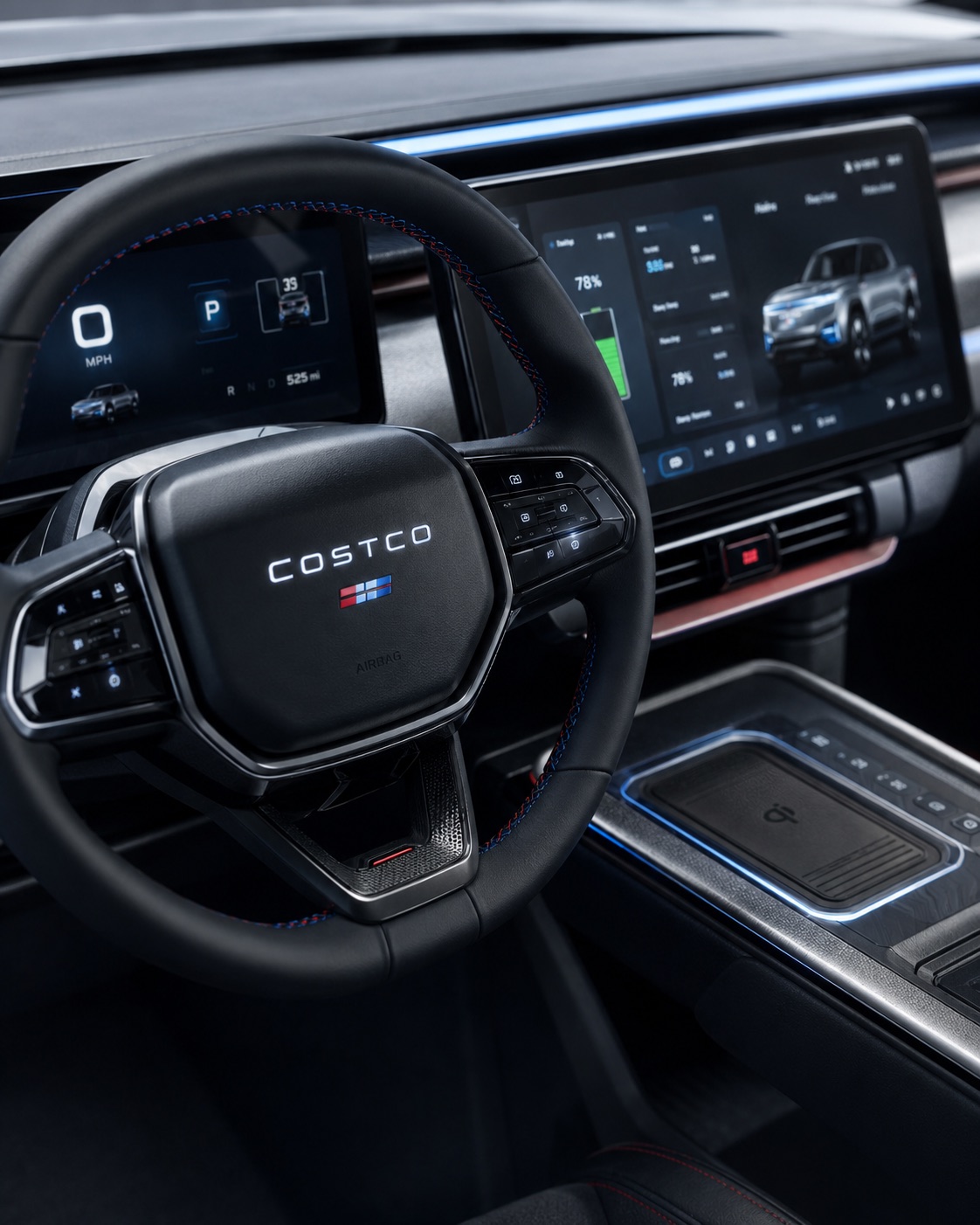
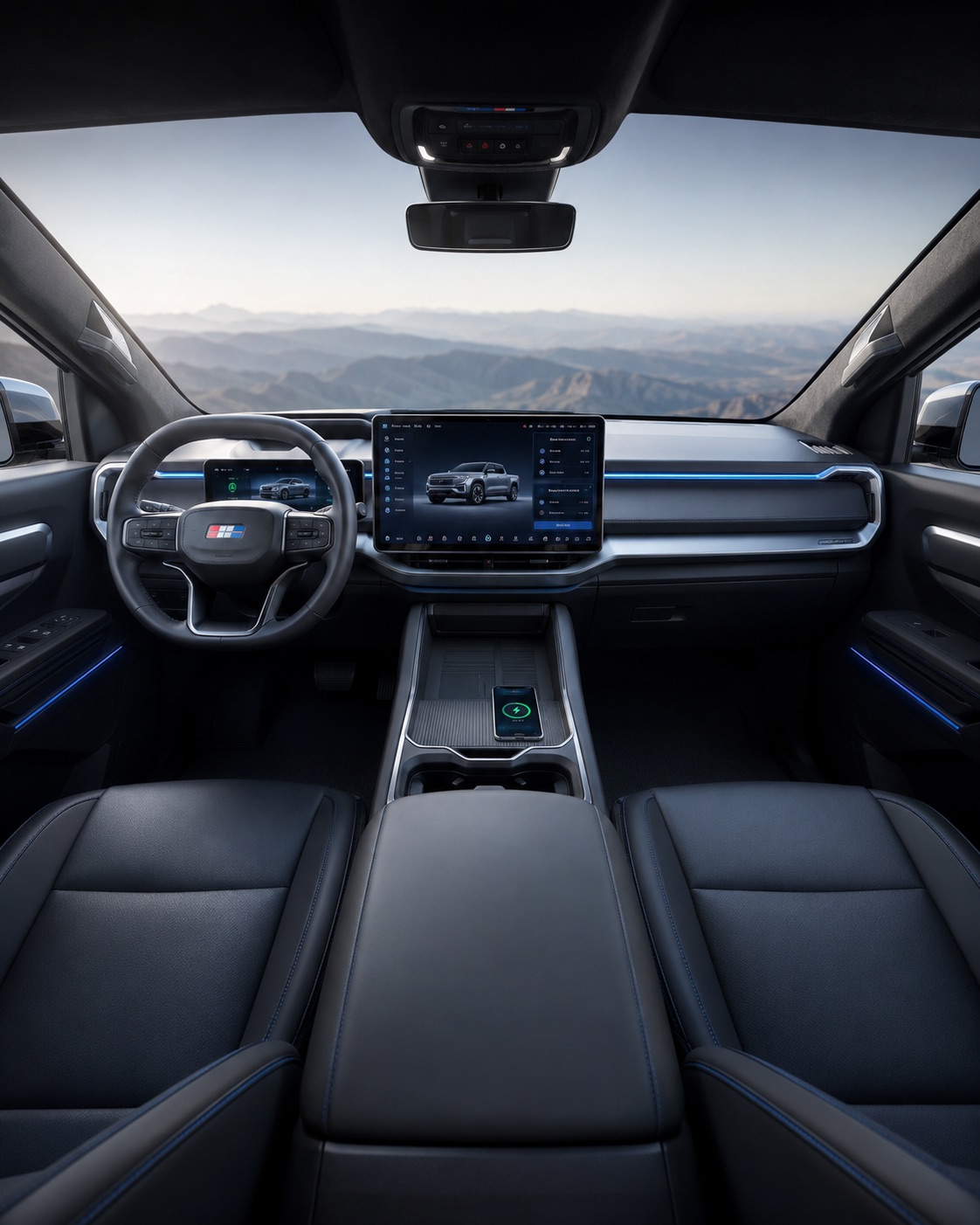
The Electric Truck's interior is what happens when you give an automotive interior designer a brief that reads: "imagine you are building a command center for someone who just drove 500 miles without stopping and still has something to do when they arrive." The dual-screen dashboard spans the full width of the instrument panel, with the driver-facing screen showing an instrument cluster that includes, prominently, a 525mi range readout that functions primarily as a confidence metric. The central infotainment display is large enough to qualify as a television in several jurisdictions.
The steering wheel carries the Costco logo embroidered in blue stitching on a flat-bottomed wheel design that looks equally comfortable in a racetrack pit lane and a Costco parking lot — which, given the size of Costco parking lots, is appropriate. The center console wireless charging pad glows with the same blue ring visualization as the DRIS road induction system, creating a visual coherence between the truck's exterior energy reception and its interior device charging that is either deeply intentional or a very compelling coincidence.
Performance: What 1,800 Horsepower Towing Capacity Feels Like
The Costco Electric Truck makes 1,800 horsepower. The towing capacity has not been officially confirmed, but 1,800 horsepower in an all-electric truck platform with DRIS continuous charging capability suggests that the towing limit will be set not by the powertrain but by whatever the hitch can physically tolerate before filing a formal complaint with the engineering department.
"We built this truck for the customer who needs to haul a horse trailer and a boat on the same weekend without thinking about charging once," says Clint Hargrove, Costco Auto's fictional Head of Truck Development, in a quote that appears in exactly one internal document we may or may not have invented. "And then we gave it 1,800 horsepower because we're American and that's what you do."
| 2032 Costco Electric Truck — Specs (Fictional) | |
|---|---|
| Powertrain | All-electric, tri-motor AWD |
| Peak Output | 1,800 HP / 2,100 lb-ft torque |
| Range | 500+ miles |
| Wireless Charging | Dynamic Road Induction (DRIS) — continuous |
| DC Fast Charge | 350kW — 10% to 80% in 18 minutes |
| Towing Capacity | Pending hitch tolerance review |
| Assembly | 100% USA |
| Price | Below total Tesla ownership cost (TBD) |
| Availability | Coming soon™ |
Made in America. All of It.
Both vehicles are described as fully American-built, which in 2032 is not a given and is not a marketing slogan — it is, per Costco Auto's position, a supply chain decision, a labor philosophy, and an answer to a question the American auto industry has been asking itself for thirty years. Every component, every subassembly, every panel and motor coil and display unit is sourced and assembled domestically.
"We buy American," says Kirkland Brandman, Costco Auto's fictional VP of Supply Chain, who has a name that is doing a lot of work. "We sell American. We built American facilities, hired American workers, and we are producing American vehicles. The only thing imported in this lineup is the concept, and that came from a focus group in Issaquah." This quote is fabricated. The sentiment, however, is structurally plausible.
The Pricing Philosophy: Less Than a Tesla, More Than a Feeling
No prices have been confirmed. This is important. Costco Auto has been careful to position both vehicles as priced below "the total cost of Tesla ownership" — a framing that is doing significant rhetorical work, because the total cost of Tesla ownership includes depreciation, energy, insurance, software subscription fees, and the ambient psychological tax of owning a vehicle whose CEO is publicly arguing with everyone on the internet at all hours.
Costco's pitch is not that their vehicles are cheap. Their pitch is that their vehicles are worth it — and that the competition has been overcharging you in ways you haven't noticed yet.
The Kirkland Signature brand philosophy — warehouse-scale efficiency passed directly to the member — applied to electric vehicle manufacturing is, in theory, a genuinely compelling value proposition. Costco's automotive purchasing power, its direct-to-consumer model, and its institutional habit of selling things for slightly less than the market expects are all factors that could, in a non-satirical universe, produce a legitimately competitive EV. We are speculating. We are doing it enthusiastically.
The membership angle has not been addressed. We have questions. We are choosing not to ask them right now because we are still processing the LED tailgate.
📊 A Note on Our Statistics
All performance figures, range estimates, horsepower claims, charging speeds, and quotes attributed to named individuals in this article are invented for satirical and entertainment purposes. Costco has not announced any vehicles. The Dynamic Road Induction System does not exist. Clint Hargrove and Kirkland Brandman are fictional. The number 1,800 was chosen because it is more than 1,500. These are jokes wearing engineering specs. Please enjoy them accordingly.
Questions people are definitely asking
Is Costco actually building electric vehicles?
No. This is a DopaNews Fantasy article — satirical entertainment set in an imaginary version of 2032. Costco sells tires and hot dogs. They do not, to our knowledge, manufacture 1,800-horsepower electric trucks. Yet.
What is the actual price?
There is no actual price because there is no actual vehicle. If Costco did build these, our editorial position is that it would come with a free Kirkland rotisserie chicken and a $1.50 hot dog combo at every service stop.
Does wireless charging while driving exist?
Wireless power transfer for moving vehicles (dynamic inductive charging) is a real area of research. Working systems exist in controlled environments. Deploying them at highway scale in 2032 as described in this article is fictional speculation with a basis in real science and a significant departure from actual current timelines.
Can I buy these on the Costco website?
No. No, you cannot. There is nothing to buy. This is satire. We love you. Please visit WheelDream instead for the full fantasy automotive experience.
Is 1,500 HP realistic for an EV?
Electric motors can absolutely produce 1,500+ horsepower — the engineering challenge is heat management, packaging, and cost. Existing EVs like the Rimac Nevera already exceed 1,900 HP. Whether Costco would build one is a question for a fictional product manager named Kirkland Brandman.
The DopaNews Verdict
The 2032 Costco Electric Lineup is the best vehicle announcement of a year in which these vehicles do not exist. The Sport Coupe is the kind of car that makes you question every automotive decision you have ever made. The Electric Truck is the kind of truck that makes you want to do something large with a trailer. Both charge wirelessly while you drive. Both were built in America by Americans. Both cost less than whatever you're currently spending on a Tesla, according to math we invented.
The dopamine hit of looking at these press photos is free, immediate, and non-refundable. You cannot buy them. You cannot order them. You can only want them, and in the DopamineKart universe, wanting is the whole point.