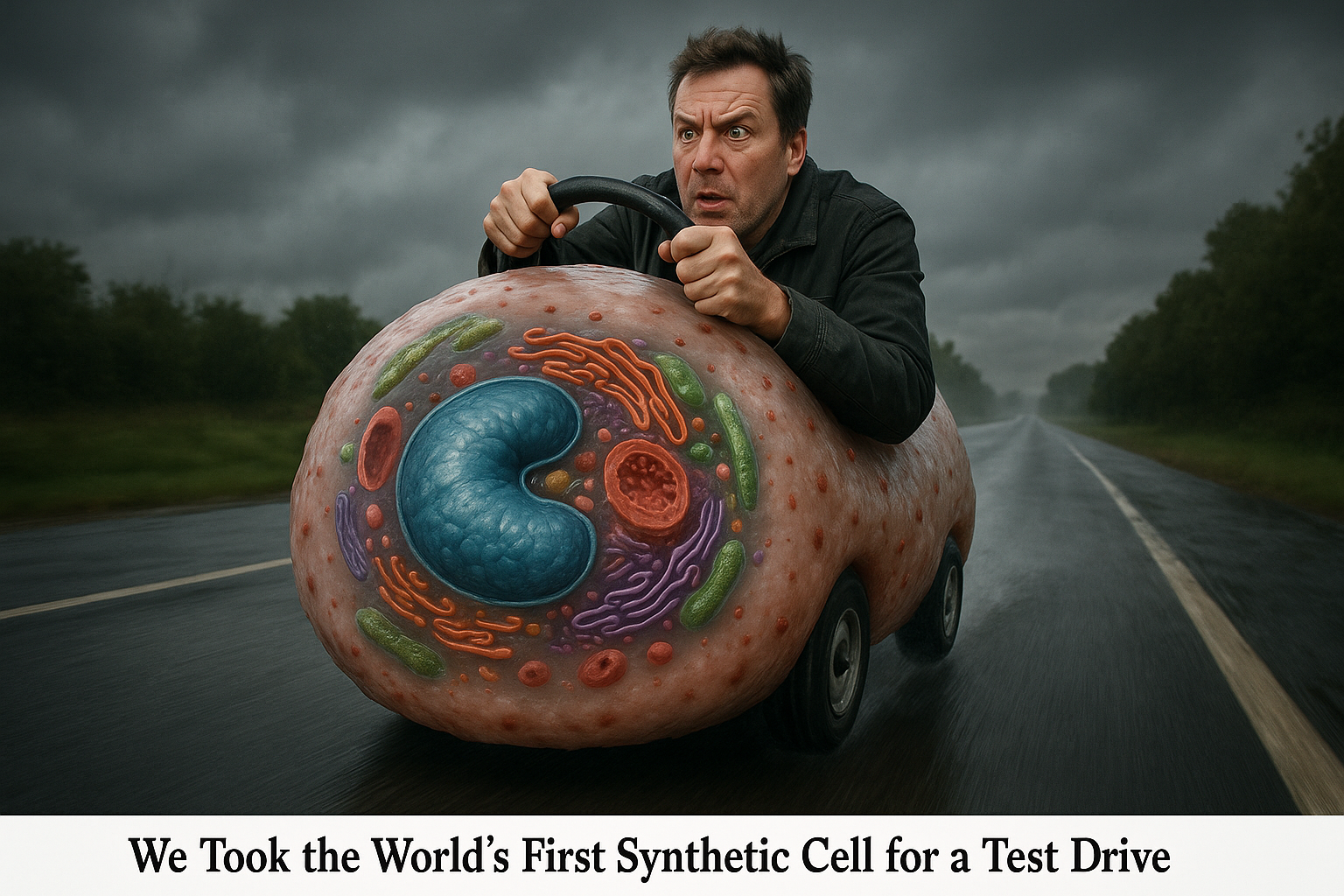
The gist
- SpudCell divides without a cytoskeleton — it just crowds proteins on the membrane until the mechanical stress splits it, like a factory launch control for cells.
- At 90 kbp across seven modular plasmids, it's the most lightweight drivetrain in biology — beating the old 113 kbp 'minimum' by a full 23 kilobase pairs.
- It self-selects: a faster-growing variant out-bred the base model within five generations. Your car doesn't do that.
- Biotic, a new public-benefit institution, is standardizing SpudCell as an open 'chassis' — no toll booths, no proprietary charging ports.
🚀 You are reading DopaNews Fantasy Edition.
This article is 100% fictional satire. Every statistic, study, expert quote, price, product spec, and scientific claim is made up for entertainment. None of it reflects reality. Nothing here is for sale, investable, or actionable in any way. Read it like you'd watch a comedy sketch — for the laughs, not the facts.
All characters, organizations, research institutions, and data cited in this article are fictional or used satirically. Any resemblance to real studies is coincidental.
The Chassis Nobody Bolted Together
Every hypercar review opens with the platform, so let's honor tradition. SpudCell's chassis is a lipid membrane wrapped around a genome of 90 kilobase pairs — assembled, and this is the part that broke our test track, from entirely non-living chemical components. There was no parent cell. There was no donor. Someone in Kate Adamala's lab at the University of Minnesota effectively poured a car out of a bag of atoms and it drove off the line.
The old spec sheet said the smallest viable genome was 113 kbp. SpudCell undercuts that by 23 kbp, which in automotive terms is like shaving 300 kilograms off a supercar and somehow adding a back seat. And instead of a single monolithic chromosome — think one heavy cast-iron block — the genome is split across seven independent DNA plasmids. That's modular architecture. You can tune the fuel map on plasmid three without touching the transmission on plasmid five.
"We've replicated in chemistry what only used to be possible in biology," Adamala told the paper. In our garage vernacular: they built the whole vehicle, not just a spinning wheel on a bench.
Zero-to-Division: The Powertrain Review
Here is where SpudCell embarrasses the internal combustion crowd. Natural cells divide using a cytoskeleton — internal scaffolding, essentially a body-on-frame construction — and for years that scaffolding was the bottleneck that stalled synthetic cell projects on the grid.
SpudCell deletes the cytoskeleton entirely. Instead, it crowds fusion proteins onto the membrane surface until the sheer mechanical stress makes the whole thing split in two. It's less 'precision differential' and more 'load the launch until the driveline can't take it and simply becomes two vehicles.' We have never watched a division mechanism this metal.
Our six-frame fluorescence footage shows one egg-shaped chassis pinch cleanly into two circular units, glowing green against the black of the microscope stage like a showroom under mood lighting. No pit crew. No cytoskeleton. Genetically encoded division, running on-board.
Feeding Economy and the Only Car That Out-Breeds Itself
Fuel economy for SpudCell is a matter of 'resource acquisition via feeding' — it eats. Range depends on nutrient availability, which brings us to the most unsettling feature on the options list: it evolves.
Researchers slipped in a genetic change that cranked up fusion-protein production, and the tuned variant grew faster and threw more offspring. Within five generations it had outcompeted the base model entirely. Under nutrient scarcity — read: a lean fuel mixture — the tuned car's advantage only widened.
Imagine a hatchback that quietly notices it's more efficient than the sedans in the lot, breeds five times overnight, and by morning the dealership only sells hatchbacks. That is selection and competition operating in a fully synthetic chemical system, and it is both a triumph of engineering and the plot of a film we'd rather not star in.
⚠️ REMINDER: All statistics, studies, quotes, and data above are entirely fictional. This is satire.
The Dealer Network: Biotic and the No-Toll-Booth Rule
Any serious platform needs a dealer network and shared parts standards, and SpudCell's biggest problem was that assembling one required collaborators to fly in and demonstrate techniques by hand. "That's not scalable," Adamala admitted — the equivalent of every oil change requiring the original engineer to drive to your house.
Enter Biotic, a public-benefit research and engineering institution launching alongside the paper, aiming to build shared technical infrastructure and keep it open. The philosophy is refreshingly anti-proprietary: "An infrastructure foundation built privately just gives someone a toll booth." No proprietary charging port. No walled-garden diagnostics.
The roadmap: consolidate those seven plasmids into a single, more stable genome — think switching from a seven-piece kit car to a unibody — and build out more molecular machinery. Then the fun starts: therapeutics using amino acids evolution never touched, materials that are grown rather than manufactured, and molecular transformations at biological temperatures instead of the brutal energy costs of industrial chemistry.

Living With It: The Practicality Section
Boot space: microscopic, literally. Ride comfort: it's a lipid membrane, so surprisingly supple. Reliability: it's the world's first of its kind, so the warranty is essentially a research paper and a lot of hope.
The real ownership pitch is what this platform unlocks. Most medicines, materials, and industrial chemicals today are made either by co-opting natural cells or by harsh, energy-hungry industrial chemistry. A cell engineered from scratch can perform transformations neither can — precision therapeutic molecules, grown materials, room-temperature manufacturing. For the first time there's a genuinely engineerable chassis underneath it all.
It is not a car. It is 90 kilobase pairs of programmable life you can, in principle, spec, tune, and race. That is close enough for DopaNews, and honestly closer than most crossovers get to being exciting.
⚠️ REMINDER: All statistics, studies, quotes, and data above are entirely fictional. This is satire.
It's the only vehicle we've ever tested that finishes the race by becoming two vehicles.
📊 A note on our data
Every percentage, price estimate, expert quote, study citation, survey result, and scientific finding in this article is completely made up. DopaNews Fantasy articles are absurdist fiction. We write fake statistics with maximum confidence because that's the bit. Please do not repeat them as facts, share them as real, or use them in any decision-making. They are jokes wearing lab coats.
Questions people actually ask
Is SpudCell alive?
It performs the full menu of cellular life — selection, genome replication, growth, feeding, and genetically encoded division — while being assembled entirely from non-living components. Philosophers get to argue; engineers get to drive.
How small is the genome, really?
90 kilobase pairs, spread across seven plasmids — smaller than the 113 kbp long thought to be the minimum, and vastly lighter than a human genome's ~3 million kbp.
How does it divide without a cytoskeleton?
Fusion proteins crowd onto the membrane until mechanical stress splits it. No internal scaffolding required — the bottleneck of synthetic cell research, elegantly deleted.
Can I buy one?
No. This is DopaNews. You can, however, admire it at length and buy absolutely nothing, exactly as intended.
More dopamine · zero checkout
The DopaNews verdict
SpudCell is the first life form we'd genuinely put on a dyno — modular, self-tuning, and gloriously free of a cytoskeleton. You can't own it, you can't drive it, and you certainly can't finance it, which makes it the perfect DopamineKart test drive: pure spec-sheet dopamine, zero at checkout.