The gist
- Tokyo now hosts nine confirmed subterranean bioluminescent farms feeding at least fourteen all-dark restaurants.
- The glow is edible, calibrated, and priced by lumen-hour — a plate of 'Reef Risotto' emits light for roughly 40 minutes.
- Regulators created an entirely new food-safety category in March 2026 just to classify a glowing turnip.
- Diners eat in pitch black; the food itself is the only light source in the room.
🚀 You are reading DopaNews Fantasy Edition.
This article is 100% fictional satire. Every statistic, study, expert quote, price, product spec, and scientific claim is made up for entertainment. None of it reflects reality. Nothing here is for sale, investable, or actionable in any way. Read it like you'd watch a comedy sketch — for the laughs, not the facts.
All characters, organizations, research institutions, and data cited in this article are fictional or used satirically. Any resemblance to real studies is coincidental.
The farms nobody was supposed to find
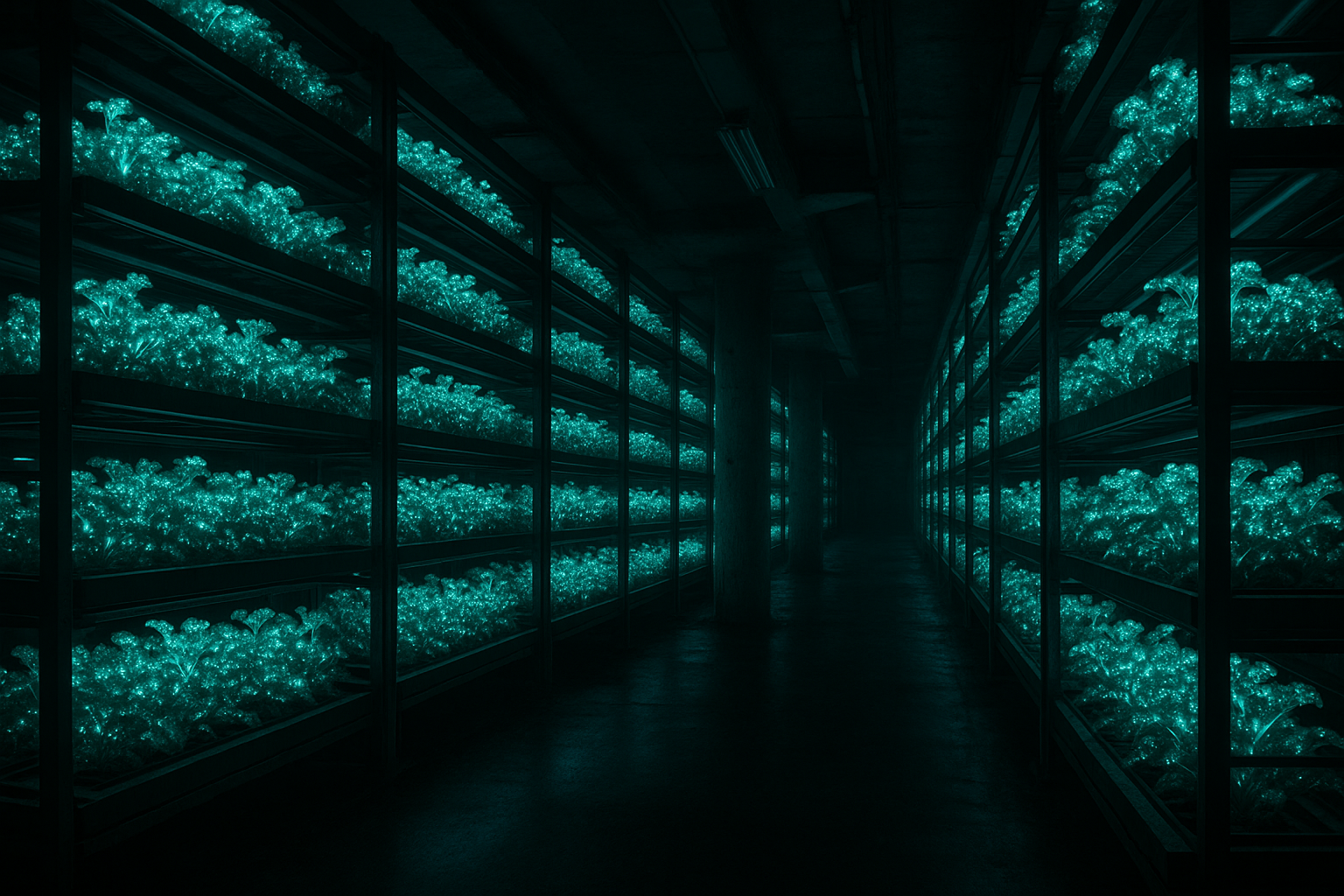
Beneath a shuttered pachinko parlor in Nakameguro, an elevator drops four floors into what looks like a rave for vegetables. The facility, called Hikari-Nō, occupies 1,400 square meters of former stormwater infrastructure and produces around 90 kilograms of bioluminescent produce a week. Nothing here is lit by a bulb. The plants light the room.
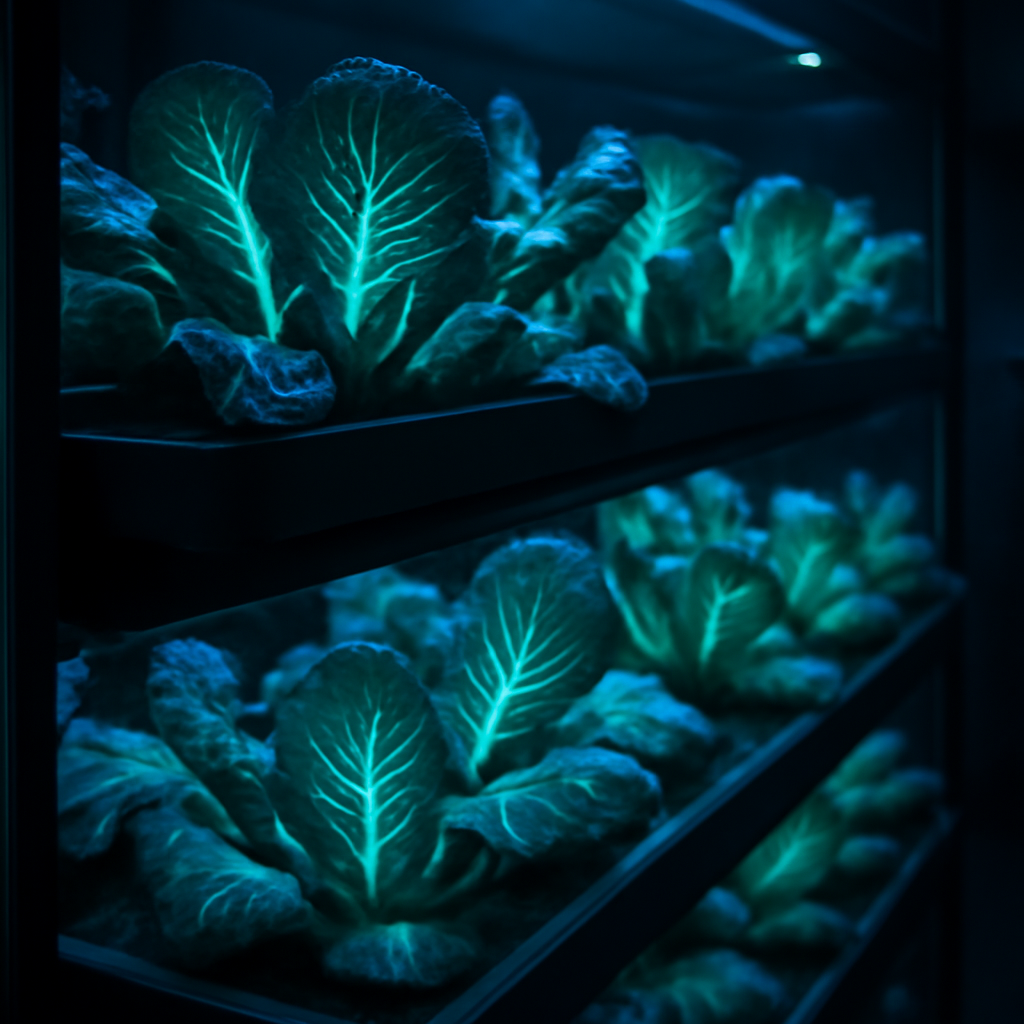
The star crop is a modified sea lettuce spliced with luciferase pathways borrowed from the deep-sea Vampyroteuthis squid, cultivated in shallow recirculating trays. Alongside it grow luminous oyster mushrooms — descendants of the naturally glowing Panellus stipticus, dialed up to what growers describe as 'reading-light intensity.' The whole B4 floor glows a permanent bruised teal.
'People assume it's neon or UV,' says lead grower Ren Fujisawa, wiping algae from a sensor. 'It is entirely metabolic. The lettuce is not lit. The lettuce is the light. If you turn off our climate control, it keeps glowing for eleven hours out of pure spite.'
How you grow light you can eat
The core input is DopaGlo's proprietary 'PhotoBroth,' a nutrient slurry dosed with luciferin precursors that the crops convert into stored bioluminescence. Farms run 18-hour dark cycles — sunlight actually suppresses the glow — under strict humidity control at 94% and water temperatures held at 16.5°C for the plankton tanks.
Output is measured not in tonnage but in lumen-yield. A premium tray of glow-lettuce delivers roughly 0.8 lux at 30 centimeters and stays luminous for four to six hours after harvest, degrading gracefully from cyan to a dim amber before going dark. Farmers call the final dim phase 'the last supper window.'
The mushrooms are trickier. Dr. Aiko Tanabe, a mycologist consulting for three of the farms, notes that overfeeding luciferin makes them glow so brightly they cook themselves. 'We lost an entire flush in February,' she says. 'They reached self-searing luminance. It smelled incredible. It was a catastrophe.'
The restaurants that turned off the lights
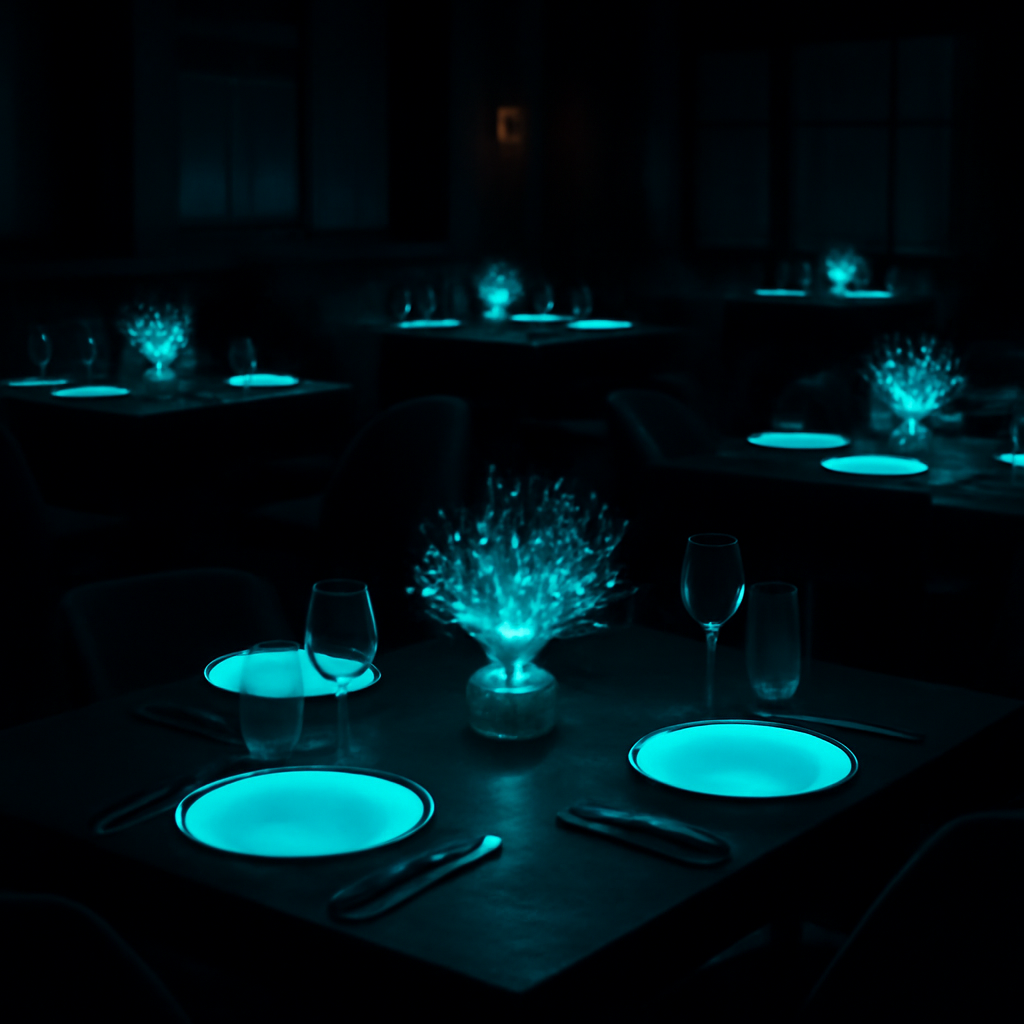
Aboveground, fourteen restaurants now serve exclusively in total darkness, relying entirely on the food's own emission. At Kurayami, a 22-seat counter in Ebisu, diners are led in blindfolded and the blindfolds come off in a room with zero ambient light. The first course — a glowing plankton consommé in a black bowl — hovers in front of you like a small cyan moon.
Chef Haruto Mizuki designs each course around its light curve. 'The risotto is engineered to peak at course four and fade by dessert,' he explains. 'By the final plate the room is nearly black again. You end the meal the way you started — trusting your hands.' A tasting menu runs ¥28,000, plus a ¥3,000 'lumen surcharge' for the brightest seasonal produce.
Table lighting is banned, phones are collected at the door, and the staff wear IR goggles to navigate. Regulars report a strange side effect: after ninety minutes of eating your own light source, stepping back onto a Tokyo street feels 'aggressively over-illuminated,' per one Tabelog reviewer who awarded five stars and 'mild existential dread.'
⚠️ REMINDER: All statistics, studies, quotes, and data above are entirely fictional. This is satire.
The regulators had to invent a whole new food
None of this was legal until recently. In March 2026, Japan's Consumer Affairs Agency created Category 8-L — 'Photobioactive Edibles' — after a six-month deadlock over how to label a turnip that emits visible light. Every glowing item now carries a mandatory 'active luminance rating' on its packaging, from L1 (faint dinner glow) to L5 (do not stare directly).
There are quirks. Farms must post 'no fireflies' signage, because escaped glow-plankton reportedly attracts wild fireflies in confusing numbers. And any produce exceeding L4 must be transported in blackout crates to avoid what one inspector drily termed 'unauthorized street illumination.'
Consumer safety officer Kenji Ohara confirms the food is entirely edible and the luciferin metabolizes harmlessly. 'The only documented effect is that your, ah, output may faintly glow for a few hours,' he says. 'We recommend not being alarmed. We have added this to the label. It is called the L-note.'
What it costs to eat the dark
The economics are surprisingly brutal. Underground farm rents run cheap — nobody wants a windowless sub-basement — but energy costs for the climate control are ferocious, and glow-crops spoil into darkness within a day. A kilo of L4 glow-lettuce wholesales at ¥9,800, roughly forty times ordinary greens.
Home kits exist for the ambitious. DopaGlo's countertop grow-tank ships with 2 liters of starter plankton, a PhotoBroth cartridge subscription, and a blackout hood, retailing at ¥64,000. Reviewers say it produces enough glow for 'one romantic dinner or two mediocre ones,' and warns the plankton must be 'burped' nightly or it goes dark and sulks.
⚠️ REMINDER: All statistics, studies, quotes, and data above are entirely fictional. This is satire.
The lettuce is not lit. The lettuce is the light.
📊 A note on our data
Every percentage, price estimate, expert quote, study citation, survey result, and scientific finding in this article is completely made up. DopaNews Fantasy articles are absurdist fiction. We write fake statistics with maximum confidence because that's the bit. Please do not repeat them as facts, share them as real, or use them in any decision-making. They are jokes wearing lab coats.
Questions people actually ask
Is bioluminescent food actually safe to eat?
Per Japan's new Category 8-L rules, yes — the luciferin metabolizes harmlessly, though officials note your output may faintly glow for a few hours, dubbed the 'L-note.'
Why do the restaurants keep the lights off entirely?
Because the food is the only intended light source. Ambient lighting would drown the glow, so tables, phones, and bulbs are banned to preserve the effect.
How long does a glowing dish stay lit?
Most produce glows for four to six hours after harvest; a plate of Reef Risotto emits usable light for roughly 40 minutes before fading to amber.
Can I grow glow-crops at home?
Yes — DopaGlo's countertop tank (¥64,000) grows enough glow-plankton for a dinner or two, provided you 'burp' the culture nightly.
More dopamine · zero checkout
The DopaNews verdict
Tokyo's glow-farms prove dinner can genuinely light the room — a delicious, faintly radioactive-feeling triumph of over-engineering. You can't eat any of it through your screen, but you can browse the whole luminous rabbit hole for free on DopamineKart before your salad starts glowing back.