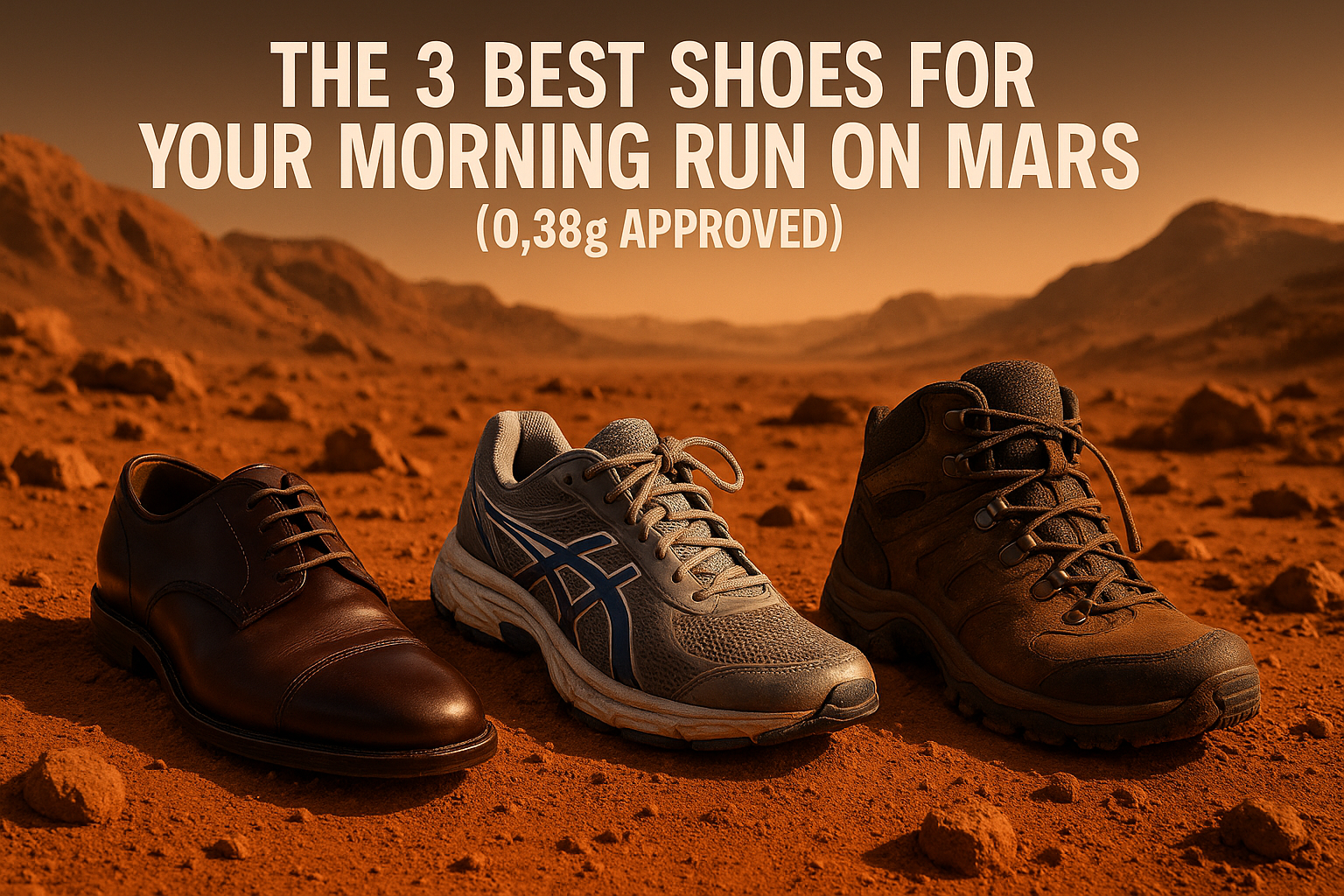
The gist
- Mars gravity (0.38g) means each stride carries 2.6x farther — you need weight, not cushion.
- Regolith is a fine, staticky dust that eats standard treads; magnetic and lugged soles are non-negotiable.
- Ballast-loaded shoes keep your foot on the ground long enough to actually run instead of bounce.
- Pair the right shoe with a cooling cap — mornings in Gale Crater still hit -40°C.
Why Your Nikes Will Get You Nowhere (Literally)
On Earth, a runner's foot spends roughly 250 milliseconds on the ground per stride. On Mars, at 0.38g, that same push-off sends you skyward for nearly a full second, converting a casual 10K into an involuntary series of moon-adjacent bunny hops. Your cardio suffers, your form collapses, and you cover a lot of ground while doing almost no actual running.
"The number one mistake new Martian runners make is bringing Earth shoes," says Dr. Priya Vanterpool, lead biomechanist at the Tharsis Institute for Locomotion. "Their whole system is tuned for a gravity that doesn't exist here. They lace up, take three steps, and clear a two-meter boulder they never intended to. It's embarrassing and it's a knee injury waiting to happen."
The fix isn't more cushion — it's more consequence. Every shoe below is engineered to increase ground contact time, either through added mass, magnetic anchoring, or aggressive lug geometry that bites into loose regolith. Think of it less as running and more as convincing the planet to let you stay.
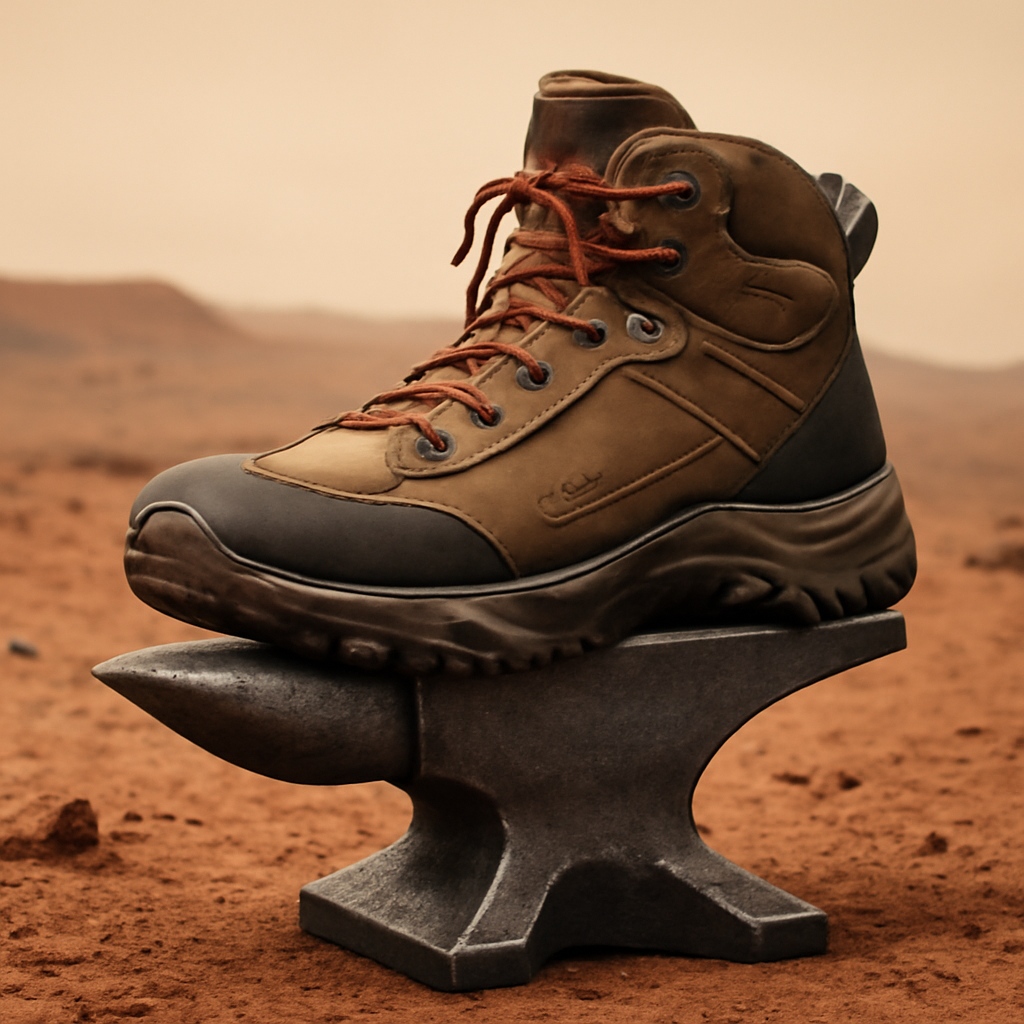
No. 1 — The Anvil-Sole GroundTruth GT-Mars
The GroundTruth GT-Mars ($1,890) solves the airborne problem the honest way: it's heavy. Each shoe packs 1.4 kg of tungsten-alloy ballast into a removable heel cartridge, giving you an Earth-equivalent foot weight without the Earth-equivalent gravity. The result is a natural, non-floaty stride that feels shockingly normal by day two.
The outsole uses a 14mm chevron lug pattern developed from Perseverance wheel-tread data, so it grips fine regolith the way a good trail shoe grips scree. There's a self-cleaning channel down the midfoot that flicks dust out with each flex — critical, because Martian dust is statically charged and clings to everything like a needy ex.
"It's the closest thing to a real run you'll get up here," says Vanterpool. "You forget you're on Mars until you look up and there are two moons." The catch: the ballast makes them a nightmare to travel with, and airlines charge you as if you're checking a small filing cabinet.
No. 2 — The MagLock Regolith Pro
If dead weight isn't your thing, the MagLock Regolith Pro ($2,340) takes the sci-fi route: electromagnets in the forefoot pulse in sync with your gait, briefly clamping the shoe to any iron-rich surface — which on Mars is basically everywhere, since the whole planet rusted. The pulse releases exactly when you want to push off, giving you a snappy, grounded turnover.
There's a real learning curve. The magnets draw power from a calf-strapped cell that lasts about 8 kilometers, and if you mistime your cadence the shoe stays clamped a fraction too long, producing what early testers called "the faceplant handshake." A wrist app lets you tune pulse timing to your stride, and once dialed in, it's genuinely magical.
The Regolith Pro is the enthusiast's pick — lighter than the GT-Mars, more technical, and unmistakably the shoe of someone who reads spec sheets for fun. It also makes a satisfying *thunk-thunk* that Martian settlement forums have unironically nicknamed "the sound of progress."
No. 3 — The BounceCancel Dyad (Budget Pick)
For the recreational hopper, the BounceCancel Dyad ($640) is the sensible entry point. Instead of ballast or magnets, it uses a stiff, negative-rebound foam that absorbs your push-off energy rather than returning it — the opposite of every hyped Earth super-shoe. You won't set records, but you also won't launch yourself into the neighbor's dome.
The Dyad's lugs are shallower and it skips the ballast, so it's featherlight and packs flat, making it the traveler's choice for a quick weekend on Mars. The tradeoff is traction: on loose morning frost-regolith it can slip, so stick to compacted paths near the settlement until the sun bakes the surface firm.
It's the shoe we'd hand a first-timer. Modest, forgiving, and cheap enough that when you inevitably trip over your own newfound athleticism and scuff a toe on a basalt shard, you won't cry about it.

The One Accessory That Makes It All Work
Shoes are only half the equation. Martian mornings in Gale Crater start around -40°C and the thin atmosphere does nothing to buffer temperature swings, so your head — and the electronics regulating your suit — need active thermal management the moment the sun clears the crater rim.
We ran the whole test kit under the Adder Error System Overclock Running Cap ($65), whose chrome cooling panels shed heat build-up from your suit's headliner and, frankly, look phenomenal in the low golden light of a Martian dawn. It won't keep you grounded, but it'll keep your comms core from throttling mid-jog.
Compare that to an Earth-side alternative like a Ciele GOCap — brilliant on a Tuesday 5K in the park, useless when your bigger problem is a computer overheating inside a pressurized helmet. On Mars, cooling isn't vanity. It's uptime.
You forget you're on Mars until you look up and there are two moons.
Questions people actually ask
Can't I just wear ankle weights with my normal running shoes?
You can, and people do, but ankle weights change your gravity center without fixing ground contact time, so you still float — just with worse form. Purpose-built ballast sits under the foot for a reason.
How much slower will I run on Mars?
By clock time, potentially faster per stride due to the longer flight phase — but pace is chaos to control. Most settlers report their honest, controlled pace lands close to their Earth pace once they adjust.
Are the MagLock magnets safe near settlement electronics?
The pulses are shielded and short-range, but you'll want to keep them a meter from unshielded data cores. Also, do not wear them near the greenhouse's magnetic seed sorter. Trust us.
The DopaNews verdict
The GroundTruth GT-Mars is the truest run, the MagLock is for gearheads, and the BounceCancel Dyad is where beginners should start — all crowned by a cap that keeps your gear from cooking. Naturally, none of this exists and you can't buy any of it, which is the whole point: browse the Martian running catalog for free on DopamineKart, then go for a perfectly ordinary jog on the one planet that still charges you full gravity.