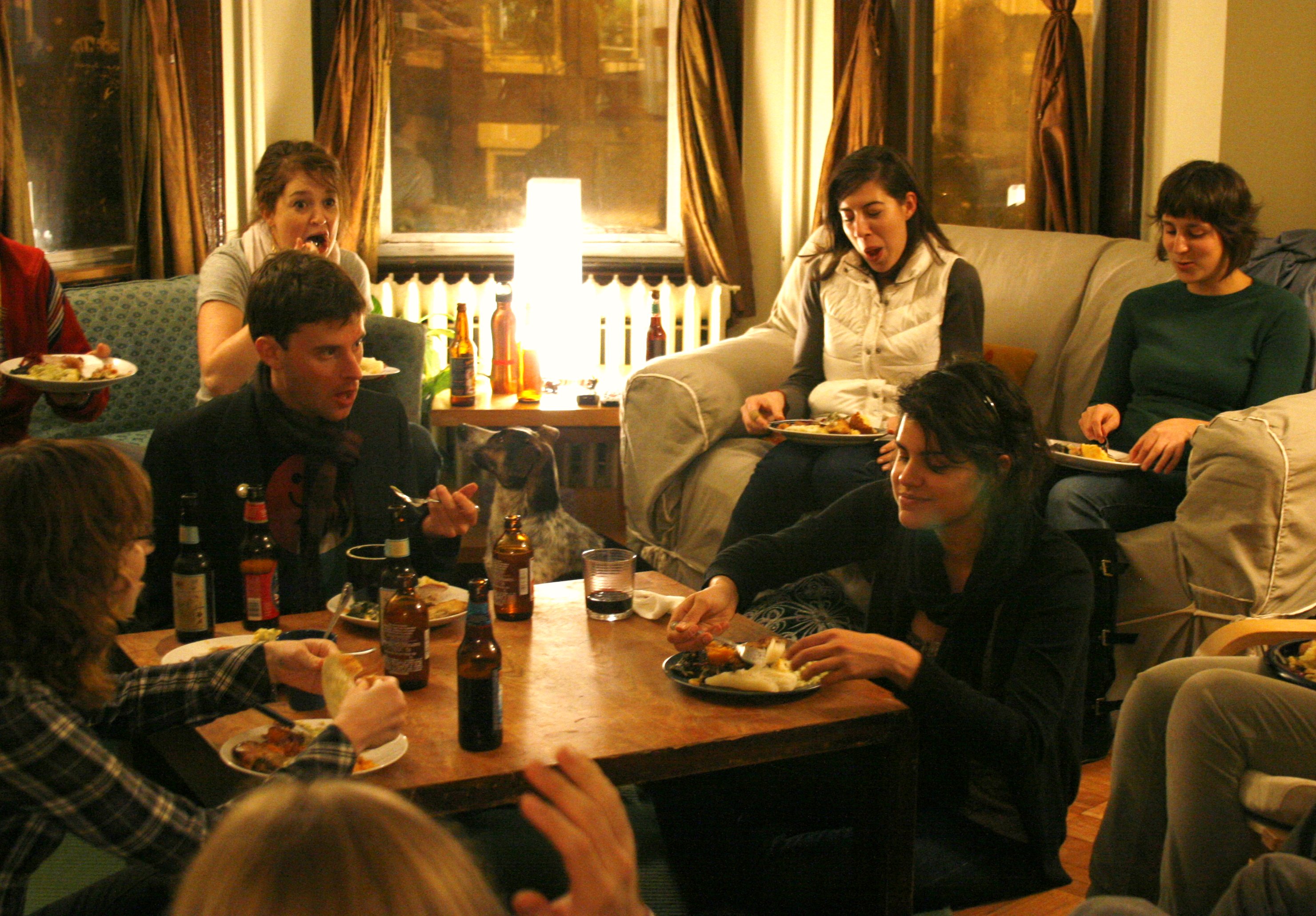
Quick take
- "Friendsgiving" is a portmanteau first documented online in 2007 — it did not originate with the sitcom Friends, despite the common assumption.
- The practice of gathering with friends instead of family for a Thanksgiving-style meal predates the word by decades, with commentators pointing to precedents going back to the 1960s.
- Independent surveys from YPulse, Evite, and Green Giant each show real, measured growth in participation over the past decade, even though their exact percentages differ by methodology.
- Because it's potluck-style by default, the real risk at a Friendsgiving isn't the menu — it's food sitting in the USDA's "danger zone" too long before anyone eats it.
Ask most people where "Friendsgiving" came from and they'll guess the sitcom — a bunch of friends around a table, Thanksgiving episode, done. That's not actually where the word started, and the real paper trail is more interesting: an internet-era coinage grafted onto a much older, quieter tradition of people building their own version of the holiday when going home wasn't an option. Here's what's actually documented about where the term came from, how fast the practice has spread, and what the USDA wants you to know before you set a potluck table for a dozen people you love but didn't grow up with.
Where the word actually came from
"Friendsgiving" is a portmanteau of "friends" and "Thanksgiving," and according to Merriam-Webster, it was first used online in 2007 to describe an informal meal — appearing in early web and social posts, not in a script. The dictionary didn't formally add the word until January 2020, after several years on its "Words We're Watching" list, which tracks terms that are common enough to need defining but haven't yet cleared the bar for entry.
The 2011 window is where the term picked up real momentum: a Baileys Irish Cream ad campaign used "Friendsgiving" that year, and it also turned up as a plot point on The Real Housewives of New Jersey. From there, Google search interest for the word climbed steadily, and by 2012–2013 the Emily Post Institute — the etiquette authority — had started fielding actual reader questions about how to host one, which is a reasonable signal that the practice had moved from niche slang to something people needed real hosting advice for.
The practice predates the word — by decades
This is the part that surprises people: gathering with friends instead of family for a Thanksgiving-style meal isn't a 2010s invention. Wikipedia's entry on Friendsgiving points to a mid-1960s precedent that's arguably the most famous: Alice Brock and her husband Ray hosted Thanksgiving dinners in Massachusetts for friends who were estranged from their own families, and one of those dinners — attended by a young Arlo Guthrie in 1965 — became the basis for the song "Alice's Restaurant." Commentary from Woman's World has also pointed to the 1973 animated special A Charlie Brown Thanksgiving, in which Charlie Brown's friends end up sharing an improvised, un-traditional Thanksgiving meal together — a scene that reads almost exactly like a modern Friendsgiving, made nearly 35 years before the word existed.
What both of those examples share with the modern version is the same underlying reason people do this at all: not everyone can, or wants to, go home for the holiday. Long before "Friendsgiving" was a searchable word, that logistical and emotional reality was already producing the exact same kind of gathering.
The growth, according to the people who actually track it
Because it's a marketable holiday moment, several companies and pollsters have tracked Friendsgiving's growth over the years — and while their exact numbers vary by methodology and sample, the direction is consistent across every source that has repeated the same survey more than once.
- 2014 → 2019YPulse's Thanksgiving survey found that 39% of 19–37-year-olds planned to celebrate Friendsgiving in 2019, nearly double the 21% who said the same when the question was first asked in 2014. Gen Z teens (13–18) showed an even sharper jump in one year alone — 40% planning to celebrate in 2019, up from 17% the year before.
- 2017 → 2019Google Trends data cited by YPulse showed a 20% increase in searches for "Friendsgiving" over that two-year window, with the term registering almost no meaningful search volume at all between 2004 and 2012.
- Ongoing, per EviteEvite — the invitation platform — has reported Friendsgiving party invitations growing an average of roughly 30% year over year in recent seasons, alongside a separate finding that the number of celebrants has roughly doubled since 2014. Evite also puts the average Friendsgiving guest list at about 18 people, with the Saturday before Thanksgiving as the single most popular date.
- 2023A Green Giant-commissioned survey reported that nearly half of Americans said they planned to attend at least one Friendsgiving that year, a notably higher topline than earlier surveys — a reminder that different pollsters, sample groups, and question wording can produce different absolute numbers even when they agree the trend is upward.
Every one of those numbers comes from a named survey or platform, not an internal estimate — and it's worth being upfront that they don't all agree with each other on the exact share of Americans celebrating. What they agree on is the direction: more people are doing this now than a decade ago, and the growth shows up whether you're measuring search interest, party invitations, or direct survey responses.
| Measure | What changed |
|---|---|
| 19–37-year-olds planning to celebrate | 21% (2014) → 39% (2019) |
| Gen Z teens (13–18) planning to celebrate | 17% (2018) → 40% (2019) |
| "Friendsgiving" search interest | +20% (2017–2019, per Google Trends) |
| Evite Friendsgiving invitations | ~+30% year over year, recent seasons |
| Average Friendsgiving guest list size | ~18 people (Evite) |
Hosting one without anyone getting sick: the real USDA rules
A Friendsgiving is potluck-style almost by definition — everyone brings a dish, dishes travel, and they often sit out on a counter for hours while people mingle. That's exactly the scenario the USDA's Food Safety and Inspection Service built its "Danger Zone" guidance around: bacteria that cause foodborne illness grow fastest between 40°F and 140°F, doubling in number in as little as 20 minutes at the worst part of that range. The agency's rule of thumb is that food should never sit in that zone for more than 2 hours — or more than 1 hour if the room or outdoor temperature is above 90°F.
Transport hot and cold separately
Keep hot dishes above 140°F by wrapping them in insulated bags or towels, and keep cold dishes at or below 40°F in a cooler packed with ice or gel packs. If you're driving, put the cooler in the air-conditioned cabin, not a hot trunk.
Keep the clock running
Once a dish is out, it's on the 2-hour clock (1 hour if the room is warm). A chafing dish or slow cooker on "warm" can hold hot food above 140°F for longer than a plain serving bowl can.
Ask before people just show up with food
A short group thread — who's bringing what, and does it need a fridge, an outlet, or an oven when it arrives — heads off five people bringing pie and zero people bringing anything that needs to stay hot.
Have a no-fridge-needed backup
Whole fruit, whole vegetables, bagged chips and dip, dried fruit, nuts, and jerky don't need refrigeration or a danger-zone clock at all — useful for a guest arriving early or a table that's already crowded.
Note dietary info on the dish
A small card noting nuts, dairy, gluten, or meat saves a guest from having to interrogate the host mid-party — especially useful at a mixed group where not everyone knows each other's allergies.
Don't let the buffet become the fridge
Once the meal's winding down, box up anything still good within that same 2-hour window rather than letting it linger on the counter through dessert and cleanup.
Why "who coined it" doesn't really matter
No single person is credited with inventing "Friendsgiving" — it emerged the way a lot of internet-era slang does, showing up in scattered posts before any one source can claim it. What's actually more interesting than the coining is what the practice reveals: outlets from Reason to the Washington Post have framed the rise of Friendsgiving as evidence people are actively curating their own holiday traditions rather than defaulting to inherited ones, particularly in cities with a lot of transplants who can't easily get home for a Thursday dinner. Not every take on it is celebratory — at least one critic has argued the "cutesy portmanteau" partly reflects delayed household formation and holiday travel that's become less affordable for younger adults than it used to be. Both readings can be true at once: it's a real, spreading tradition, and it's also a response to real logistical constraints.
Common questions
Did "Friendsgiving" come from the TV show Friends?
No. Merriam-Webster traces the term's first documented online use to 2007, well after Friends ended its run in 2004, and no source ties the coinage to the show.
When did it become an official dictionary word?
Merriam-Webster added "Friendsgiving" in January 2020, after tracking it on its "Words We're Watching" list for several years.
Is Friendsgiving actually growing, or does it just feel that way?
Multiple independent trackers — YPulse's youth surveys, Evite's invitation data, and Google Trends search volume — each show real upward movement over the past decade, even though they don't all report the same exact percentage.
What's the single most important food-safety rule for a potluck?
The USDA's 2-hour rule: don't let hot or cold dishes sit in the 40°F–140°F "danger zone" for more than 2 hours, or 1 hour if it's above 90°F in the room.
Is Friendsgiving usually instead of family Thanksgiving, or in addition to it?
Per Wikipedia's overview of the practice, most people treat it as a second, separate gathering held on or near Thanksgiving — though for some it has fully replaced the traditional family meal.
Friendsgiving is a real cultural pattern with a documented paper trail, not just a marketing invention — the word is barely two decades old, but the impulse behind it goes back at least to the 1960s. The growth in participation isn't a single overhyped statistic either; it shows up independently across youth surveys, an invitation platform's own data, and plain search interest, even if the exact "percent of Americans" figure moves depending on who's asking. If you're hosting one this year, the one part of this that isn't up for debate is food safety: potluck dishes traveling from multiple kitchens and sitting out for hours is exactly the scenario the USDA's danger-zone rule exists for, so a cooler, a chafing dish, and a rough sense of when each dish arrived will do more for your guests than anything else on this page.
Disclosure. No business relationship, sponsorship, or affiliate link is attached to any source, brand, or survey cited in this piece. Statistics are attributed to their original publisher (Merriam-Webster, Wikipedia, YPulse, Evite, Green Giant/PR Newswire, USDA/FSIS) and are not DopamineKart estimates. The hero photograph is real, unedited documentary photography credited to its photographer via Wikimedia Commons.
Corrections: email us