Quick take
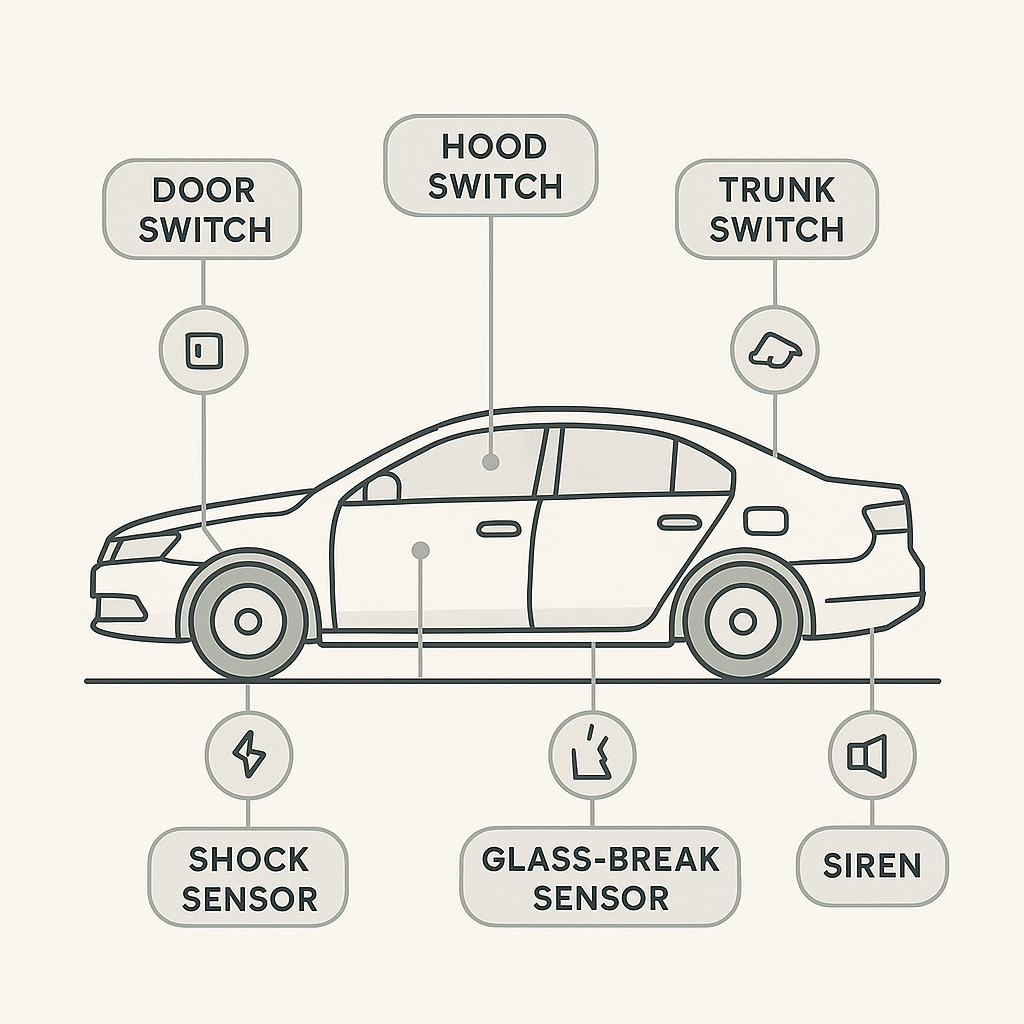
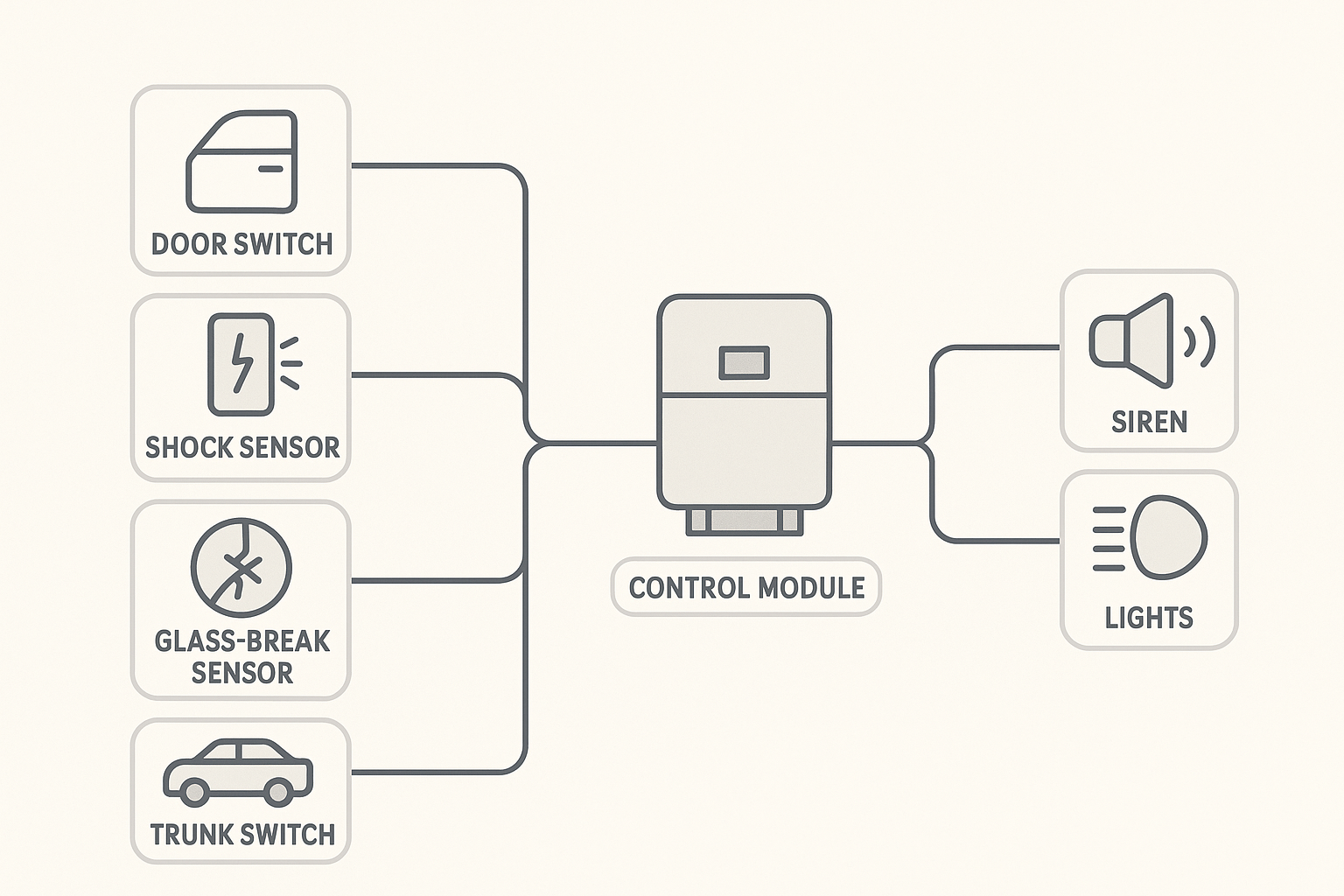
- A car alarm is a loop: sensors detect a state change, a control module decides if that change is a threat, and if it is, the module fires a hidden, often self-powered siren and flashes the lights.
- Door, trunk, and hood switches are simple open/closed triggers; the shock sensor and the glass-break sensor are a different job entirely — one feels vibration, the other listens for a specific sound.
- There isn't one kind of car key. A mechanical cut key, a transponder chip key, an RF remote, and a proximity smart key are four genuinely different mechanisms, often layered into the same physical fob.
- The remote sends a rolling code that changes every use, specifically so a recorded signal can't be replayed — but that doesn't stop a relay attack, a different technique that never touches the code at all.
- Two completely separate anti-theft systems exist below the alarm layer: a manual kill switch (a hidden physical break in the starting circuit) and a GPS-connected remote disabler (used by lenders and recovery services to cut the engine after the car is already moving).
Press the button, hear the chirp, walk away — a car alarm feels like a single action, but underneath it's a small always-on circuit doing three separate jobs: watching for a change, deciding if that change means something, and reacting loud enough that a stranger three houses over can hear it. Here's each piece, in order, and where the real security gap actually is.
Every sensor wired into the car
Every car alarm starts with a set of switches and sensors wired to a central control module, and they're not all doing the same job. Some are simple binary switches; others are actually interpreting a physical signal and deciding whether it means something. Here's the full set, and what each one is actually built to catch.
Door, trunk, and hood switches
The simplest sensors in the system are mechanical: a switch in each door jamb, one in the trunk, and usually one under the hood, each just detecting "open" vs "closed." When the alarm is armed and one of those switches changes state, it's an instant, unambiguous trigger — there's no interpretation involved, no sensitivity to tune. This is also the exact mechanism behind one specific, common alarm event: the trunk popping open on its own, or being popped by someone with a slim-jim or a coat-hanger through the trunk seal. The trunk switch doesn't know why it opened — mechanical failure, a bad latch, or an actual break-in read identically to it, which is why "the trunk keeps setting off my alarm" is almost always a latch or wiring problem, not sensor sensitivity.
The shock sensor vs. the glass-break sensor — two different jobs
These get conflated constantly, and they work on genuinely different principles. A shock sensor is usually a small piezoelectric element that outputs a voltage when it physically vibrates — it's catching movement of the car itself: someone rocking it, bumping it, or hitting a window hard enough to shake the frame. It cannot tell the difference between a real impact and a truck driving past and shaking the pavement, which is why it's responsible for most false alarms, and why sensitivity is almost always adjustable on the control module.
A true glass-break sensor is a separate device, usually a small microphone-based module, and it isn't listening for vibration at all — it's listening for the specific acoustic signature of glass shattering: a sharp high-frequency spike followed immediately by a lower-frequency thud, a pattern that's genuinely rare in ordinary road noise. Not every car alarm has one; cheaper systems rely on the shock sensor alone and simply accept the false-alarm tradeoff. A system with both catches two different attack methods: rocking/prying (shock) and smashing a window (acoustic).
The siren: where it hides, and why
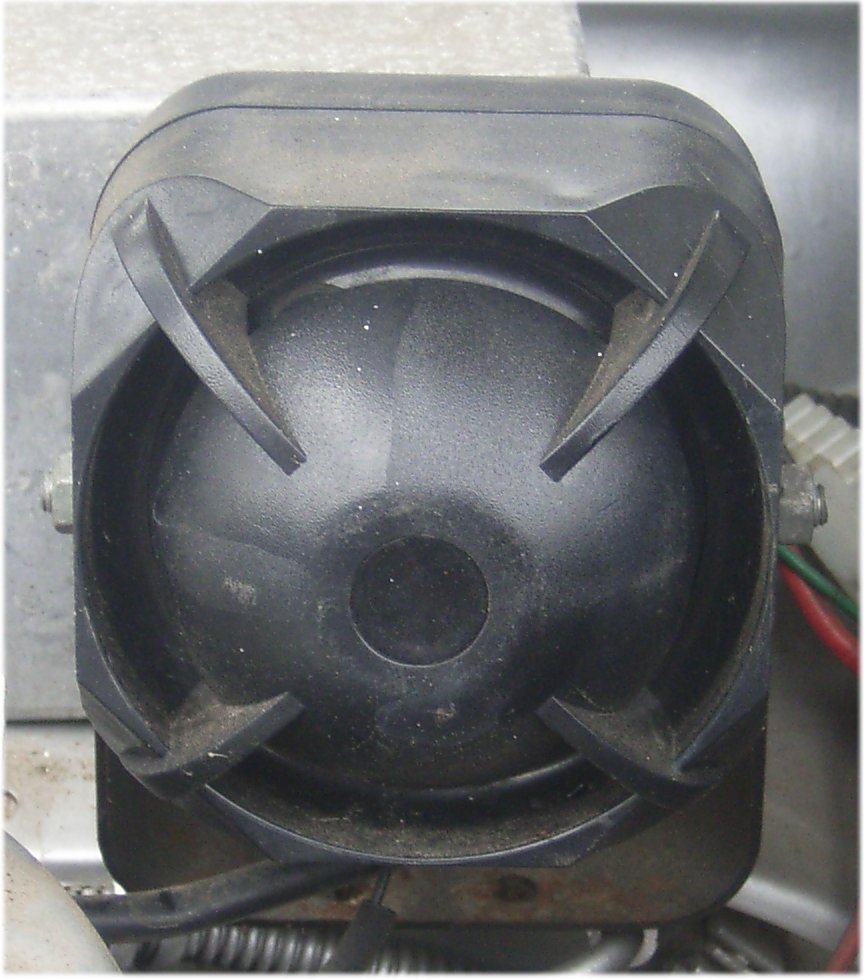
The siren itself is deliberately installed somewhere it's hard to reach quickly — low in the engine bay, behind the front bumper, or zip-tied up under a fender liner, specifically so a thief can't just rip out one wire and silence the whole system in the two seconds before it starts drawing attention. Better sirens are self-powered, meaning they carry their own small backup battery: disconnect the car's main battery (a classic first move for a thief trying to kill the alarm) and the siren keeps screaming anyway, because it isn't relying on the car's power at that point. Cheaper sirens skip the backup battery and go silent the instant the main battery is disconnected — a real, meaningful difference in what a siren actually protects against.
The control module, and what actually counts as a trigger
All those sensors feed into one small box — the control module, sometimes called the alarm's "brain" — which is really just deciding whether an input matters right now. Disarmed, a door switch opening is nothing; armed, the exact same signal is a trigger. In practice, the module is watching for a specific set of trigger forms:
- Door, trunk, or hood opened while armed — the instant mechanical-switch trigger.
- Shock/vibration above threshold — someone hitting, rocking, or leaning on the car.
- Glass-break acoustic signature detected — on systems that have the sensor.
- Voltage drop on the main battery — some systems trigger if the battery is disconnected, specifically to catch the "just unplug the battery" bypass attempt.
- Tilt beyond a set angle — on systems with a tilt sensor, catching the car being jacked up (a wheel-theft or tow-theft pattern).
- Ignition turned on without the correct key/remote sequence — the trigger that bridges into the immobilizer, covered next.
The module also runs the arming/disarming state itself and tracks how long ago it was armed — most alarms ignore trigger events for a few seconds right after arming, so the doors settling and locks clunking don't set it off immediately.
This is also where factory and aftermarket systems genuinely diverge. A factory alarm's control module is wired into the car's immobilizer — the separate system that stops the engine from starting without the correct key transponder — so a triggered alarm and a car that won't start are the same integrated system. Most aftermarket alarms bolt onto the existing wiring without touching the immobilizer, meaning they can make noise and flash lights, but a thief who's already inside and knows what they're doing may still be able to start the car through other means. That's the real practical gap between the two, more than any spec sheet.
The keys: four different mechanisms, one word
"Car key" covers four genuinely different pieces of technology, and most modern keys are actually two or three of them combined into one physical fob.

The mechanical cut key is the oldest and simplest: a physically cut piece of metal that turns a lock cylinder, no electronics anywhere in the exchange. Nearly every car still has this as a backup, even ones that are normally started with a button — there's almost always a hidden mechanical key blade inside the fob, for when the electronics fail or the fob battery dies.
The transponder chip is a small passive RFID chip embedded in the key's plastic head, with no battery of its own — it's powered briefly by a magnetic field from a coil around the ignition barrel when the key is inserted. The car reads the chip's unique code and only permits the immobilizer to release if it matches; this exists specifically to stop the old trick of starting a car with a cut key alone or a screwdriver in the ignition barrel.
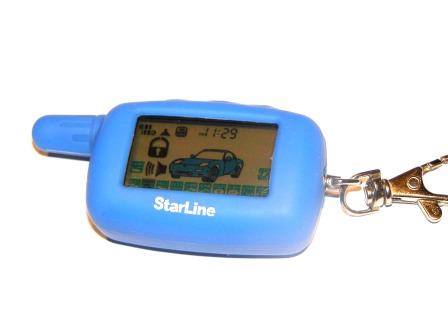
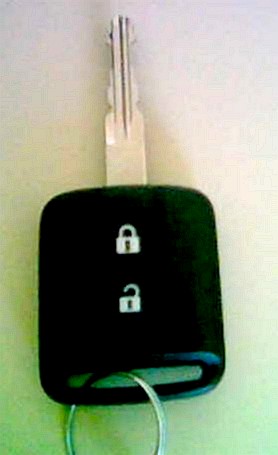
The RF remote is the button-press unit already covered above — a radio transmitter sending a rolling code to lock, unlock, and sometimes remote-start, entirely separate from the transponder chip even when it's molded into the same piece of plastic.
The proximity smart key is the newest layer: a battery-powered transmitter that automatically answers the car's short-range "are you there?" signal, enabling passive entry (the door unlocks when you touch the handle, no button press) and push-button start. This is also the layer that a relay attack specifically targets, covered further down.
What happens when someone tries to start it anyway
If a thief gets the door open — through a real key, a broken window, or a lock pick — and tries to start the car without the correct transponder chip or proximity key nearby, the immobilizer's handshake simply fails: the car's computer never receives the expected coded response, so it withholds fuel injection, spark, or the starter circuit itself, depending on the system. On most modern cars the engine won't even crank; on some, it can crank and briefly catch before the immobilizer cuts it back off within a couple of seconds, which is exactly the "starts, then dies" behavior a lot of people report about a stolen-attempt vehicle. Critically, this is a different system from the alarm — a car can have a fully silent, disabled alarm and still refuse to start, because the immobilizer check happens at the engine computer, not the alarm's control module.
The remote: rolling codes, and the relay-attack hole nobody closed
Early car remotes sent a fixed code — the same signal every time you pressed lock. That's trivially easy to record with a cheap radio receiver and replay later, so virtually every remote made in the last two-plus decades uses a rolling code instead: a code that's cryptographically derived from a shared counter between the remote and the car, changing every single press. Record today's signal and it's already useless tomorrow — the car's expecting the next code in the sequence, not a repeat of the last one.
That closed the replay-attack door, but it didn't close the building. The gap that actually gets cars stolen today is a relay attack, and it doesn't touch the rolling code at all — it doesn't need to. Passive keyless entry systems (the kind where the car unlocks just because the key is nearby, no button press) constantly send a low-power "are you there?" signal, and the key automatically answers if it's close enough. A relay attack uses two devices: one held near the key (even through a wall, in a house), one held near the car, silently forwarding that conversation between them in real time. The car thinks the key is inches away because, electronically, as far as the signal timing is concerned, it might as well be. Nothing is cracked or decrypted — the attacker is just extending the conversation's reach.
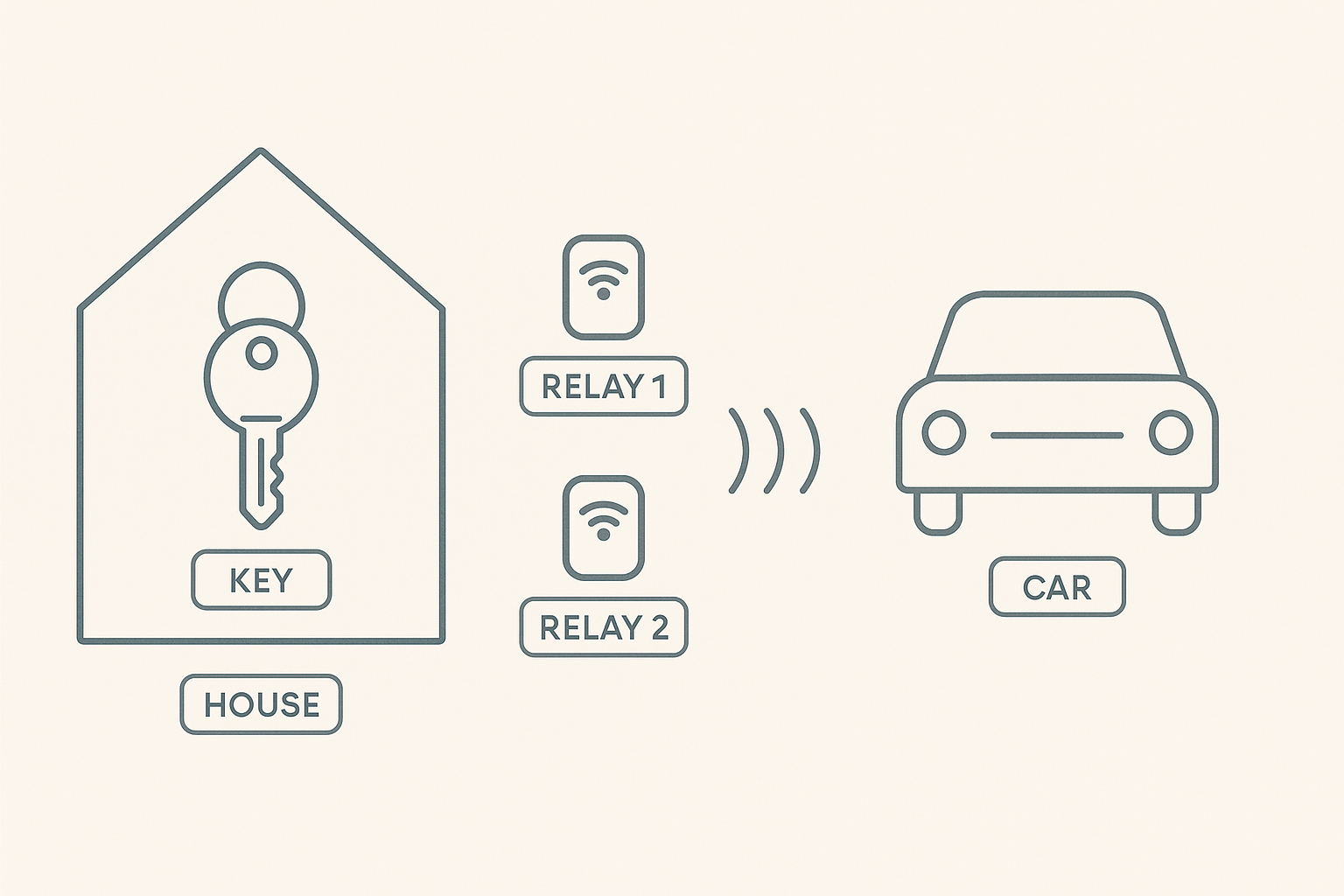
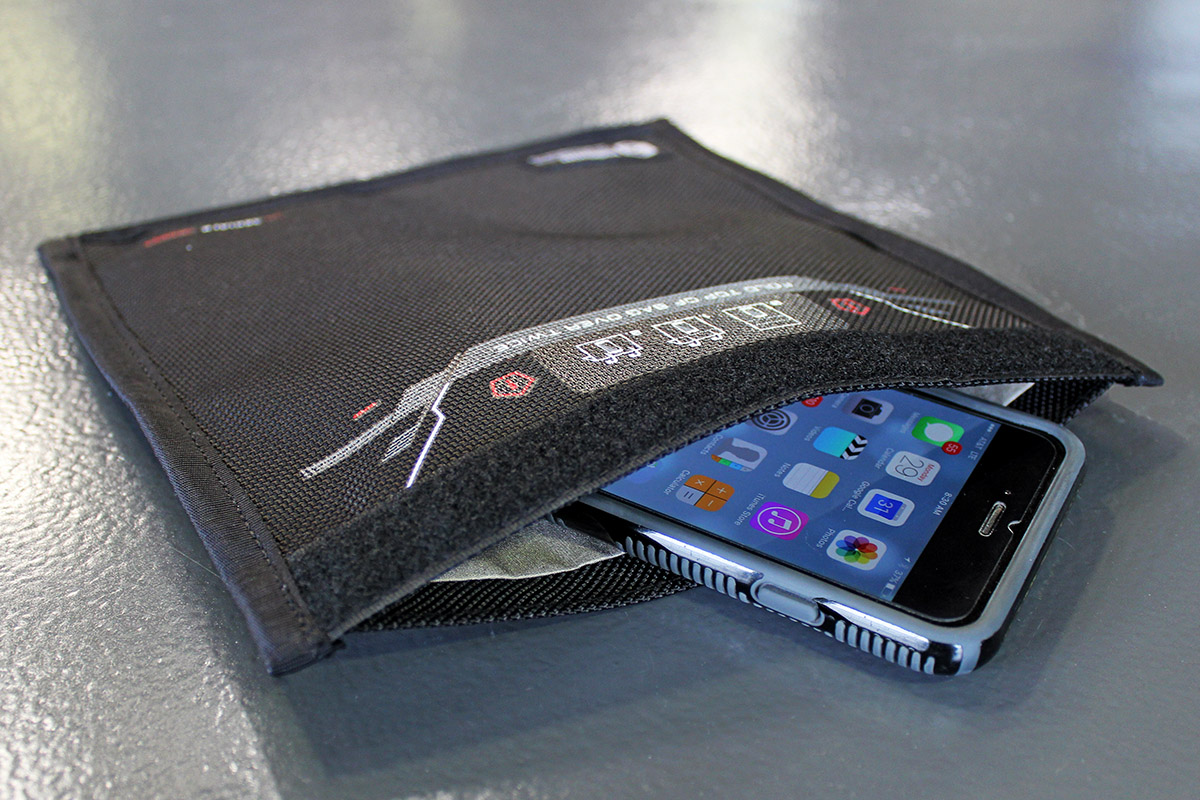
The practical countermeasure has nothing to do with the alarm system itself: a signal-blocking pouch (often called a Faraday pouch) for the key, or simply keeping the key far enough from any exterior wall, prevents the key from answering the relay in the first place. Some newer key fobs also add a motion sensor that puts the key to sleep — stops broadcasting — after a period of stillness, which is a more elegant fix but only present on select recent models.
The kill switch: the low-tech answer nothing above can beat
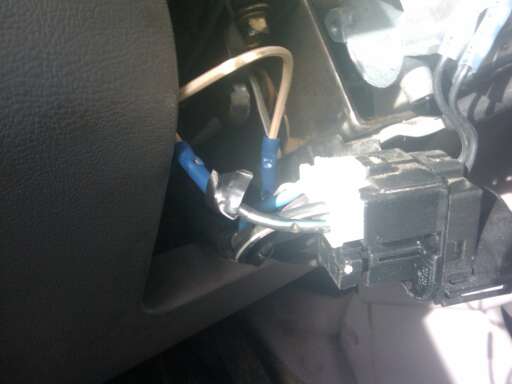
Underneath all of the above sits the oldest, cheapest, and arguably most effective anti-theft device there is: a hidden manual kill switch, wired into the ignition, starter, or fuel pump circuit and installed somewhere a thief has no reason to look — under a seat, behind a trim panel, inside the dash. Flip it off, and the circuit is physically open; the car simply cannot start, full stop, regardless of what key or fob is used. Flip it back on before driving, and everything works normally.
Its real advantage over every electronic system above is that it's not detectable by scanning, jamming, or relaying anything — there's no signal to intercept because there isn't one. Its real disadvantage is exactly the same coin flipped over: it only works if the thief genuinely doesn't find it, and a poorly hidden or commonly-located kill switch install is easy for anyone who's seen one before to spot.
Remote vehicle disablers: the GPS shutoff nobody talks about
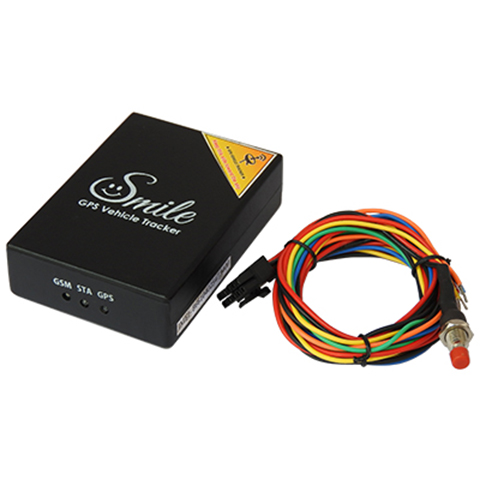
There's a second, entirely separate category worth knowing about, and it's not really marketed as "alarm" equipment at all: GPS-connected starter-interrupt devices, most commonly installed by auto lenders on subprime/buy-here-pay-here financing deals, and separately by stolen-vehicle recovery services. These pair a GPS tracker with a small relay wired into the starting circuit, and — critically — they're designed to let the car start and be driven normally, then cut power to the starter or fuel system after a set delay once the vehicle is already moving, rather than blocking the engine from starting at all.
The reasoning behind the delayed-shutoff design is safety: killing the engine the instant someone turns the key, mid-reverse-out-of-a-parking-spot, is worse than letting them get the car underway and then losing power gradually a few seconds or minutes later, generally while still able to coast to a stop. In practice this has been genuinely controversial — there are documented consumer complaints and legal cases (including FTC and state-level actions against specific lenders) over these devices triggering unexpectedly or without adequate warning, sometimes stranding drivers in unsafe locations. It's a real technology with a real, debated safety record, not a hypothetical — worth knowing about separately from anything the factory or aftermarket alarm on the car is doing.
Common questions
Why does my car alarm keep going off for no reason?
Almost always the shock sensor's sensitivity is set too high, picking up vibration from traffic, wind, or someone brushing past the car rather than an actual impact. It's usually adjustable on the control module itself or through a shop. A trunk that keeps triggering it is a separate, mechanical issue — usually a worn latch, not a sensor problem.
What's the difference between a shock sensor and a glass-break sensor?
A shock sensor feels physical vibration through the car's body — it can't tell a real hit from a truck driving by. A glass-break sensor is a microphone-based module listening specifically for the acoustic signature of shattering glass. Not every alarm has both; cheaper systems rely on the shock sensor alone.
Do rolling codes make car alarms unhackable?
No. Rolling codes stop someone from recording and replaying your remote's signal, which used to be trivial. They do nothing against a relay attack, which extends the key's real signal instead of copying it.
Is a factory alarm actually better than an aftermarket one?
Not automatically better at making noise, but usually better integrated — factory alarms typically connect to the immobilizer that prevents the engine from starting, which most aftermarket alarms don't touch.
Does a Faraday pouch really stop relay attacks?
Yes, functionally — it blocks the key's radio signal from reaching outside the pouch, so there's nothing for a relay device to pick up and forward in the first place.
Is a kill switch better than a car alarm?
They solve different problems. An alarm deters and alerts; a kill switch physically prevents the car from starting at all, and it can't be defeated electronically because there's no signal involved — only whether the thief finds the hidden switch.
What is a GPS remote disabler, and is it the same as a car alarm?
No — it's a separate system, most commonly installed by auto lenders or stolen-vehicle recovery services, pairing a GPS tracker with a relay that can cut the starter or fuel system remotely, typically with a delay after the car is already moving for safety. It has nothing to do with the factory or aftermarket alarm on the vehicle.
A car alarm is a small, honest piece of engineering doing exactly what it says: watch for a state change, decide if it matters, make noise if it does — through sensors that are genuinely doing different jobs (a switch, a vibration sensor, an acoustic sensor) even though they get lumped together as one thing. But the alarm is only one layer. The keys themselves are actually four different technologies wearing one fob's clothing, the immobilizer is a completely separate system from the noise-making alarm, and underneath all of it sit two much older, lower-tech answers — a hidden manual kill switch, and increasingly, a GPS-connected remote disabler that most people don't know exists until a lender installs one.
Where it actually gets interesting — and where most of the real security conversation lives now — isn't the siren at all. It's the remote link, and specifically the gap between "this code can't be copied" (true, solved) and "this key can't be tricked into answering from far away" (still mostly unsolved outside of a physical pouch).
Disclosure. This is an independent mechanism explainer, not sponsored by or affiliated with any car alarm, automotive security, keyless-entry, or vehicle-finance company. No product is sold or recommended in this article, and no specific lender or recovery service is named or implied. Real photography is Wikimedia Commons, credited per image above, under CC BY-SA, CC BY, and GFDL licenses. Illustrations are AI-generated (OpenAI gpt-image-1), used only for conceptual diagrams — never to depict a real product or brand mark.
Corrections: email us