Quick take
- PSI (pounds per square inch) measures the force of the water stream — how hard it hits a surface, which is what physically breaks the bond between dirt and the surface underneath it.
- GPM (gallons per minute) measures how much water volume the machine delivers — which determines how quickly loosened dirt actually gets rinsed away and carried off the surface.
- Cleaning Units, calculated as PSI multiplied by GPM, is a more complete measure of a pressure washer's real-world cleaning power than PSI alone, since a high-PSI machine with low water volume can still be a slow, inefficient cleaner.
- High-PSI water streams are a genuine safety hazard at close range — concentrated pressure washer spray can break skin and cause serious injury, not just discomfort, which is why manufacturers rate nozzles and set minimum safe spray distances.
PSI: the force that breaks the bond
Pounds per square inch measures how much force the water exerts on the area it contacts. In cleaning terms, that force is what physically overcomes the adhesion between dirt, grime, mildew, or old paint and the surface it's stuck to — a mechanical scrubbing action performed entirely by fast-moving water instead of a brush. Higher PSI breaks that bond more effectively and can lift more stubborn buildup, which is why PSI became the headline number manufacturers put on the box.
But PSI alone only describes the force at the point of contact — it says nothing about how much water is actually reaching the surface to do that work over a given area, or how efficiently the dislodged dirt gets carried away afterward. That's the piece PSI leaves out entirely.

GPM: the volume that carries it away
Gallons per minute measures the volume of water the pump moves through the machine, independent of how much pressure that water is under. In practice, GPM is what determines how quickly a cleaned area actually gets rinsed — a high-PSI, low-GPM machine can break dirt loose effectively but then struggle to flush it fully off a large surface, requiring more passes over the same spot to finish the job. A higher-GPM machine covers more surface area per minute with enough water volume to both loosen and rinse in fewer passes.
This is why two pressure washers with identical PSI ratings can feel meaningfully different to use: the one with higher GPM finishes a driveway or deck faster, not because it hits harder, but because it's moving more water to do the rinsing half of the job.
Cleaning Units: the number that combines them
Because PSI and GPM measure two different halves of the same job, some manufacturers and reviewers use a combined figure called Cleaning Units (or Cleaning Power Units), calculated simply as PSI multiplied by GPM. It's not a perfect metric — real-world performance still depends on nozzle design, pump consistency, and the specific surface being cleaned — but it's a meaningfully more complete comparison than PSI in isolation, since it accounts for both the force doing the loosening and the volume doing the rinsing.
A pressure washer with high PSI but low GPM and one with moderate PSI but high GPM can end up with similar Cleaning Units and similar real-world cleaning speed, despite very different numbers on the box — which is exactly the kind of comparison PSI alone hides.

Where the force becomes a real hazard
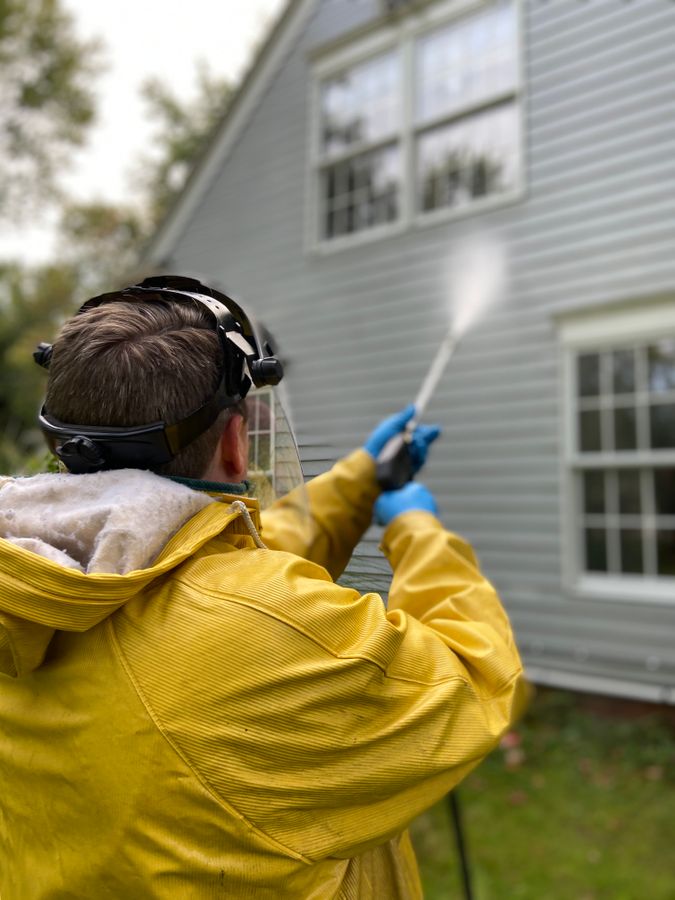
It's worth being direct about this rather than treating it as a footnote: a pressure washer's concentrated stream carries enough force at close range to break skin, and injuries of this kind are documented and serious — not comparable to a garden hose. This is a genuine physical risk from the mechanism itself, not a hypothetical caution. Manufacturers rate nozzles for specific spray patterns and publish minimum safe standoff distances for exactly this reason, and a narrow zero-degree nozzle at close range is capable of injecting water forcefully enough to cause real tissue damage.
This doesn't require special equipment to manage safely — keeping the nozzle at a proper working distance, using a wider spray pattern for anything near skin, and never pointing the stream at a person are the basic, well-established precautions that account for how the tool actually works.
| Spec | What it actually measures |
|---|---|
| PSI (pounds per square inch) | Force of the water stream — what breaks the bond between dirt and the surface |
| GPM (gallons per minute) | Volume of water delivered — what rinses loosened dirt off the surface |
| Cleaning Units | PSI × GPM — a more complete comparison of real-world cleaning power than either spec alone |
| High PSI, low GPM | Breaks dirt loose effectively but may need more passes to fully rinse a large area |
| Nozzle angle | Narrower angle concentrates force into a smaller area — more cleaning power, more risk at close range |
| Safety consideration | Concentrated streams can injure skin at close range; follow the manufacturer's minimum safe spray distance |
Common questions
Is a higher PSI always better for cleaning?
Not by itself — PSI without adequate GPM can leave a machine slow at actually rinsing large areas, even if it breaks dirt loose effectively. Cleaning Units (PSI × GPM) is a more complete comparison.
What's a safe distance to hold a pressure washer nozzle from a surface or skin?
This varies by nozzle angle and the machine's PSI, so always check the specific manufacturer's guidance — but as a general principle, narrower nozzle angles require greater standoff distance, and the nozzle should never be pointed at a person regardless of distance.
Why does my pressure washer feel slower than its PSI rating suggests?
Low GPM is a common cause — a high-PSI machine with limited water volume can break dirt loose quickly but take longer to rinse it away, especially over a large surface area.
Do all pressure washer nozzles produce the same force?
No — nozzle angle changes the spray pattern and concentrates or spreads the same PSI over a different area. A narrow (0-degree) nozzle concentrates force into a small point and is both more aggressive on stuck-on grime and considerably riskier at close range.
Can a pressure washer damage a surface, not just clean it?
Yes — excessive PSI or too close a nozzle distance can strip paint, gouge softwood, or damage mortar and siding. Matching PSI and nozzle angle to the surface being cleaned is part of using one correctly.
PSI gets the marketing spotlight because it's a single, easy-to-compare number, but it's genuinely only half the story — GPM decides how efficiently that force actually finishes a job, and the combination of both is what real-world cleaning speed depends on. Neither spec alone tells you everything worth knowing before buying or using one.
The force involved is also not purely academic: this is a tool capable of real injury at close range, and that fact follows directly from the same physics that makes it good at removing grime. Respecting manufacturer-rated spray distances isn't excessive caution — it's an accurate response to how the tool actually works.
About this explainer. This article describes the general physics behind pressure washer cleaning power and the documented safety considerations that follow from it, not the specifications of any single product. It contains no affiliate links and no product recommendations — DopamineKart Legit publishes this category of explainer for reference, independent of any specific model's marketing claims. Photography is licensed stock photography, credited per image.
Corrections: email us