How to Pack a Carry-On: The Order That Makes It Fit
Rolling versus folding is the argument everyone has. It matters far less than the order you put things in, and than being honest about how much you are actually taking.
Updated 18 August 2026 · 7 min read read
The short version. Heavy things at the wheel end, rolled soft clothes as the filler, structured items flat on top. Roll what creases badly in a stack; fold what has a shape worth keeping. Shoes get socks stuffed inside them. Do the toiletries first, because that is the bag that decides whether you clear security without unpacking.
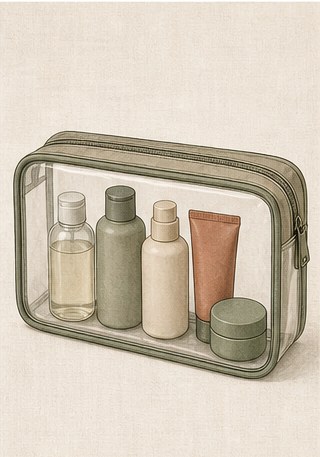
Liquids are the one rule you cannot pack your way around: containers of 100ml or less, in one clear resealable bag, and the limit is the container size printed on it, not how much is left in it. A half-empty 200ml bottle is still confiscated.
All 9 on one board
The whole set in a single image — this is the one to save or pin. Each panel is broken out
underneath with what it is actually for.
Pack It In This OrderNine steps · save this one
01Start empty02Fold or roll03Roll tight04Cubes05Shoes low06Toiletries07Flat on top08Cables09Lift test
AI-generated illustration, and the lead image for this guide. All nine steps on one sheet — the panels below are cut from it. The title and labels are live text, not part of the image, so they translate with the page.
The nine, in order
Work through them in sequence the first time. After that only three of them need thinking about.
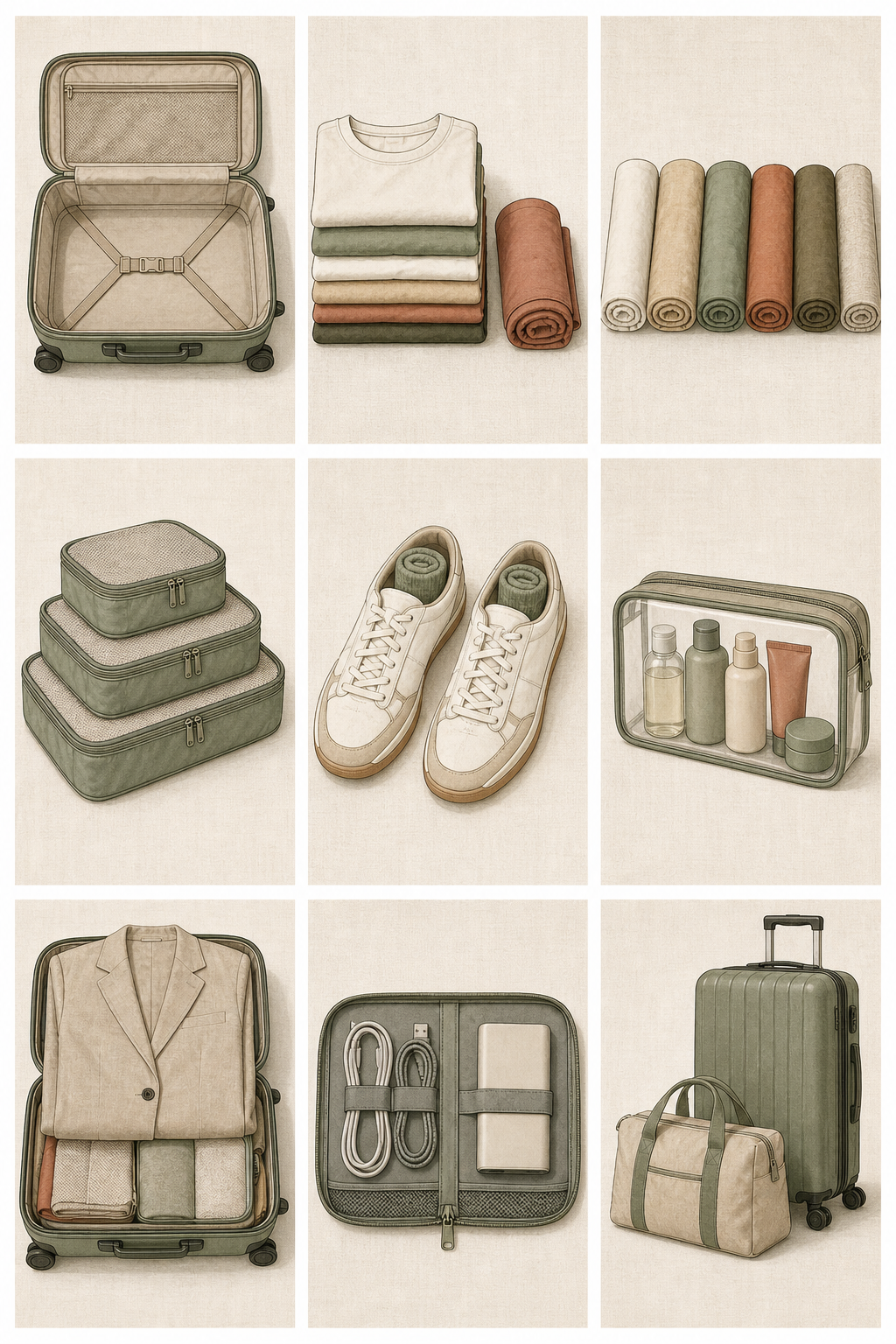
01Start empty and honest
Lay the case flat and open before anything goes near it. The mistake that costs the most space is packing into a bag that already has last trip’s odds and ends in the lid pocket.
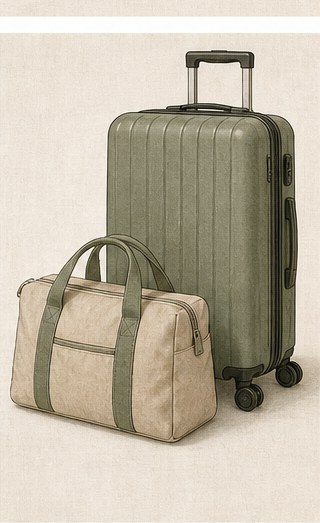
Weigh the empty case once. Some hard shells eat 4kg of your allowance before you pack anything.
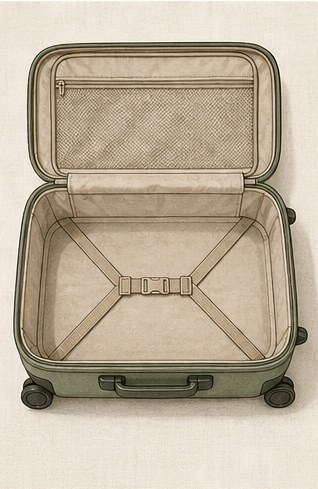
02Fold or roll, decided per garment
Roll jersey, knits and anything soft — they crease from pressure, and a roll has no fold line to crease along. Fold shirts, tailoring and anything with a shape worth keeping. Doing all of one is the error; the garment decides.
Rolling saves less space than people claim. Its real benefit is fewer creases.
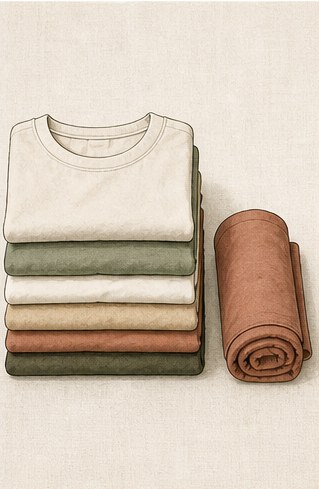
03Roll tight, then use them as filler
Rolled clothes are the only packing material that adapts. They go into the gaps around everything rigid — beside the shoes, along the edges, in the hollow of the handle bar — rather than in a neat layer of their own.
Air is the enemy. Every gap you leave is space you paid for and did not use.
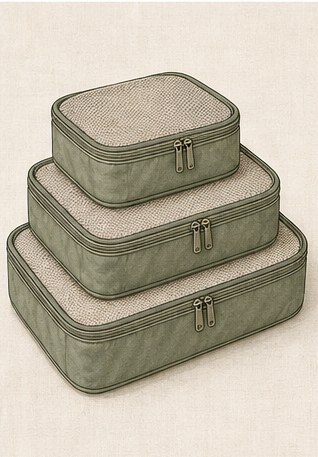
04Cubes: for finding, not for space
Packing cubes do not create room — they compress a little and cost a little in their own fabric. What they buy is not having to excavate the whole case to find one t-shirt on day three.
Worth it for trips with several stops. Overkill for one hotel and three nights.
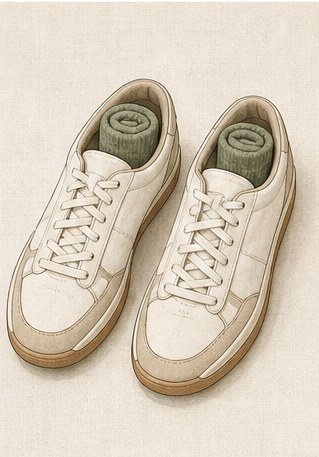
05Shoes at the wheel end, stuffed
Shoes are the heaviest thing and the least compressible, so they sit at the wheel end where the weight rides low when the case is upright. Their hollows are free space: socks, chargers, anything small that would otherwise need a gap of its own.
Two pairs is the honest maximum for a carry-on, including the pair you travel in.
06Toiletries, packed first and packed last
Assemble the liquids bag before anything else, because it is the one that decides whether you get through security without unpacking — then put it in last, at the top, where you can lift it straight out.
Solid versions of what you can bear to switch — bar shampoo, stick sunscreen — skip the rule entirely.
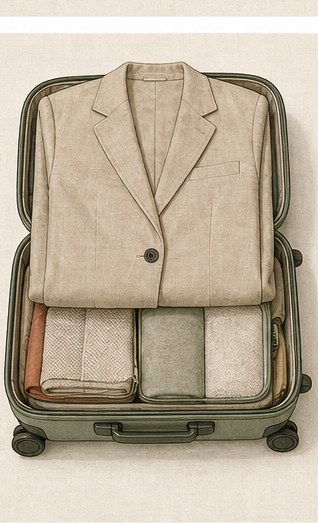
07Structured things flat on top
A blazer or a shirt you need uncreased goes on the very top, laid flat across everything else, never rolled or wedged down a side. If it has to fold, fold it once along the shoulder seam and let the lapels sit face up.
Hotel bathroom, hot shower, ten minutes on a hanger fixes most of what the flight does.
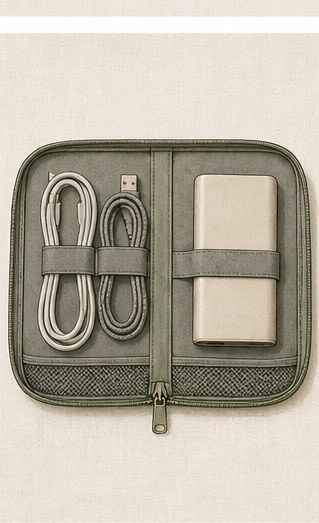
08One pouch for everything with a cable
Cables migrate and tangle with whatever they touch. One flat pouch, packed along a side wall rather than in the middle, and you stop finding a charger in a shoe.
Power banks must travel in the cabin, never in checked baggage — that is an airline rule, not a preference.
09Close it, lift it, then decide
Zip it and pick it up. If it is unpleasant to lift now, it will be worse down an aisle and into an overhead locker. This is the moment to take one thing out, and there is always one thing.
Check your airline’s cabin dimensions AND weight limit — they differ far more than the bags sold as "cabin size" suggest.
AI-generated illustration. Not a photograph. Every panel above is cut from a single generated sheet, which is how the
style stays consistent across all 9.
If you remember three things
Heavy at the wheel end, soft rolls as filler, structured flat on top.
Liquids bag built first, packed last, lifted straight out.
Lift the closed case. Take one thing out.
The rest is preference, and preference is not what makes it fit.
The part that is not technique
Almost every carry-on problem is a quantity problem wearing a technique costume. No folding method makes ten days of outfits fit into a cabin bag; what makes it fit is deciding that some things get worn twice.
The useful test is to lay out everything you plan to take, then remove the items you packed "in case". Those are the ones that come home unworn, and they are the reason the case would not shut.
Notes
No products are named or linked on this page and there are no affiliate links on it. Nothing here is monetised.
The nine panels are cut from one generated illustration sheet, which is why the palette is identical across them. Nothing depicted is a real product — every case, cube and bottle is deliberately unbranded.
The liquids rule and the power-bank rule are airline and security regulations, not our advice. Cabin size and weight limits vary by airline and change, so check yours rather than trusting a number here.
No affiliate links on this page. Nothing here is monetised.
No prices anywhere on this site — they move faster than an article can stay honest about them.