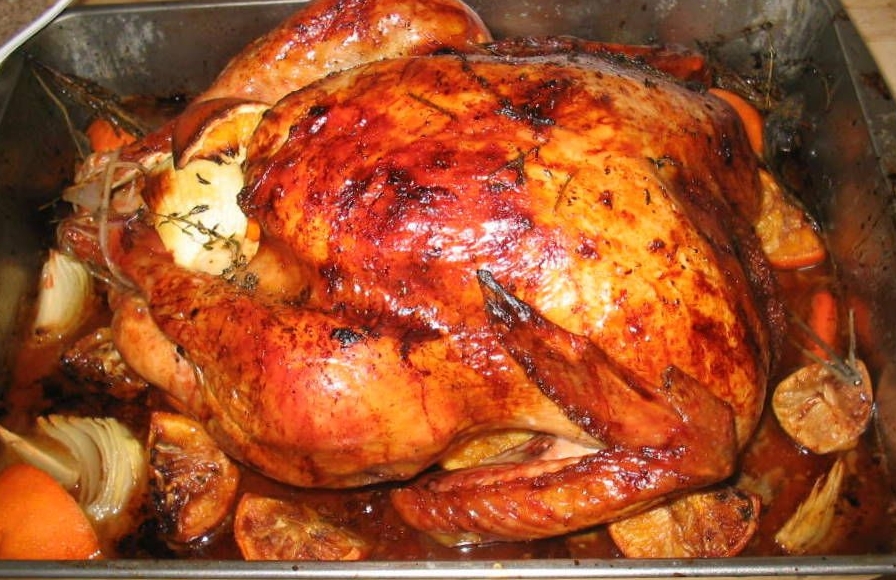
Quick take
- Dry brine and wet brine both work through salt, but by different mechanisms — dry brine denatures proteins and reabsorbs its own moisture, wet brine moves water in by osmosis. Food scientists generally favor dry for crisper skin and no diluted flavor.
- Spatchcocking (removing the backbone and flattening the bird) puts the dark meat and white meat at roughly the same distance from the heat, so they finish closer to the same time — and it roughly cuts total roast time versus a whole bird.
- USDA's real safe minimum is 165°F, checked with a food thermometer in the innermost thigh, innermost wing, and thickest part of the breast — not judged by juice color or cook time alone.
- Carryover cooking is real: a resting turkey can climb another 10–15°F after it leaves the oven, which is why pull timing and a real 30-minute rest both matter.
Most Thanksgiving turkey advice is folklore dressed up as technique — "cook until the juices run clear," "baste every 20 minutes," "let it rest a little." None of that is wrong exactly, but none of it explains what's actually happening to the meat. The four things that actually determine whether your turkey turns out juicy, evenly cooked, and safe to eat are: how you salt it beforehand, whether you flatten it before it goes in the oven, the number you pull it at, and what you do with it in the 30 minutes after. Here's the real mechanism behind each one.
Wet Brine vs. Dry Brine: What the Salt Is Actually Doing
Both methods use salt to change how meat holds onto moisture, but they get there differently. A wet brine submerges the turkey in a saltwater solution — a common ratio is about 1 cup of kosher salt per gallon of water, with the bird brined 12 to 24 hours (roughly 1 to 1.5 hours per pound), fully submerged and kept below 40°F. Osmosis moves water across the cell membranes of the meat, and over time salt diffuses in as well, denaturing some of the muscle proteins so they can trap more water than they started with. The turkey comes out of the brine measurably heavier than it went in.
A dry brine skips the water. Salt — roughly a tablespoon of kosher salt per 5 pounds of turkey, or about a third of a cup for a 14–16 pound bird — goes directly on the skin and under it, 1 to 3 days ahead, uncovered in the fridge. At first the salt pulls moisture out to the surface. Left alone, that now-salty liquid reabsorbs back into the meat over the following hours, carrying the salt with it and denaturing proteins the same way a wet brine does — the turkey effectively bastes itself in its own concentrated juices. The uncovered fridge time also dries the skin surface, which is a real advantage for crisping later in the oven.
Food-science-focused sources, including Serious Eats' J. Kenji López-Alt, generally come down on the side of dry brining, for two concrete reasons: it doesn't take up refrigerator space the way a bucket or bag of brine and turkey does, and it doesn't dilute the meat's own flavor with water. Aromatics added to a wet brine — herbs, citrus, garlic — mostly don't make it into the meat either way; flavor molecules are too large to cross the same cell membranes that water and salt ions pass through, so a fragrant brine smells great in the bucket but contributes very little actual flavor to what you eat.
Spatchcocking: Why Flattening the Bird Cooks It More Evenly
A whole turkey is a bad shape to cook evenly. The breast — lean white meat that's done and starting to dry out around 150–160°F — sits up top, closest to the oven's heat. The legs and thighs — dark meat that needs to climb past 170°F to render its connective tissue properly — are lower, partly shielded by the cavity and the bulk of the bird, and take longer to get there. By the time the thigh catches up, the breast has usually overshot into dry territory.
Spatchcocking solves the geometry problem directly. Using kitchen shears, you cut along both sides of the backbone and remove it, then flip the bird breast-side up and press down firmly on the breastbone until it cracks and the turkey lies flat. With the backbone gone, the legs and thighs end up spread out in roughly the same plane as the breast instead of tucked underneath it, so all of it is exposed to the oven's heat at close to the same rate.
The practical payoff is speed as well as evenness. A whole 12–14 pound turkey roasted at 325°F takes roughly 3 to 3¾ hours. Spatchcocked and roasted at a hotter 425°F, the same size bird — working out to roughly 4 to 6 minutes per pound — is typically done in 60 to 90 minutes, which several sources describe as cutting total roasting time close to in half.
The Real Doneness Number: USDA's 165°F, Checked in Three Places
Per USDA's Food Safety and Inspection Service, turkey reaches a safe minimum internal temperature at 165°F, measured with a food thermometer — not estimated by time, and not judged by the color of the juices. FSIS specifies checking it in three places: the innermost part of the thigh, the innermost part of the wing, and the thickest part of the breast. All three need to reach 165°F, because they're the parts of the bird most likely to still be underdone even after the rest of it looks finished. Insert the thermometer probe away from bone, since bone conducts heat differently than muscle and will throw off the reading.
There's a real nuance worth knowing here, and it isn't a shortcut around the 165°F rule — it's carryover cooking, covered next. Because a resting turkey keeps climbing in temperature after it leaves the oven, some food-science sources (ThermoWorks among them) pull the breast a few degrees under 165°F, planning for the rest to finish the job, rather than cooking straight to 165°F in the oven and then overshooting well past it during the rest. Either approach is fine — what actually matters is confirming 165°F has been reached everywhere it needs to be, with a thermometer, before you carve and serve.
Carryover Cooking: What Happens in the 30 Minutes After the Oven
Carryover cooking is the continued rise in a food's internal temperature after it's removed from a heat source, driven by residual heat still moving from the hotter exterior toward the cooler center. It's most pronounced in large, dense cuts — and a whole turkey qualifies. A resting turkey can climb another 10 to 15°F after it comes out of the oven, which is a big enough swing that ignoring it either undercooks the bird at pull time or overcooks it by carving time.
Resting also does more than let the temperature settle. During roasting, heat pushes moisture toward the center of the meat and tightens the muscle fibers; a rest of at least 30 minutes gives that moisture time to redistribute and reabsorb into the fibers instead of pooling out onto the cutting board the moment you make the first cut. Skip the rest, and you lose juice you spent hours protecting.
Four Checkpoints, In Order
Put together, these aren't four competing methods to pick between — they're four sequential decisions, and dry brine plus spatchcocking is a common, compatible combination (salt the flattened bird 1–3 days ahead, then roast it hot and flat).
Dry Brine (or Wet)
Salt 1–3 days ahead (dry) or submerge 12–24 hrs (wet). Either way, salt is doing real protein-level work, not just seasoning the surface.
Spatchcock
Remove the backbone, flatten the bird. Puts dark and white meat at nearly equal distance from the heat.
Temp Check
165°F at the thigh, wing, and breast. Use a thermometer, not a clock or the color of the juices.
Rest
Minimum 30 minutes, tented loosely. Carryover cooking finishes the temperature climb; resting finishes the moisture.
Turkey Roasting Time, by Weight
These are the standard estimates for a whole, unstuffed turkey roasted at 325°F — always use a thermometer to confirm, since oven variance and starting temperature shift these ranges.
| Turkey weight | Whole bird, 325°F |
|---|---|
| 8–12 lb | 2¾ – 3 hrs |
| 12–14 lb | 3 – 3¾ hrs |
| 14–18 lb | 3¾ – 4¼ hrs |
| 18–20 lb | 4¼ – 4½ hrs |
| 20–24 lb | 4½ – 5 hrs |
| 12–14 lb, spatchcocked, 425°F | 60 – 90 min |
Common questions
Do I actually need to brine at all?
No — it's optional, not a food-safety requirement. Brining (wet or dry) is purely about moisture retention and, for dry brine, skin texture. A turkey seasoned normally and cooked to 165°F is just as safe.
Can I dry brine and spatchcock the same turkey?
Yes, and it's a common combination — salt the flattened bird 1 to 3 days ahead, then roast it hot. The two techniques address different problems (moisture retention vs. even cooking) and don't conflict.
Is it safe to wet brine at room temperature?
No. The turkey needs to stay below 40°F for the entire brining period, which means brining in the refrigerator or a cooler packed with ice — never on the counter.
Why does my turkey read "done" but still taste dry?
Usually because the breast overcooked while the oven waited for the thigh to catch up — the classic whole-bird geometry problem spatchcocking addresses — or because it wasn't rested before carving.
What if I don't own a food thermometer?
Get one before Thanksgiving. USDA's own guidance is explicit that a food thermometer is the only reliable way to confirm 165°F has been reached; there's no accurate substitute.
None of this is complicated once you know why each step exists. Brining — wet or dry — changes what the meat's proteins can hold onto. Spatchcocking changes the bird's geometry so heat reaches dark and white meat at closer to the same rate. 165°F, checked with a thermometer at the thigh, wing, and breast, is the actual finish line, not a guess. And the 30 minutes after the oven aren't dead time — carryover cooking and moisture reabsorption are still happening. Do those four things in order and the rest of the recipe is just seasoning.
Disclosure. DopamineKart has no business relationship with any brand, thermometer maker, or cookware company named or implied in this piece. Nothing here is sponsored, no prices or deals appear, and no affiliate links are included. Technique claims are drawn from USDA FSIS food safety guidance, Serious Eats, America's Test Kitchen / The Kitchn, and ThermoWorks, cited in the sources file accompanying this draft. Photography is Wikimedia Commons, credited above.
Corrections: email us