
Quick take
- Christmas sweaters weren't originally a joke. Mass-produced "Jingle Bell Sweaters" showed up in the 1950s as sincere, if modest, holiday knitwear.
- The "ugly" framing is a 1980s development, cemented in pop culture by things like Clark Griswold's sweater in National Lampoon's Christmas Vacation.
- The modern ironic party tradition is widely credited to a 2002 Vancouver gathering thrown by Chris Boyd and Jordan Birch, who are reported to have later trademarked "Ugly Christmas Sweater Party" in Canada.
- National Ugly Sweater Day, the third Friday of every December, turned the joke into an annual fixture promoted by retailers and fan sites.
- Tipsy Elves, founded in San Diego in 2011 by two former UC San Diego fraternity brothers, built an entire company around sweaters designed on purpose to be as loud as possible — and later appeared on Shark Tank.
Somewhere between your grandmother's closet and the office holiday party, the ugly Christmas sweater flipped meaning entirely. What used to be an accident — a genuinely uncool gift, worn out of obligation — is now a costume people go looking for on purpose. That flip didn't happen randomly. It has a rough timeline, some specific names attached to it, and, eventually, an actual company built to manufacture the joke on an industrial scale. Here's what's real.
Before it was a joke: the 1950s "Jingle Bell Sweater"
Christmas-themed knitwear isn't a recent invention. Sweaters printed or knitted with holiday motifs — snowmen, sleighs, jingle bells — were mass-produced starting in the 1950s, marketed under names like "Jingle Bell Sweaters." They weren't designed to be funny. They were fairly restrained, fitting the more buttoned-up postwar fashion sensibility of the era, and they were simply one more seasonal garment alongside regular holiday clothing.
The shift toward "loud" happened gradually as decorating technique caught up with the holiday theme: bigger patterns, brighter colors, and eventually the glitter, sequins, and pom-poms that later became shorthand for the genre. None of that was originally ironic — it was just where the aesthetic of festive knitwear ended up by the time it collided with 1980s fashion.
How the 1980s turned it into a punchline
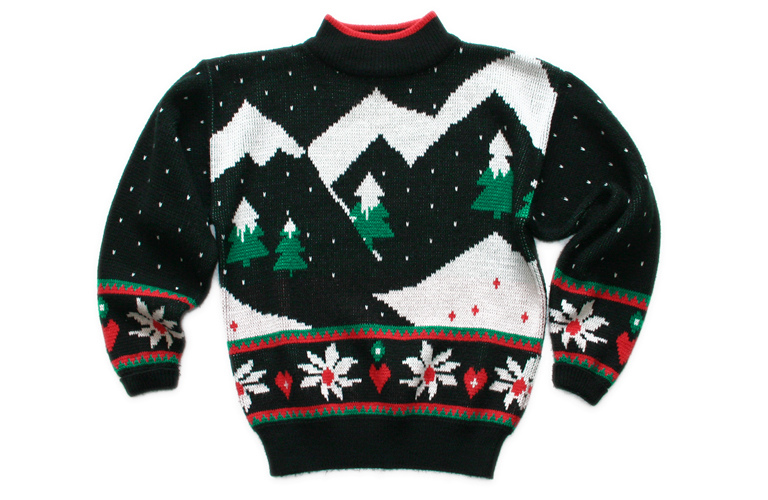
The decade that gave Christmas sweaters their "ugly" reputation is the 1980s. As shoulder pads and bigger silhouettes took over mainstream fashion generally, holiday sweaters got louder to match — more appliqué, more novelty detail, more of everything. Pop culture noticed. National Lampoon's Christmas Vacation, released in 1989, gave the trope its most durable image: Clark Griswold's family gathered in matching, over-the-top holiday knitwear, played for laughs rather than seasonal cheer. Colorful, pattern-heavy sweaters were also a visible part of American sitcom costuming through the decade, reinforcing the association between "bold holiday sweater" and "dated, slightly ridiculous."
By the 1990s and into the 2000s, that association had curdled into embarrassment. Christmas sweaters became a stock "gag gift" — the kind of thing you got from a relative and quietly avoided wearing in public. That's the exact cultural low point the modern "ugly sweater party" trend flipped on its head.
The Vancouver party that named the moment
The specific turn from "embarrassing gag gift" to "thing people deliberately seek out" is most often traced to Vancouver, British Columbia. In 2002, Chris Boyd and Jordan Birch organized what's widely reported as one of the first "Ugly Christmas Sweater Parties," at the Commodore Ballroom, as a charity fundraiser for a friend undergoing cancer treatment. What started as a single themed party grew into an annual event and, by multiple media accounts, into the namesake of the entire modern trend — Boyd and Birch are reported to have gone on to trademark the phrase "Ugly Christmas Sweater Party" in Canada in the years that followed, though that protection applies only within Canada, not internationally.
It's worth being precise about what's solidly documented here versus what's repeated as shorthand: the 2002 Vancouver party and Boyd and Birch's names as organizers show up consistently across news coverage and Wikipedia's own sourcing. The exact trademark filing date is less consistently reported, so it's fairest to describe it as a mid-2000s follow-up rather than pin it to a single day.
From inside joke to official holiday: National Ugly Sweater Day
Once the party format caught on, it needed a date. National Ugly Sweater Day landed on the third Friday of December, a slot that's stuck for over a decade and is now recognized by holiday calendars and retailers alike. The commercial pickup was fast: by 2011, Amazon reported roughly a 600% jump in searches and sales tied to "ugly Christmas sweater" listings, and major retailers moved from selling leftover novelty stock to designing sweaters specifically to be gaudy on purpose. Workplaces adopted it as a low-stakes theme day, schools ran their own versions, and the joke became something closer to a shared national costume party.
Turning the punchline into a product: Tipsy Elves
The clearest example of the trend becoming an actual industry is Tipsy Elves. The company was started in 2011 by Evan Mendelsohn and Nick Morton, former fraternity brothers who'd met as undergraduates at UC San Diego — Morton graduating from Muir College in 2005, Mendelsohn from Revelle College in 2006. Both had been invited to ugly sweater parties themselves and had trouble finding sweaters loud enough for the occasion, which they treated as a gap in the market rather than a minor inconvenience. Mendelsohn, who was practicing law at the time and had a habit of building small side-project websites, had also noticed search interest in "ugly Christmas sweaters" climbing. He called Morton, then working as an endodontist, and the two taught themselves basic design software to put together their first batch of intentionally over-the-top sweaters.
Their first run — about 5,000 sweaters across a dozen designs — reportedly sold out within a week and a half. The company grew fast enough that both founders eventually left their original careers to run it full time. In December 2013, Tipsy Elves appeared on Shark Tank and took a funding offer from Robert Herjavec in exchange for equity; Herjavec has since described it as one of the better-performing investments to come out of the show. What began as two friends solving their own party-outfit problem is now a recognized apparel brand built entirely around sweaters designed to be as loud, busy, and deliberately over-the-top as possible.
Where the "ugly sweater" idea shows up today
The trend didn't stay contained to one company or one party format. It split into a few recognizable lanes, each with a different real-world footprint.
Tipsy Elves
San Diego apparel company founded in 2011 specifically around intentionally loud holiday sweaters; the clearest example of the joke becoming a standalone business rather than a seasonal side product.
National Ugly Sweater Day
Third Friday of December, now recognized by holiday calendars and widely promoted by retailers and fan sites as an informal national costume day.
Christmas Jumper Day
Save the Children's annual UK fundraising day, built around wearing a holiday sweater and donating, under the line "make the world better with a sweater."
Office theme days
Low-stakes, low-cost team activity that spread across offices, schools, and community groups as the party format scaled down to a single-day dress code.
| Milestone | Period |
|---|---|
| "Jingle Bell Sweaters" mass-produced | 1950s |
| Sweaters become a pop-culture punchline (Christmas Vacation era) | 1980s |
| Boyd & Birch's Vancouver party at the Commodore Ballroom | 2002 |
| Tipsy Elves founded in San Diego | 2011 |
| Amazon reports major spike in ugly-sweater searches and sales | 2011 |
| Tipsy Elves appears on Shark Tank | 2013 |
Common questions
Did ugly Christmas sweaters start as a joke?
No. Mass-produced holiday sweaters date to the 1950s and were sincere, fairly modest garments. The "ugly" reputation is a 1980s development, and the deliberately ironic party tradition is a 2000s one.
Who actually started the ugly sweater party trend?
Chris Boyd and Jordan Birch are the names most consistently credited, tied to a 2002 party in Vancouver, British Columbia. They're reported to have later trademarked "Ugly Christmas Sweater Party" in Canada, though that protection doesn't extend outside the country.
When is National Ugly Sweater Day?
The third Friday of December, every year.
Is Tipsy Elves a real company, or just a Shark Tank gimmick?
It's a real, ongoing apparel company. It was founded in 2011, appeared on Shark Tank in December 2013 and took a funding deal with Robert Herjavec, and has continued operating and expanding its holiday-sweater lineup since.
Is there a UK equivalent?
Yes — Save the Children runs an annual Christmas Jumper Day fundraiser in the UK built around the same basic idea of wearing a festive sweater.
The ugly Christmas sweater didn't start as a costume — it started as ordinary 1950s holiday knitwear that gradually got louder, became a punchline in the 1980s, and then got deliberately reclaimed starting with a 2002 Vancouver party. That reclamation is specific enough to have real names and a real date attached to it, even if some of the finer details — like an exact trademark filing date — are reported more consistently in some places than others. What's not in dispute is that the joke eventually became a real industry: National Ugly Sweater Day is now a fixture on the calendar, and companies like Tipsy Elves have built lasting businesses around sweaters made to be as loud as possible, on purpose, every single year.
Disclosure. This is an independent history piece. DopamineKart has no business relationship with Tipsy Elves, Save the Children, or any other brand or organization mentioned above. Nothing in this piece is sponsored, and no affiliate links appear anywhere in it. Photography is real and sourced from Wikimedia Commons, credited per image above.
Corrections: email us