Where to Put a Fish Tank at Home
Choosing the spot is the decision you cannot easily undo. A filled tank is far too heavy to move on a whim, so it is worth spending ten minutes on this before you spend anything on gravel.
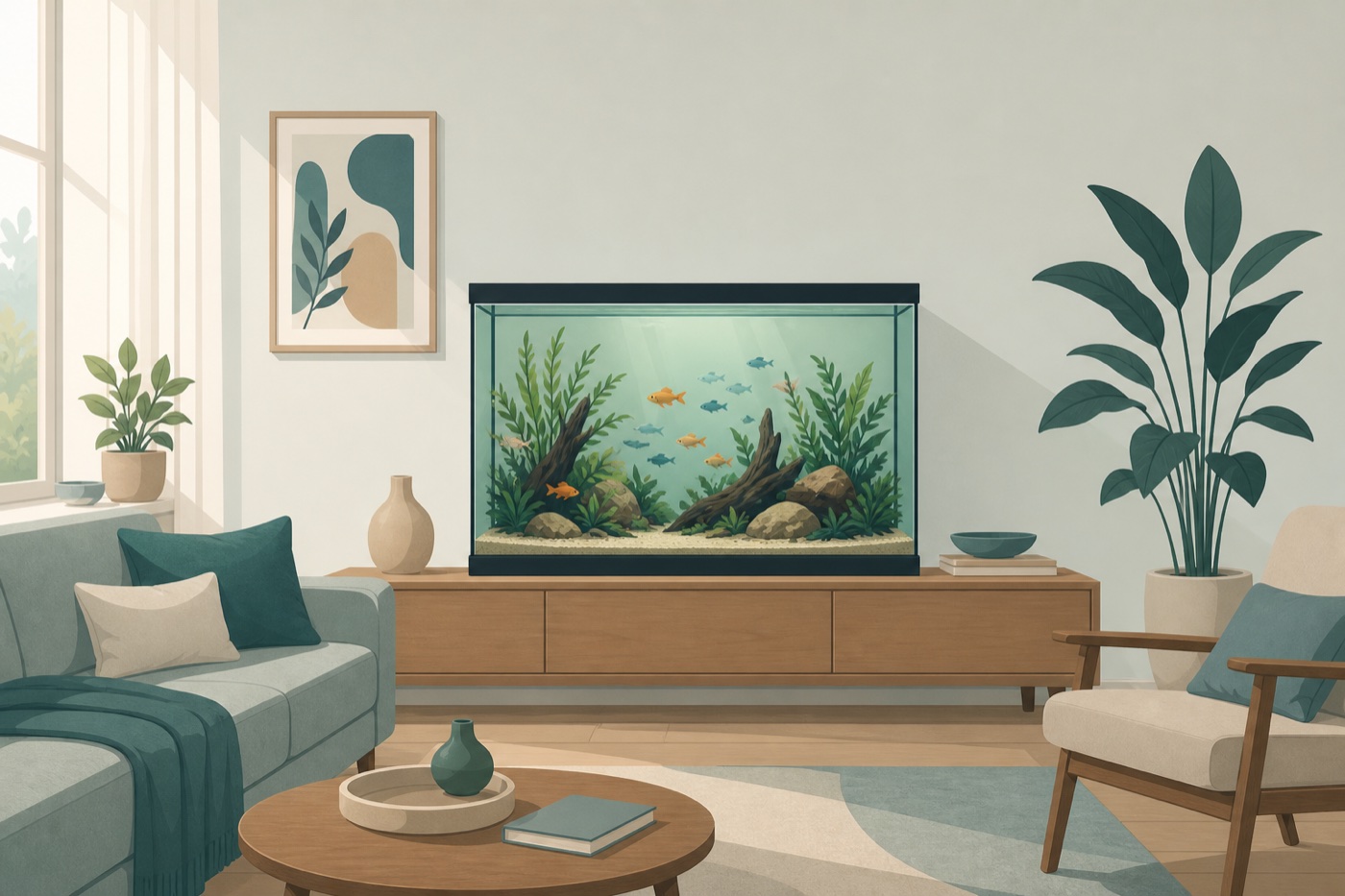
Quick answer. An interior wall, out of direct sun, away from radiators, vents and exterior doors, near an outlet, with room to stand beside it carrying a bucket. Avoid the middle of a room on an upper floor, and avoid anywhere a door can slam into it.
1 · Light is the one that bites first
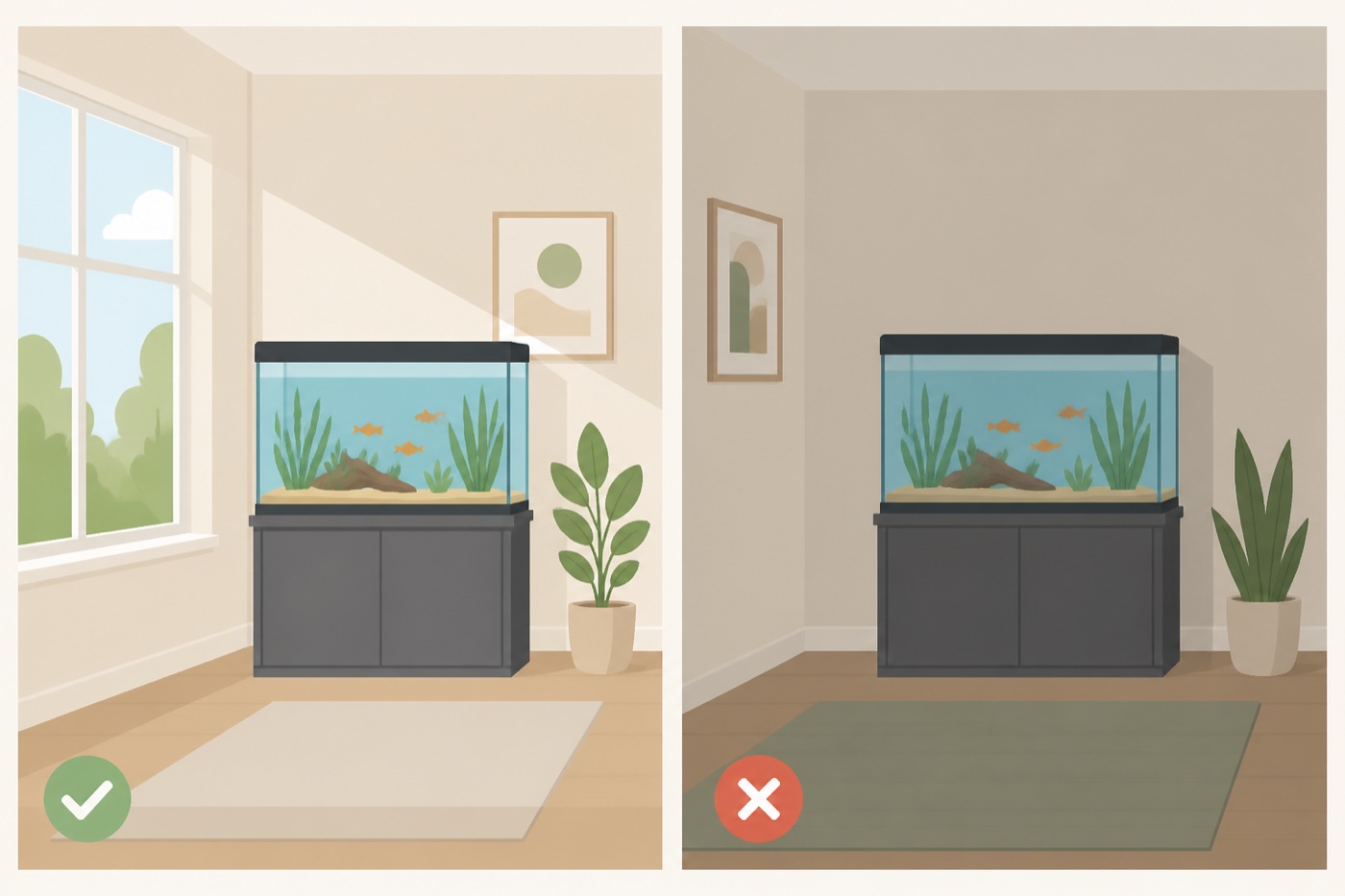
Direct sunlight on the glass grows algae, and it grows it faster than most people expect — a spot that looks bright and cheerful in the morning is a green tank by the third week. The fix is not curtains. It is choosing a wall the sun never reaches directly.
Ambient daylight is fine. Sun landing on the glass is not. If the only spot available catches an hour of direct sun, that hour is enough to matter, and you will spend the life of the tank managing it rather than enjoying it.
2 · Weight, stated as arithmetic
Water weighs about 8.34 lb per US gallon. That single number does most of the work here, because the tank you are imagining is heavier than the tank you are picturing.
| Tank | Water alone | Roughly, filled and furnished |
|---|---|---|
| 10 gal | ~83 lb | ~110 lb |
| 20 gal | ~167 lb | ~225 lb |
| 40 gal | ~334 lb | ~450 lb |
| 55 gal | ~459 lb | ~600 lb |
| 75 gal | ~626 lb | ~850 lb |
The right-hand column adds glass, stand, substrate and rock, and it is deliberately approximate — a rimmed glass tank and a low-iron one differ, and two inches of sand is not two inches of gravel. Treat it as the order of magnitude, which is the part that matters when you are deciding where to stand it.
What this article cannot tell you. Whether your floor takes it. We cannot see your joists, their span, their direction, the age of the building or what is beneath the room. Residential floors are designed to a live-load minimum spread across a whole room, and a 600 lb tank on a four-foot footprint is not spread. On a ground floor over concrete this is rarely a conversation; on an upper floor, in an older building, or anywhere you feel the floor move when someone walks past, it is a question for somebody who can actually inspect it.
What helps regardless
- Put the long side of the tank across the joists rather than along a single one, so the load is shared. Joists usually run perpendicular to the floorboards.
- Prefer a spot against a wall — floors are stiffest at their edges and most flexible in the middle of a span.
- Use a stand built for the tank's footprint. A tank supported only at its corners, or overhanging its stand, concentrates load exactly where you do not want it.
- Check it is level before it is full. A tank that is out by a few millimetres puts uneven stress on the seams, and you cannot fix it afterwards without emptying the thing.
3 · Traffic, doors and vibration
Fish habituate to a room's ordinary rhythm, but not to shocks. A hallway where a door swings open into the tank, the back of a sofa that gets knocked, a spot beside a speaker or a washing machine — these are constant low-level stress, and stressed fish get ill.
The practical test: stand in the spot and think about a normal Saturday. If something in that picture bangs, slams or thumps near the glass, choose elsewhere.
4 · Temperature swings, not temperature
Tropical tanks are heated, so the room's average temperature matters much less than how fast it changes. The heater can hold a target; it cannot fight a draught.
Avoid directly above or beside a radiator, under a ceiling vent, beside an exterior door that opens in winter, and hard against a poorly insulated exterior wall. A stable, boring interior wall beats a warm but variable one.
5 · Access — the one people forget
A tank needs a water change every week or two, forever. That means carrying water to it and siphoning water away from it, repeatedly, for years.
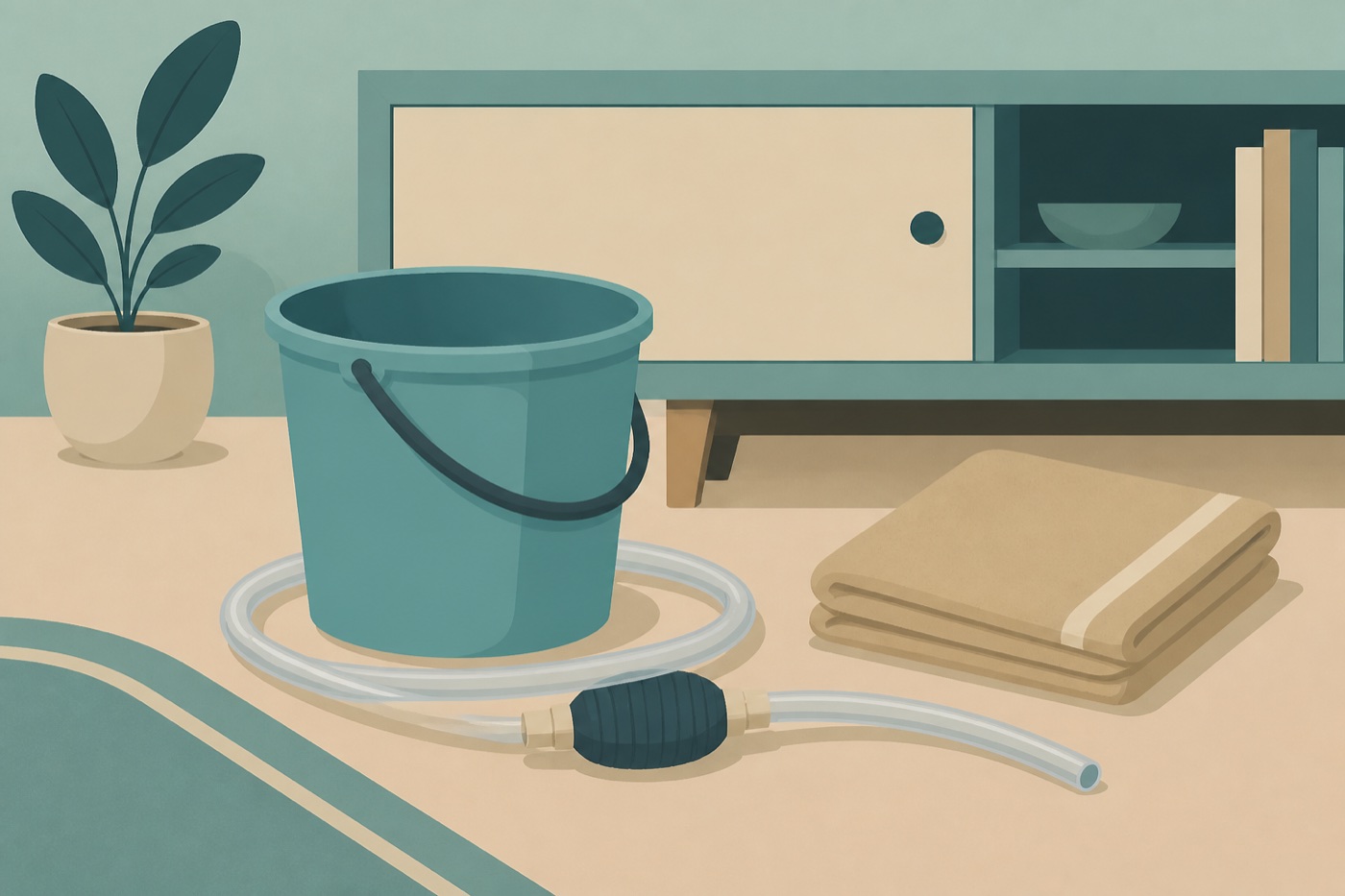
- Room to stand at the front with a bucket, and to get the lid off without moving furniture.
- A reachable outlet — filter, heater and light all need power, and an extension trailing across a walkway is its own problem.
- A tolerable route to a sink or a drain. The further the carry, the sooner water changes start getting skipped, and skipped water changes are what actually kills tanks.
- Somewhere splashes do not matter. Water gets on the floor. Not much, but every time.
A shortlist that usually works
| Good | Think twice |
|---|---|
| Interior wall, living room | Conservatory or sunroom |
| Against a wall on a ground floor | Middle of an upper-floor room |
| Near an outlet, clear floor in front | Behind a door that opens toward it |
| Away from vents and radiators | Above a radiator, under an AC vent |
| A short carry to a sink | Upstairs, far end of the house |
On the numbers
- Water density: approximately 8.34 lb per US gallon at room temperature — the figure every weight above is derived from.
- Filled weights include an allowance for glass, stand, substrate and hardscape and are rounded; manufacturers publish exact dry weights per model.
- Residential floor live-load minimums are set by building code and describe a room, not a point load. They are not a clearance for a specific spot, which is why this article does not give one.
Illustrations on this page are AI-generated and labelled. No product is pictured, and nothing here is a photograph. This guide has no affiliate links.
No affiliate links on this page. Nothing here is monetised.
No prices anywhere on this site — they move faster than an article can stay honest about them.
How we review · Corrections: email us · All Legit reviews