- KeysNever hit a $2.3B valuation without ever closing a single real estate transaction — by design.
- 68% of Gen Alpha respondents say they've already 'decided against' homeownership before turning 15.
- Researchers call it 'acquisitional abstinence': the pleasure loop now ends before the purchase, not after.
- The no-checkout economy monetizes longing itself, treating the shopping cart as the destination.
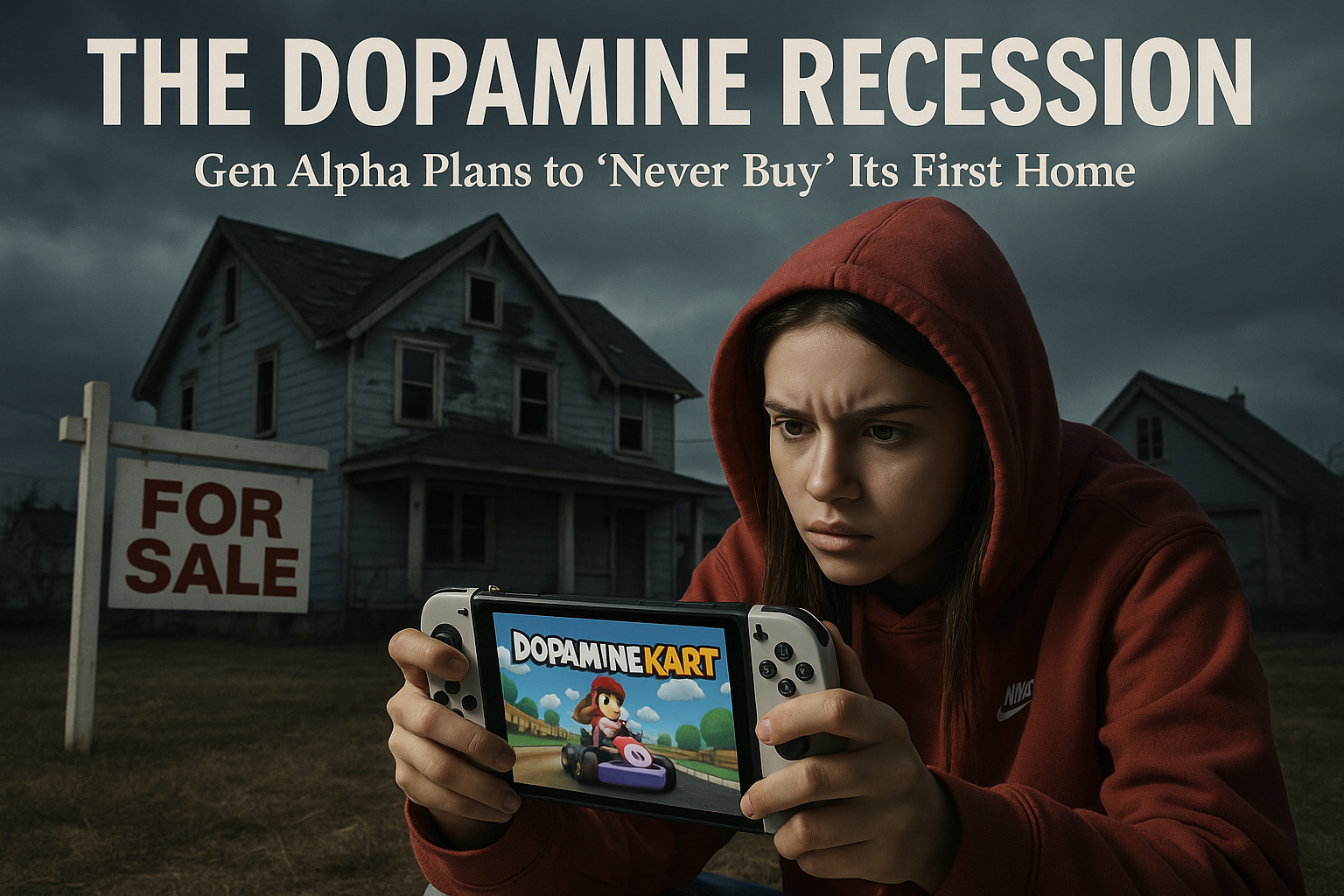
Mira Vaughn, 13, has toured 1,847 homes she will never live in. On a recent Tuesday she walked the infinity-pool deck of a $9.4M Lake Como villa on KeysNever, saved it to a folder labeled 'someday (never),' and closed the app satisfied. 'The tour is the good part,' she explained. 'Owning it would just be maintenance and property tax.' Mira is not an outlier. She is the leading edge of what economists are now calling the Dopamine Recession — an economy where an entire generation has priced in the pleasure and priced out the purchase.

WHY NOWThe Generation That Opted Out Before Opting In
According to a June 2026 study from the Halberd Institute for Post-Acquisition Behavior, 68% of surveyed Gen Alpha teens report they have already 'firmly decided against' ever buying a home — a decision most made between the ages of 11 and 13, years before they could hold a mortgage or, in most cases, a driver's license. The report, titled 'Ownership Is a Loading Screen,' frames the choice not as resignation but as consumer sophistication.
'These kids grew up watching their parents chase a closing date and then feel nothing,' said Dr. Priya Anand, the institute's lead behavioral economist. 'They've concluded, correctly, that the dopamine spike happens during the tour, not at the signing. So they simply stay in the tour forever.' Anand's team tracked pupil dilation across 4,000 minors and found peak arousal occurred at the moment of imagining the walk-in closet — and cratered the instant a price appeared.
KeysNever, the dream real-estate platform where users tour listings they can never purchase, has become the cathedral of this movement. Its most-toured property — a Kyoto tea house with no listed price and a note reading 'inquiries not accepted' — has been walked through 2.3 million times. Not one person has attempted to buy it. The company considers this its flagship success metric.
THE NUMBERSHow You Build a $2.3 Billion Company By Selling Nothing
KeysNever's Series C, announced last month, valued the company at $2.3 billion despite a lifetime transaction volume of exactly zero dollars in property sales. Investors, led by the Longing Capital fund, were reportedly reassured by this. 'A company that actually sold homes would eventually run out of longing to monetize,' explained Longing partner Desmond Ovlin. 'KeysNever has cracked recurring desire. The cart never checks out. The funnel never ends. It's beautiful.'
The model mirrors its sister platforms in the no-checkout ecosystem: WheelDream, where users spec out cars they'll never order; WanderNever, which lets you book fantasy itineraries that generate no boarding passes; and DopamineKart itself, the fantasy-luxury flagship whose slogan — 'Buy Nothing. Pay Nothing. Feel Everything.' — now functions as generational scripture. Across the network, average session length has climbed to 41 minutes, roughly triple that of platforms burdened by an actual checkout button.
Financial analysts at Meridian Sterling estimate the combined no-buy economy will reach $180 billion in 'engaged non-consumption' by 2028. 'We used to measure conversion,' said Meridian's Talia Rooke. 'Now we measure retention of unfulfilled want. It turns out that's a far more stable asset class. Desire doesn't depreciate. A sofa does.'
THE CULTUREAcquisitional Abstinence and the Death of the Housewarming
Sociologists have a term for the emerging worldview: acquisitional abstinence. The idea is that ownership has become the anticlimax — the moment the fantasy collapses into logistics, insurance, and a leaking dishwasher. 'The purchase is where the story ends,' said Dr. Marcus Feld of the Copenhagen Center for Restraint Studies. 'This generation has learned to leave before the ending ruins it.'
The cultural signaling has shifted accordingly. Where millennials once posted keys-in-hand closing photos, Gen Alpha posts screenshots of properties they've deliberately declined to pursue, captioned with the movement's unofficial motto: 'saw it, felt it, left it there.' A cottage industry of merch has followed; the top-selling item in the no-buy aesthetic remains DopaKart's DopamineKart OG Tee, worn ironically and, of course, most often only added to a cart and admired, never purchased.
Not everyone is convinced this is healthy. Critics warn that a generation training itself to want without acquiring may struggle when confronted with a real transaction — a phenomenon Feld calls 'checkout paralysis.' But the KeysNever generation is unbothered. As Mira Vaughn put it, sliding through a virtual Tuscan farmhouse she'll never inherit: 'Why would I close it? Closing it means it's over.'
A company that actually sold homes would eventually run out of longing to monetize.
The platform's total real estate transaction volume, held perfectly steady across a $2.3B valuation.
Questions people actually ask
Is the Dopamine Recession an actual economic downturn?
Not in the traditional sense — GDP is fine. It describes the collapse of purchase completion, where desire remains high but checkout rates fall toward zero across the no-buy economy.
How does KeysNever make money without selling homes?
It monetizes engaged longing — premium tour features, saved 'someday (never)' folders, and ambient fantasy subscriptions. The absence of a purchase is the product, not a bug.
Will Gen Alpha ever actually buy homes?
Researchers are split. Some predict a delayed surge; others warn of 'checkout paralysis,' in which a generation trained to admire without acquiring simply keeps browsing indefinitely.
The Dopamine Recession isn't a crisis so much as a correction — a generation quietly deciding that the wanting was always worth more than the having. And if they're right, the healthiest thing you can do today is exactly what Mira does: tour the villa, save the tee, admire the stiletto, and close the tab. On DopamineKart, the browsing is free, the cart never expires, and the dopamine costs nothing. That, apparently, was the whole point.
📰 This article is written as satirical journalism. Every statistic, think-tank citation, expert quote, and figure is invented. DopaNews does not conduct research. DopamineKart is a simulation. If you struggle with compulsive spending, visit nfcc.org.