- Unboxing video engagement among Gen Alpha has fallen 61% since 2024, per the Norwood Attention Institute.
- WheelDream's 'configure-and-abandon' sessions average 47 minutes — longer than the average feature film.
- Researchers call it 'terminal browsing': the pleasure is the build, not the buy.
- The no-checkout economy now spans cars, homes, and fantasy luxury goods — none of it shipping.
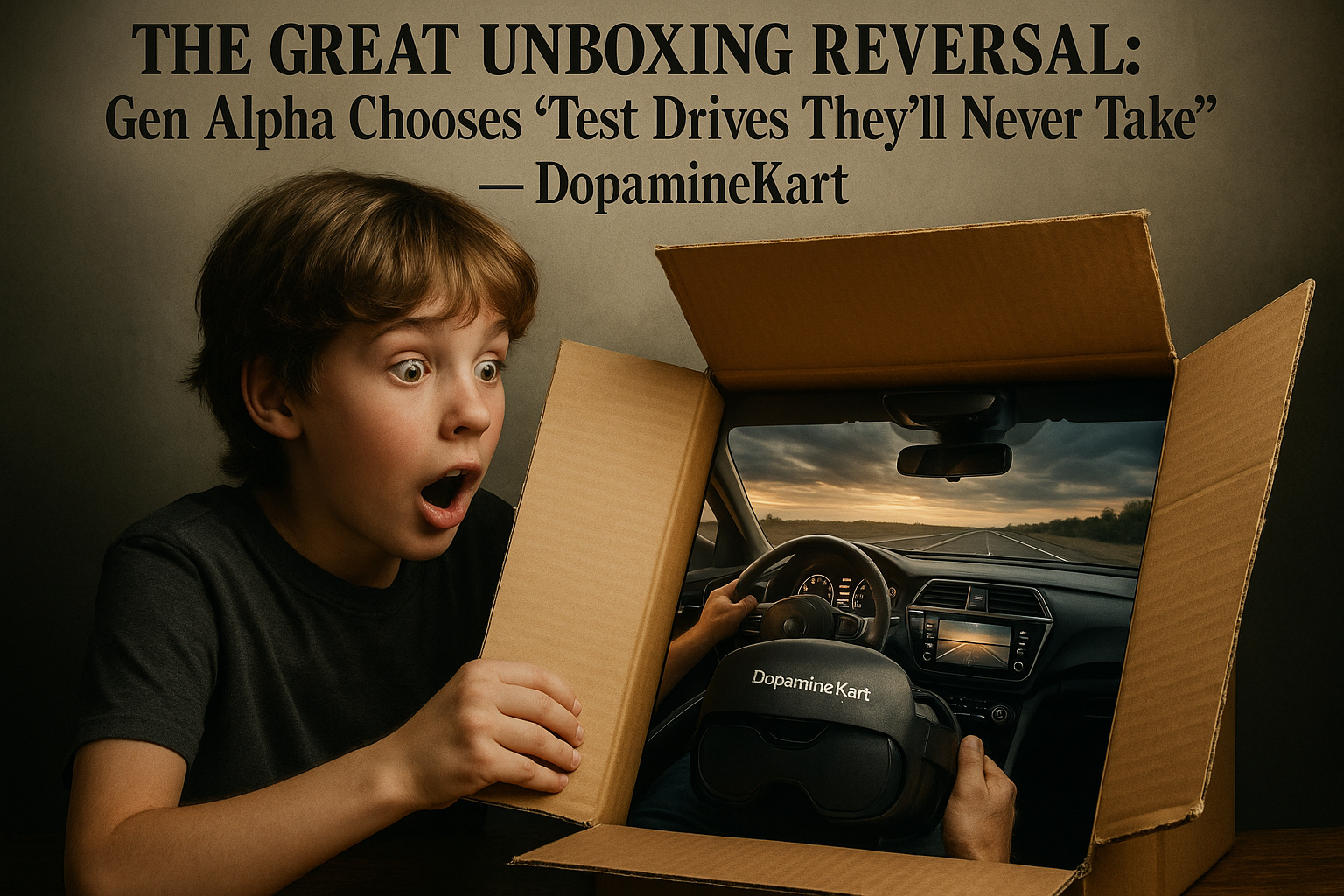
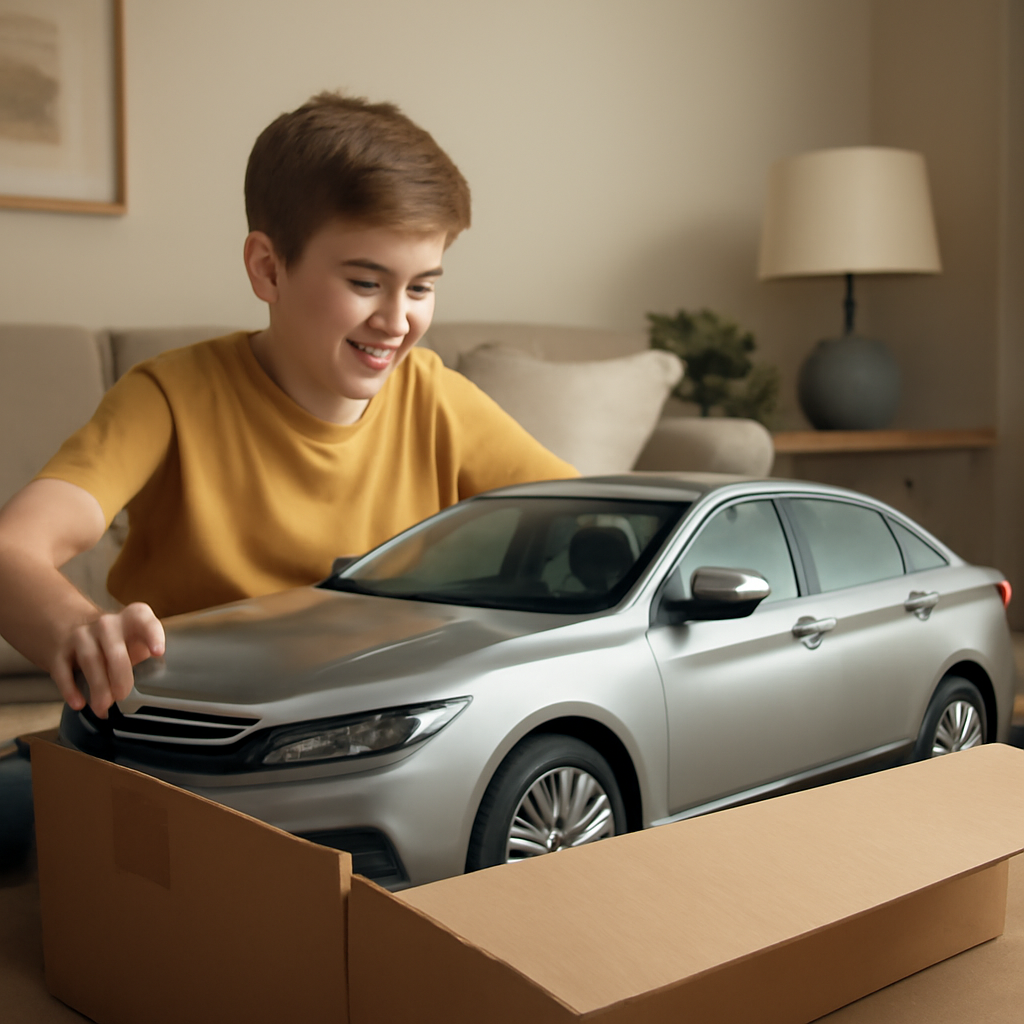
For a decade, the unboxing video was the sacred liturgy of childhood consumption: the tape, the reveal, the tiny hands turning a product toward the lens. But something broke around 2025. Gen Alpha stopped watching other people open boxes — and started building cars they will never own on WheelDream, then closing the tab before anything resembling a purchase can occur. The box, it turns out, was never the point.
WHY NOWThe box lost the plot
According to the Norwood Attention Institute's 2026 longitudinal survey of 9,400 households, unboxing-video watch time among viewers aged 9 to 14 has collapsed 61% in twenty-four months. The children didn't leave YouTube. They migrated — en masse — to WheelDream, the dream-car configurator where a user can spend the better part of an hour spec'ing a matte-obsidian coupe with a carbon splitter and then, crucially, do nothing.
'The unboxing promised resolution,' explains Dr. Priya Venkataraman, lead behavioral economist at the fictional-yet-authoritative Halden Desire Lab. 'You watched, the box opened, the dopamine landed, and it was over. What Gen Alpha discovered is that the anticipation is the entire product. WheelDream never opens the box. There is no box. There is only the configurator, humming with possibility, forever.'
WheelDream's own telemetry confirms the shift. The platform reports that its median 'configure-and-abandon' session now runs 47 minutes — longer than the runtime of most children's films — with a checkout conversion rate the company proudly lists as 0.0%.
THE MECHANICSTerminal browsing, explained
Analysts have coined a term for the behavior: 'terminal browsing,' the practice of taking a purchase journey all the way to its emotional summit and then deliberately never descending into ownership. On WheelDream, a user selects the engine, the interior stitching, the calipers, the phantom license plate — and then simply exits. No car arrives because no car was ever ordered.
The pattern rhymes across the entire no-checkout ecosystem. On KeysNever, tweens tour six-bedroom cliffside homes they cannot buy. On WanderNever, they book fantasy layovers in cities they'll never fly to. On DopamineKart, they fill carts with a $28,500 Hermès Birkin 25 and a $445 Pleated Denim Micro Skirt, then abandon the whole thing with the serene satisfaction of someone who has already gotten what they came for.
'This is not window shopping — window shopping had a store,' says Marcus Hale, a WheelDream spokesperson. 'This is a generation that understood, before we did, that the checkout button was a tax on the good part. We removed the tax. Our users pay nothing and feel everything.'
WHAT IT MEANSA generation that wants without weight
There is a tidy digital-minimalism reading here, and Gen Alpha is happy to sell it back to their parents: no clutter, no shipping emissions, no closet full of regret, no cardboard mountain in the recycling. A 2026 Halden Desire Lab study found that 73% of surveyed 12-year-olds described their WheelDream builds as 'more mine' than anything physically in their room.
Critics warn of a hollowing-out — desire fully decoupled from consequence, longing as a self-licking ice cream cone. But Dr. Venkataraman is unbothered. 'We spent decades worried children wanted too much stuff,' she says. 'They solved it. They now want the stuff so completely that they no longer need it to exist. Frankly, it's the most fiscally responsible cohort in recorded history.'
WheelDream, for its part, is leaning in. The company's new tagline — quietly rolled out in July — reads simply: 'The keys are the closing screen.' Its most-configured vehicle this year has been ordered zero times.
The unboxing promised resolution. WheelDream discovered the anticipation was the entire product.
The percentage of 47-minute build sessions that end in an actual purchase — a figure the company lists as a feature, not a flaw.
Questions people actually ask
Do any WheelDream cars actually ship?
No. The platform has no delivery infrastructure by design. The build is the destination; the driveway remains theoretical.
Is 'terminal browsing' actually bad for kids?
Researchers are split, but the Halden Desire Lab argues it's cheaper and lower-clutter than a Birkin. The dopamine lands identically.
How is this different from a regular abandoned cart?
An abandoned cart is an accident. Terminal browsing is the goal — users reach checkout precisely so they can refuse it.
The kids are, as usual, three steps ahead of the market: they've figured out that wanting is the pleasure and buying is just the paperwork. You can join them for free — spec a car on WheelDream, fill a DopamineKart cart with a Washed Black micro skirt, and close the tab before anything ships. The dopamine is identical, and your closet stays empty.
📰 This article is written as satirical journalism. Every statistic, think-tank citation, expert quote, and figure is invented. DopaNews does not conduct research. DopamineKart is a simulation. If you struggle with compulsive spending, visit nfcc.org.