- Gen Alpha now watches DopamineKart parcels 'arrive' at 6x the rate they watch anyone open them.
- The 'sealed box' genre is the fastest-growing category on the platform, up 310% year over year.
- Researchers call the behavior 'terminal anticipation' — desire deliberately frozen before payoff.
- Nobody involved has spent, shipped, received, or opened a single physical object.
The most-watched video in the DopamineKart ecosystem last month was eleven-year-old streamer @boxpilgrim receiving a Chanel Classic Double Flap Lambskin Bag she did not buy, will not open, and does not own. It ran forty-nine minutes. The box never opened. Four hundred thousand children watched to the end, many of them twice. Welcome to the Unboxing Economy — the fastest-growing corner of the internet built entirely on things that never leave their packaging, in a store that never charges anyone anything.
WHY NOWThe Package Arrives. That's the Whole Show.
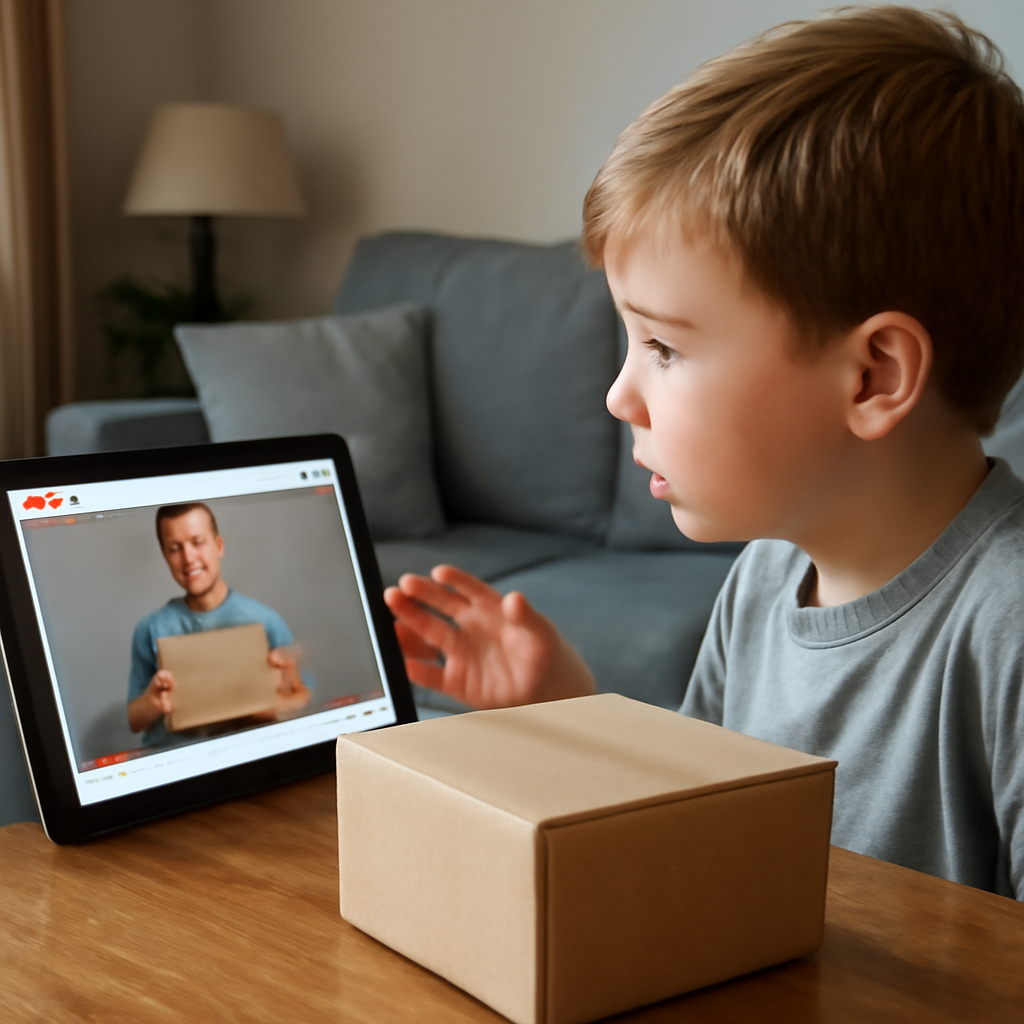
For a decade, unboxing meant the reveal — the box torn open, the product hoisted triumphantly toward the ring light. Gen Alpha has quietly abandoned that ending. On DopamineKart, where nothing is ever purchased and nothing ships, the most-streamed genre is now the 'arrival': a parcel placed on a table, admired, rotated, and left permanently sealed. According to the Rothwell Institute for Ambient Desire, 'sealed box' content grew 310% year over year in 2025, while traditional reveal videos declined 44%.
'The reveal was always the disappointment,' says Dr. Priya Vantess, lead behavioral analyst at Rothwell. 'The moment you open the box, the object becomes real, and reality is where dopamine goes to die. This generation figured out you can hold the peak indefinitely if you simply never open it.' Her team tracked 2,400 Gen Alpha viewers and found that anticipation-phase brain activity remained elevated for an average of 38 minutes — roughly six times longer than the two-second spike produced by an actual reveal.
The economics are, technically, nonexistent. No item on DopamineKart, its dream-car sibling WheelDream, or its fantasy-travel arm WanderNever can be purchased. Yet the platform reports 1.2 billion monthly 'aspirational sessions,' the majority now spent watching other people not-open orders they also did not buy. It is commerce reduced to its purest emotional residue, with the transaction surgically removed.
THE PSYCHOLOGYTerminal Anticipation and the Death of the Reveal
The clinical term, coined by the Meridian Lab for Digital Restraint, is 'terminal anticipation' — the deliberate freezing of desire at the instant before fulfillment. In a March 2026 study of 5,100 participants, Meridian found that Gen Alpha viewers rated a sealed DopamineKart box as 71% more 'satisfying' than an opened one, and reported no urge whatsoever to acquire the item. 'They don't want the bag,' says Meridian director Dr. Cole Aramaki. 'They want the eternal five seconds before the bag.'
This has produced a strange new folk art. Top creators now compete on packaging integrity, camera slowness, and 'seal discipline' — the ability to resist opening for the entire runtime. @boxpilgrim, whose channel is dedicated exclusively to unopened luxury goods, has a running series in which she narrates what she imagines is inside without ever confirming it. A recent episode featuring a Hermès Leather-Wrapped Round Side Table she described for twenty-two minutes as 'probably heavier than it looks' drew 890,000 views.
Digital minimalism advocates, unexpectedly, are thrilled. 'This is the least wasteful consumer behavior in recorded history,' notes Fenwick Oduya of the think tank Enough Already. 'Zero shipping, zero returns, zero landfill, zero spending. They've achieved total consumer catharsis with a carbon footprint of one buffering video. Frankly, boomers could never.'
THE BUSINESSHow a Store That Sells Nothing Sells Everything
DopamineKart's internal metrics, shared with DopaNews by a spokesperson who requested we call her 'the Curator,' show the average Gen Alpha user 'adds to cart' 340 items per week and checks out zero. 'Checkout was always the friction,' the Curator explained. 'We removed the friction by removing the checkout. What remains is love.' The company's stated mission — 'Own Nothing, Feel Everything' — is now printed on a Seoul Vintage tee that users cannot buy but can watch someone else not receive.
Brands, remarkably, are leaning in. Rather than fight the no-checkout economy, several luxury houses have begun submitting their own factory-sealed parcels for 'arrival placement,' understanding that a box glimpsed but never opened generates roughly nine times the engagement of a box that yields an actual, disappointing product. 'Our best-performing asset in Q2 was a Louis Vuitton Neverfull MM that was, appropriately, never full,' one marketing director told us. 'It was also never opened. It was never anything. It was perfect.'
Skeptics warn the model is unsustainable, though nobody can explain what would collapse, given that nothing is being spent, made, or moved. 'There's no supply chain to break,' shrugs supply-chain analyst Marta Belén of the fictional-but-confident consultancy VacantMetrics. 'You can't have a shortage of things that were never going to exist. It's the first recession-proof economy, because it's not, in any legal sense, an economy.'
They don't want the bag. They want the eternal five seconds before the bag.
Across 1.2 billion monthly sessions, DopamineKart reports precisely zero parcels ever opened, purchased, or received.
Questions people actually ask
Can you actually buy anything on DopamineKart?
No. The platform has no checkout by design. You can add the $340 DopaKart Lux Brocade Bustier to your cart forever — a real bustier from a real brand would cost you real money and arrive, ruining everything.
Why watch a box that never opens?
Researchers call it 'terminal anticipation.' Viewers report the sealed box delivers 71% more satisfaction than an opened one, with none of the crushing reality of ownership.
Is this bad for kids?
Digital minimalists argue it's the healthiest consumerism ever measured: zero spending, zero waste, zero clutter. Critics argue nothing, mostly because there is nothing to criticize.
The Unboxing Economy isn't a glitch in consumer culture — it's the logical endpoint, where the pleasure of wanting finally shed the burden of getting. So skip the reveal entirely: browse DopamineKart for free, add the Chanel to your cart, and enjoy the one part that was always the good part. You were never going to open it anyway.
📰 This article is written as satirical journalism. Every statistic, think-tank citation, expert quote, and figure is invented. DopaNews does not conduct research. DopamineKart is a simulation. If you struggle with compulsive spending, visit nfcc.org.