If the Ocean Pulls Back, Do Not Film It
A tsunami announces itself in three ways, and any one of them is enough to act on. The instinct to go closer and record it is the one that kills people.
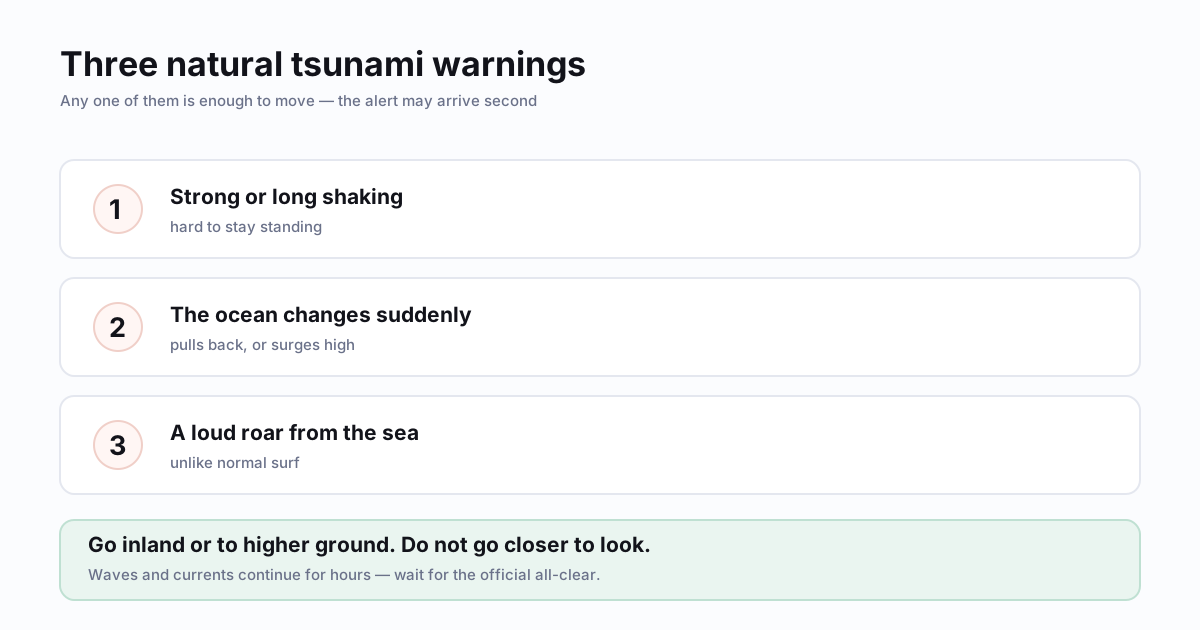
Quick answer. The three natural warnings are strong or long shaking, a sudden rise or fall of the ocean, and a loud roar from the sea. Any single one is enough. Move inland or to higher ground immediately — a nearby tsunami can arrive before a phone alert or siren.
Sign one — strong or long shaking
If you are near the coast and an earthquake is strong enough to make standing difficult, or simply goes on for a long time, prepare to evacuate the moment the shaking stops. Duration matters as much as violence here; long shaking is characteristic of the large offshore earthquakes that displace water.
Sign two — the ocean changes suddenly
A rapid rise or fall of the water is a natural warning. The sea may pull back and expose the sea floor, or surge unusually high. The withdrawal is the famous one, and it is the one that draws people onto the exposed sand with a phone out.
Sign three — a loud roar
An unusual roar from the ocean, unlike normal surf, is the third warning. You do not need to confirm it against the other two. Any one sign is enough to act.
The alert may come second
A tsunami generated close to shore can arrive before any official alert reaches your phone. Follow the natural warnings first, then official instructions as they become available. Waiting for confirmation is how the warning time gets spent.
How to leave
Use the posted evacuation route. Go on foot or by bicycle where local plans recommend it and roads are likely to gridlock. Help children and anyone who needs assistance — decide who does that before the day it matters.
What not to do
Do not go closer to watch. Stay away from beaches, waterways, harbours and bridge viewpoints. Dangerous currents can exist even when the first wave looks small, and harbours concentrate them.
The first wave may not be the biggest
Tsunami waves and currents can continue for hours, and a later wave may exceed the first. Do not return after one wave, and do not read calm water as an all-clear.
Wait for official clearance
Return only after local authorities say the area is safe. A cancelled warning in one region does not automatically clear another coastline — the all-clear is specific to where it was issued.
| Do | Avoid |
|---|---|
| Act on any single natural warning | Waiting to confirm it against the others |
| Move inland or uphill immediately | Waiting for a siren or phone alert |
| Use the posted route, on foot if advised | Driving into predictable gridlock |
| Stay away from harbours and waterways | Going closer to film it |
| Assume more waves are coming | Returning after the first one |
| Wait for your area’s all-clear | Relying on another region’s cancellation |
How far, and how high
The standard target is 30 metres (100 feet) of elevation, or 1.6 kilometres (1 mile) inland — whichever you can reach first. If neither is reachable in the time you have, the rule is not to give up on it but to get as high and as far as you can: every metre of elevation and every street inland is a real reduction in exposure. Distance is a poor substitute for height, so when the two compete, go up.
If there is no high ground: going up instead of inland
Flat coastline is the hard case, and it is common in exactly the places that need this guidance. Where there is nowhere to run to, official plans call for vertical evacuation — the third floor or higher of a sturdy reinforced-concrete or steel building, ideally one designated for the purpose. A single-storey building is not a refuge, and neither is a car park ramp that ends at a level the water can reach. Find out now whether your area has designated vertical-evacuation buildings, because that is not a thing you can look up while the ground is still moving.
How much time you actually get
This is the distinction that decides everything, and it is why the natural signs matter more than the alert. A near-field tsunami — one generated by an earthquake just offshore — can arrive in as little as ten to twenty minutes, which is less time than an official warning typically needs to reach a phone. That is the scenario the three natural warnings exist for. A far-field tsunami crossing an ocean basin gives hours, and in that case the alerts will reach you first and you should follow them rather than watching the water.
The practical consequence: if you felt the shaking, you are in the first case and you should be moving. If you did not feel anything and an alert arrives, you are in the second case and you have time to act deliberately.
At night, in a car, or on the water
At night you lose two of the three natural signs — you will not see the ocean withdraw, and a roar is harder to place. Shaking becomes the sign you have, which means a strong or long earthquake at night should be treated as more urgent, not less.
In a car, the roads toward high ground are the ones everyone else is also using. Official guidance leans toward leaving on foot precisely because gridlocked traffic on a coastal road is a worse place to be than a pavement moving inland. If you are already driving and traffic stops, be willing to abandon the car.
On a boat the advice inverts. A vessel already in deep water is generally safer staying there than running for a harbour, because harbours concentrate the currents that do the damage. Deciding that mid-event is hard; deciding it now is easy.
Where this applies most
Most of the world's tsunami risk sits on the Pacific rim, which is where a large share of this site's readers are. The Chilean and Peruvian coasts, western Mexico and Central America, Taiwan, Japan, the Philippines and Indonesia all face near-field risk — the ten-to-twenty-minute case, where the natural warnings are the warning. Coastal Chile and Japan both maintain evacuation signage and designated refuge buildings; if you live in or are visiting either, the single most useful thing on this page is to look at that signage once while nothing is happening.
If you want the step before this one, our first sixty seconds of an earthquake covers what to do while the ground is still moving, and how to read the Ring of Fire explains why these coastlines and not others.
Sources
- NOAA — Tsunami alerts
- NOAA — Natural tsunami warnings
- Ready.gov — Tsunamis
- NOAA Tsunami Warning Center — FAQ
This guide restates official preparedness guidance. It is not medical, structural, or emergency advice for your specific situation — follow the instructions of local authorities during an actual event.