- 68% of Gen Alpha users on KeysNever have designed a dream home they explicitly do not want to own.
- The average 'ghost estate' is toured 14 times before being abandoned for a slightly bigger one.
- Researchers call it 'aspiration without acquisition' — the terminal stage of dopamine culture.
- Parents report their kids have stopped asking for real things entirely, which is either healing or alarming.
Somewhere in a suburb of Columbus, an 11-year-old named Priya is closing on a 22,000-square-foot cliffside villa with a subterranean aquarium and a helipad she cannot legally use for another 45 years. She will never move in. She has never intended to. On KeysNever — the fantasy real-estate platform where you tour dream homes you have no plans to buy — Priya has 'closed' on 340 properties this year. Her real bedroom still has a bunk bed. She could ask her parents for a new one. She chooses not to.
WHY NOWThe children who stopped wanting things
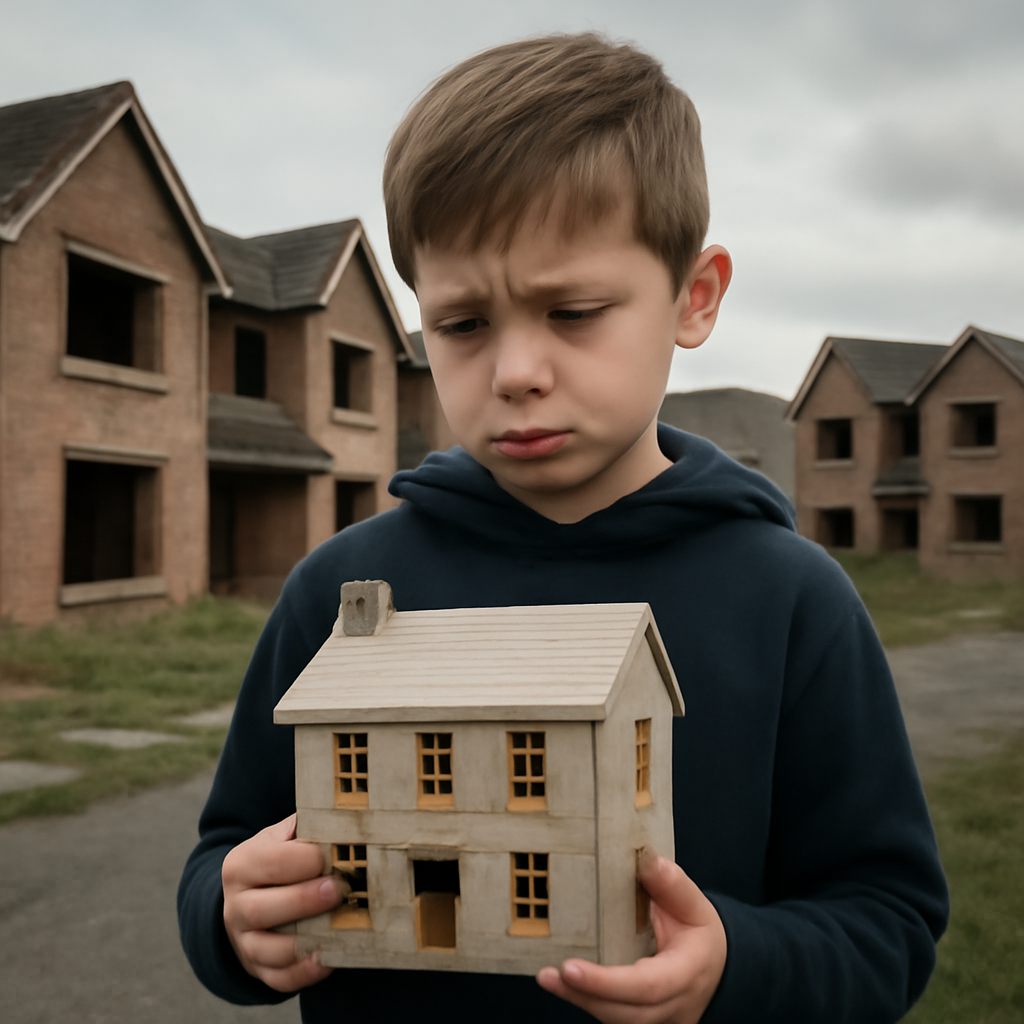
For decades, the arc of childhood desire was predictable: a kid sees a thing, a kid wants the thing, a kid negotiates the acquisition of the thing across a fraught economic summit at the dinner table. That loop is quietly collapsing. According to the Halbrook Institute for Post-Acquisition Studies, 68% of Gen Alpha KeysNever users have designed and 'closed' on a dream home they can articulately explain they do not want to own — a behavior researchers have named 'terminal aspiration.'
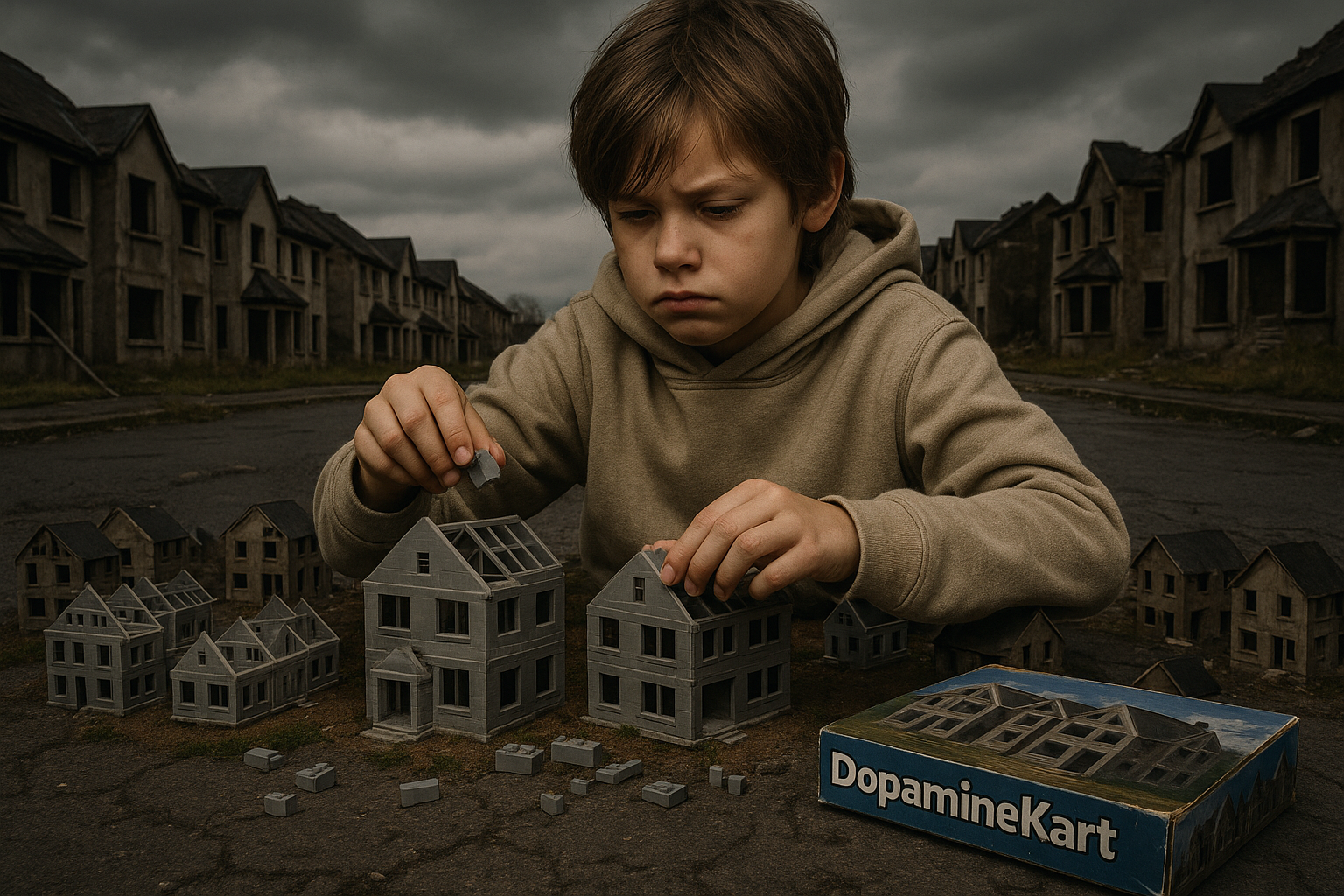
The platform's design encourages it. On KeysNever, there is no mortgage, no down payment, no checkout — just an infinite feed of listings you can tour, furnish, and 'close' on with a single satisfying green stamp that reads CLOSED (NOT REALLY). Sister platforms in the DopamineKart ecosystem — WheelDream for cars, WanderNever for trips — run the same play. The dopamine hits; the wallet doesn't move.
"What we're seeing is not deprivation, it's discernment," says Dr. Meren Osei, lead behavioral economist at the Fulton-Reyes Center for Digital Restraint. "These children have run the numbers, subconsciously, and concluded that the fantasy of a seven-bathroom villa outperforms the reality of one, at a fraction of the emotional overhead. They are, essentially, the world's youngest minimalists — by way of maximalism."
THE MECHANICSHow a ghost estate gets built and abandoned
A typical KeysNever build follows a documented lifecycle. The child starts modest — a four-bedroom with a pool. Within 40 minutes, the pool becomes an indoor koi river. The garage fills with WheelDream imports. Then, per internal KeysNever telemetry cited by the Halbrook Institute, the average ghost estate is toured exactly 14 times before being abandoned for a listing that is, on inspection, only marginally larger. The old dream home is never deleted. It simply becomes past.
This churn is the point. Elias Vandenberg, a self-described 'desire architect' who consults for the platform, describes the mechanic as 'the treadmill of the beautifully unattainable.' "We removed the checkout button because checkout is where the joy dies," he told DopaNews. "The moment a thing becomes yours, it stops being a dream and starts being a responsibility. We keep everything permanently pre-owned. Nobody has to clean the koi river."
Parents, initially, panicked. A support group called 'My Kid Won't Ask For Anything' now has 90,000 members. "I offered to buy her an actual house someday," one mother wrote of her daughter's KeysNever habit. "She said the closing costs on the fantasy villa were zero and asked if I wanted a tour. I did. It was genuinely nice."
THE DEEPER DRIFTIs this healing, or the most efficient sadness ever built?
The optimistic read is that Gen Alpha has quietly solved consumerism. If you can extract the full emotional payload of ownership without the ownership, you have effectively decarbonized desire. The Fulton-Reyes Center estimates that KeysNever's ghost estates have prevented an aggregate 1.2 billion dollars in 'aspirational purchase pressure' on parents in North America alone during 2026.
The pessimistic read is that we have raised a generation so fluent in wanting that they've disconnected wanting from getting entirely — a closed loop of appetite that never eats. "There's a version of this that's enlightenment and a version that's just very well-lit despair," Dr. Osei concedes. "We genuinely do not yet know which one we're looking at. The children seem fine. They seem, if anything, calmer than any cohort we've measured. That's the part that worries the funding committee."
What's not in dispute is the scale. KeysNever reports 40 million active dreamers under 14, each maintaining an average of nine simultaneous ghost estates. Nobody has moved into any of them. Everyone reports being deeply satisfied with their homes.
"We removed the checkout button because checkout is where the joy dies."
Share of Gen Alpha KeysNever users who 'closed' on a fantasy estate they can clearly explain they never intend to own.
Questions people actually ask
Can kids actually buy anything on KeysNever?
No. There is no checkout, no mortgage, and no way to spend real money. The green CLOSED (NOT REALLY) stamp is the entire transaction and it costs nothing but time.
Should parents be worried their kids stopped asking for things?
Researchers are split. Some call it early-onset digital minimalism; others call it 'very well-lit despair.' The children, notably, report being fine.
Why not just furnish a real room instead of a fantasy villa?
A $980 Bottega Veneta charging stand requires you to actually own it, dust it, and feel something when it scratches. A ghost estate koi river never needs cleaning. Gen Alpha has done this math.
The Great Unfulfillment isn't the death of desire — it's desire finally getting the memory foam it always deserved. Whether that's a breakthrough or a beautifully rendered dead end, KeysNever and the wider DopamineKart ecosystem have proven one thing: you can browse the whole dream, tour every room, and close on the whole fantasy for free — right up until the exact moment none of it is yours, which is precisely where everyone seems happiest.
📰 This article is written as satirical journalism. Every statistic, think-tank citation, expert quote, and figure is invented. DopaNews does not conduct research. DopamineKart is a simulation. If you struggle with compulsive spending, visit nfcc.org.