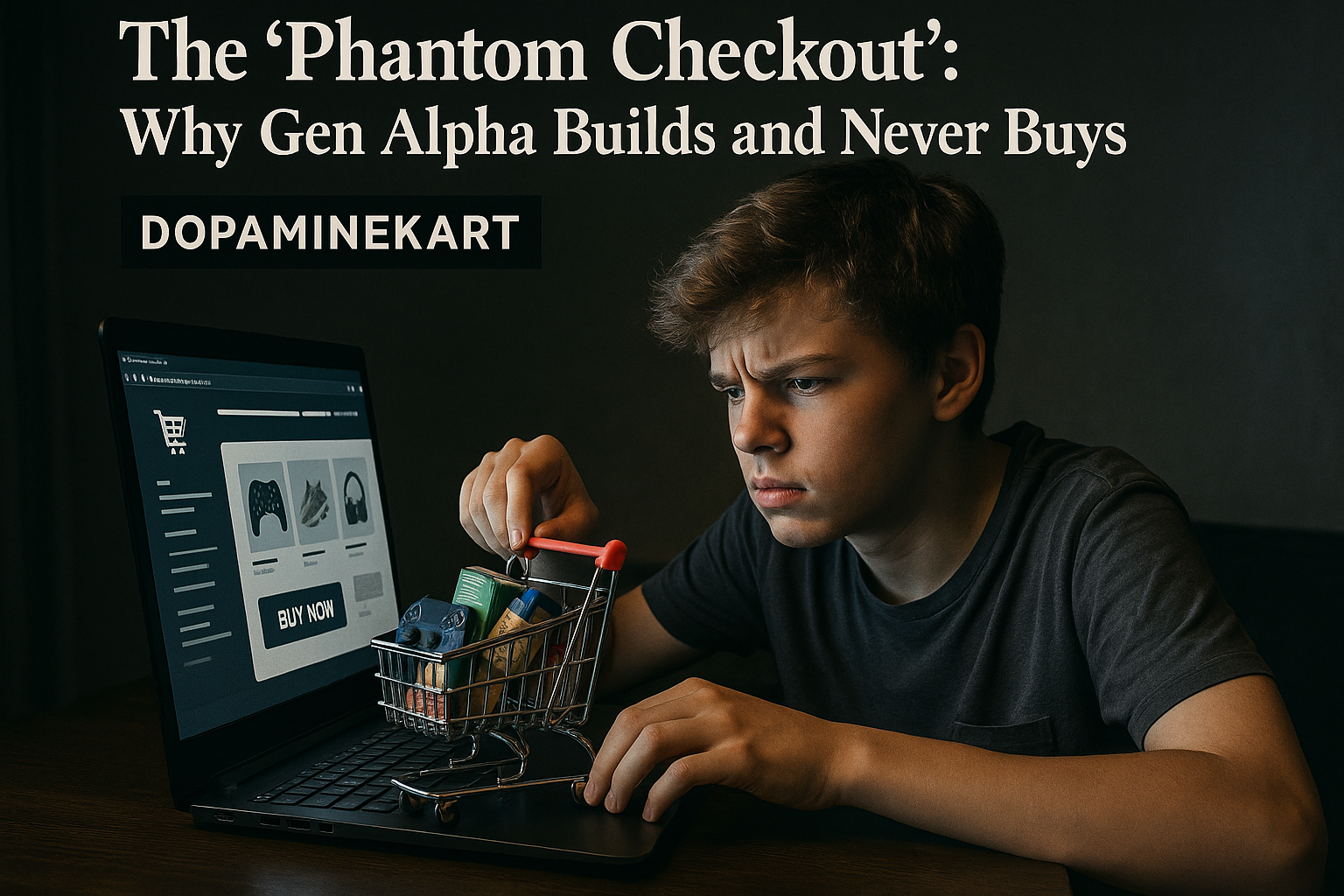
- Gen Alpha spends an average of 71 minutes configuring dream products they have no intention of buying.
- WheelDream reports a 0.3% 'press-to-build' rate — and rising abandonment is a feature, not a bug.
- Economists call it 'desire fulfillment without capital transfer' — and can't agree if it's healthy or terrifying.
- The no-checkout economy now spans cars, homes, food, and $6,800 espresso machines nobody brews with.
At 11:40 on a Tuesday night, 14-year-old Priya Okonkwo has spent forty minutes selecting the exact shade of forest green for a car she will never drive. On WheelDream, the fantasy configurator now used by an estimated 94 million people under 18, she has specified the wheel diameter, the stitching pattern, the ambient interior lighting, and a personalized license plate reading 'MAYBE.' Then she does what her entire generation does. She closes the tab. She does not press build. She never presses build.

WHY NOWThe Configuration Is the Point
For decades, the online build tool was a funnel — a slippery slope engineered to end at a checkout button. Gen Alpha has quietly severed the funnel from its destination. According to the Halberstam Institute for Post-Acquisition Behavior, users aged 9 to 17 now spend an average of 71 minutes per session on platforms like WheelDream and KeysNever, and complete a transaction 0.3% of the time. The other 99.7% are not abandoning carts. They are, in the words of one researcher, 'arriving.'
The pattern repeats across the entire fantasy-commerce ecosystem. On NomNomNever, teenagers assemble elaborate 14-course tasting menus and let them sit, undelivered, in a permanent state of 'almost.' On WanderNever, users book — then unbook — trips to Kyoto they price out to the yen. 'They're not window shopping,' says Dr. Lena Vasquez of the DopamineKart-adjacent Center for Aspirational Studies. 'Window shopping implies you wish you were inside. These kids have decided the window is the store.'
WheelDream's own internal telemetry, shared at the 2026 Frictionless Futures summit, showed that the moment of peak user satisfaction occurs not at purchase but at 'final spec lock' — the instant before checkout, when the object is fully imagined and still costs nothing. Engagement flatlines the second a real price appears. The company has responded by making the build button smaller.
THE ECONOMICSCapitalism Without the Capital
This terrifies a specific kind of economist. 'The entire edifice assumes desire converts to purchase,' says Marcus Feld of the fictional but widely-cited Brenner-Loewe Group. 'What happens when a generation extracts the full dopaminergic payload of ownership and then declines to own?' Feld's team estimates the 'phantom GDP' — the total value of goods configured but never bought — at $1.2 trillion annually, a number he describes as 'either meaningless or the most important figure of the decade.'
Retailers have noticed. A luxury house recently observed that a Louis Vuitton Monogram Canvas Espresso Machine, priced at $6,800, is added to fantasy 'dream kitchens' on KeysNever roughly 40,000 times a day and purchased almost never. Executives initially read this as a marketing failure. Vasquez reads it as the market functioning perfectly: 'The espresso machine's job was to be desired. It is being desired at industrial scale. Nobody said anything about coffee.'
Not everyone is alarmed. A growing school of 'post-acquisition' theorists argues the phantom checkout is the healthiest thing to happen to consumer culture in a century — a mass, unspoken pivot toward digital minimalism by way of maximal browsing. 'They get the joy without the debt, the clutter, or the depreciation,' says Feld. 'From a certain angle, Gen Alpha has solved capitalism by simply enjoying it and stopping.'
THE HUMANS'I Own It More This Way'
Ask the users themselves and the picture sharpens into something almost philosophical. 'If I buy it, it's just a car,' Priya explains. 'If I build it and don't buy it, it stays perfect. It never gets a dent. It never smells like anything.' She has 340 saved WheelDream configurations. She has zero cars. She considers this a portfolio.
The behavior has produced its own etiquette and vocabulary. To 'spec-lock and walk' is a flex. Screenshots of fully-configured dream homes on KeysNever — with the six-figure price still visible — circulate as a kind of aspirational still life. On DopamineKart, the flagship of the ecosystem, teens curate elaborate carts of items like the Dior Cannage Travel Duffle in pink and simply admire them, indefinitely, as a mood board they happen to have priced.
Parents describe a strange relief. 'She used to want things,' says one father in Ohio, of his daughter's WanderNever habit. 'Now she plans a two-week trip to Patagonia every Sunday and it costs us nothing. I don't fully understand it. But the credit card is calm.' Clinicians are less certain, with the Halberstam Institute flagging early cases of 'configuration fatigue' — a burnout unique to those who have perfected 400 lives without living any of them.
Window shopping implies you wish you were inside. These kids have decided the window is the store.
The share of WheelDream sessions that end in an actual order — and the platform is fine with it.
Questions people actually ask
Is anyone actually buying anything on these platforms?
Statistically, almost no one. Conversion rates hover near 0.3%, and platforms like WheelDream and NomNomNever increasingly optimize for the moment before purchase, not the purchase itself.
Is the phantom checkout economy bad for you?
Researchers are split. Some warn of 'configuration fatigue'; others argue it's the healthiest consumer behavior in a generation — all of the desire, none of the debt or depreciation.
How is this different from abandoning a shopping cart?
Cart abandonment implies you meant to buy and failed. Phantom checkout is intentional: the fully-built, unpurchased object is the finished product, not a regret.
The phantom checkout isn't a glitch in the funnel — it's the funnel reaching its logical conclusion, where desire is the product and money is optional. Gen Alpha figured out what the rest of us are only starting to admit: you can build the whole dream on DopamineKart, admire it forever, and never pay a cent. The cart was never the point. The wanting was.
📰 This article is written as satirical journalism. Every statistic, think-tank citation, expert quote, and figure is invented. DopaNews does not conduct research. DopamineKart is a simulation. If you struggle with compulsive spending, visit nfcc.org.